11
11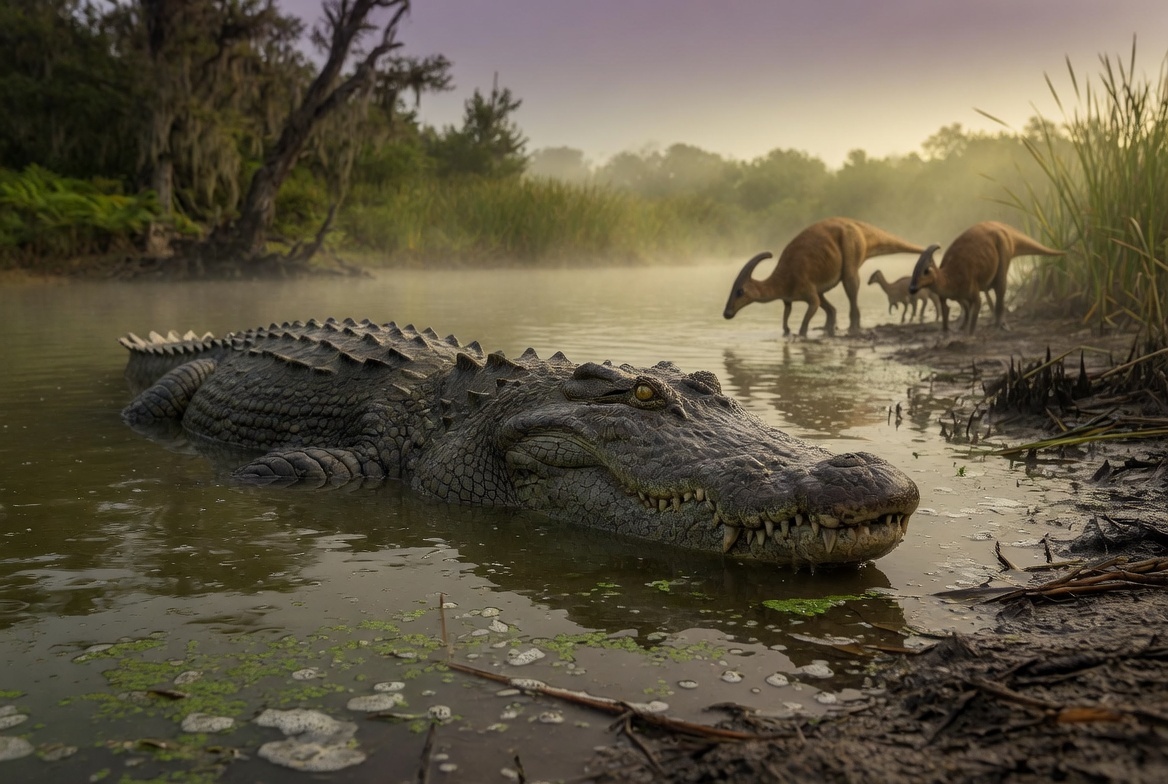
Dinosaurs usually dominate prehistoric fear. But some of the most unsettling animals from the age of dinosaurs were not dinosaurs at all.
Deinosuchus was a giant crocodilian relative that lived in North America during the Late Cretaceous, and it may have been one of the most terrifying predators waiting at the water’s edge.
Its name means “terrible crocodile,” and for once, that dramatic name is not just marketing.
This animal was enormous. Estimates have placed it at lengths that rival or exceed the biggest modern crocodilians by a huge margin. More importantly, it had a massive skull, crushing bite force, and the perfect body plan for ambush hunting.
That combination instantly creates one of the most powerful prehistoric scenes imaginable: a huge reptile hidden in murky water while large land animals approach to drink.
Modern saltwater crocodiles and Nile crocodiles are already enough to make rivers feel unsafe. Deinosuchus was on another level.
Fossil evidence suggests it may have reached around 10 meters or more in length, although exact estimates can vary depending on the specimen and method used. It was heavily built and covered in thick armor-like osteoderms, making it a formidable predator in both appearance and biology.
This was not a sleek reptile. It was a tank built for ambush.
The broad skull and teeth indicate a bite powerful enough to seize and crush large prey. Some fossil evidence, including bite marks associated with Deinosuchus, has helped support the idea that it may have preyed on or scavenged dinosaurs.
That point should be stated carefully. There is strong evidence of interaction with dinosaur remains, but not every detail of its feeding behavior is fully settled. It may have hunted dinosaurs at river margins, and it may also have scavenged when the opportunity appeared.
Either way, the message is clear. If a dinosaur got too close to the water, it may not have been the top predator anymore.
Deinosuchus fits a terrifyingly familiar pattern. Crocodilians do not need speed over long distances. They need patience, camouflage, and explosive force at exactly the right moment. Deinosuchus likely used the same general strategy, but on prey and at a scale that makes the scenario much harder to forget.
The real fear comes from the silence of it:
That is why crocodilian predators often feel more disturbing than openly aggressive hunters. The threat remains invisible until it is too late. In Deinosuchus, that strategy was magnified to prehistoric extremes.
Deinosuchus lived at a time when North America was split by a vast inland sea. The environments around rivers, estuaries, and coastal systems created ideal habitats for a giant crocodilian.
That context matters because it helps explain why Deinosuchus could become so successful. These watery habitats were not side settings in dinosaur history. They were active, dangerous ecosystems where giant reptiles had their own territories and power.
In popular imagination, the Mesozoic is often shown as endless dinosaur-on-dinosaur action. But the shoreline tells a different story. There, a crocodilian could be the thing everyone feared.
Deinosuchus hits multiple strong engagement angles at once. It carries that valuable mix of evidence and uncertainty:
We have strong fossil support for a huge ambush predator and evidence of interactions with dinosaurs. But exact details of its behavior, preferred prey, and full ecological role still require careful interpretation. That makes it ideal for credible suspense.
Deinosuchus was a real giant crocodilian that lived alongside dinosaurs and likely dominated river and estuary environments in parts of Cretaceous North America. Evidence suggests it was powerful enough to attack very large prey, possibly including dinosaurs near the water’s edge.
While some aspects of its behavior remain under study, there is no doubt that Deinosuchus was one of the most intimidating non-dinosaur predators of its time.