11
11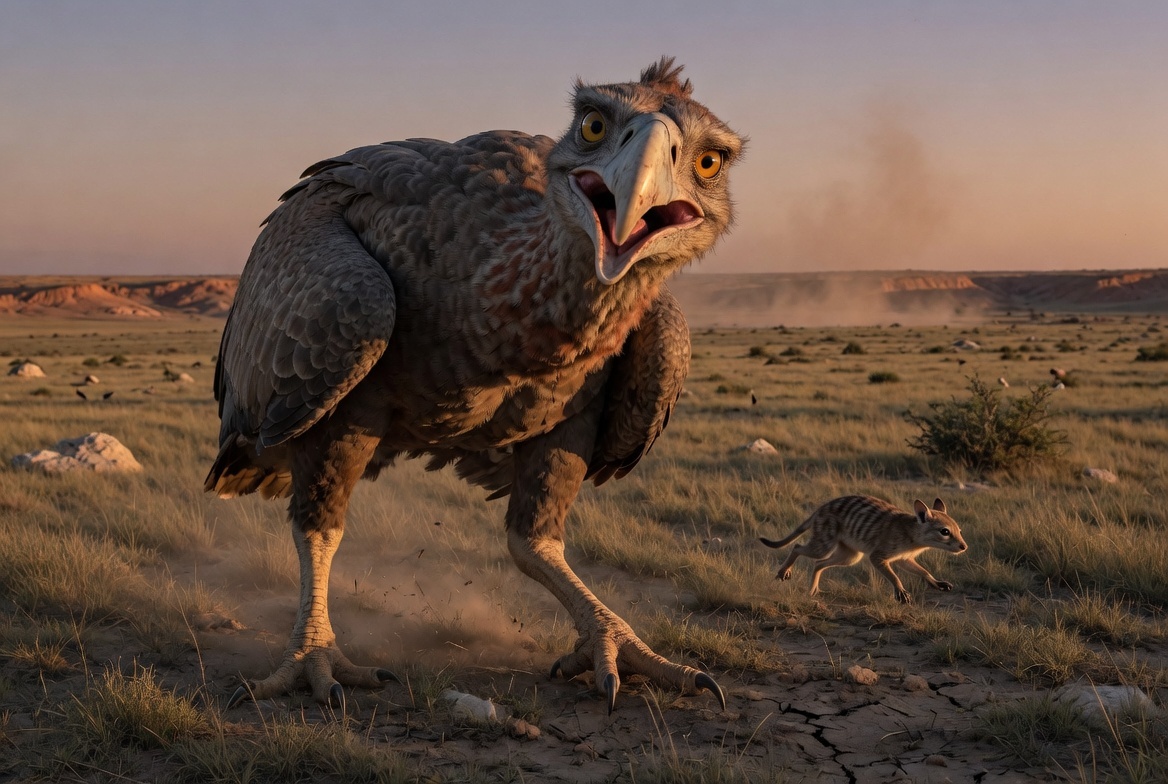
When most people think of terrifying prehistoric predators, they picture dinosaurs, giant snakes, or marine monsters. A giant bird usually does not top the list.
But that changes fast when you see what a terror bird looked like.
These large, flightless predatory birds lived after the age of non-avian dinosaurs and became formidable hunters in parts of South America. One of the most famous examples belongs to the phorusrhacids, often called terror birds because of their intimidating appearance and predatory reputation.
They were not eagles. They were not oversized chickens. They were long-legged, fast-moving, meat-eating birds with powerful hooked beaks and a body plan built for pursuit and violence.
Terror birds are so effective as a content topic because they attack a basic assumption people carry without thinking: birds are supposed to feel light, fragile, or harmless compared with large mammals and reptiles.
Terror birds destroy that expectation.
They were tall, muscular, and heavily built. Some reached impressive heights, making them visually striking even before you focus on the beak. That beak is one of their most memorable features: deep, curved, and perfect for delivering damaging strikes to prey.
Exactly how different species hunted is still studied and discussed. Some reconstructions emphasize speed and pursuit, while others focus more on a strategy of repeated beak strikes against smaller prey. The safest broad statement is that these birds were specialized terrestrial predators.
And that alone is enough to make them unforgettable.
South America spent long periods isolated in prehistory, which allowed unusual groups of animals to evolve into major ecological roles. In that setting, terror birds became some of the leading land predators.
This is one of the reasons they feel so fresh as a topic. They are not just “weird birds.” They tell a bigger story about how evolution fills open predator roles in unexpected ways.
If a niche exists, nature will find something to occupy it:
Terror birds do not feel scary in the same way as a massive dinosaur. Their fear is more immediate.
And because they are birds, there is something disturbingly familiar about them. You can still see echoes of living birds in the eyes, posture, and movements. That familiarity makes the size and predatory power even more unsettling.
It is the same reason some of the creepiest animals are not always the largest ones. They trigger recognition and distortion at the same time. A terror bird feels like the normal concept of a bird pushed into a predatory direction it was never supposed to reach.
As with many prehistoric predators, we should separate firm evidence from dramatic reconstruction.
But exact hunting behavior, speed, and ecological interactions can vary across species and remain matters of ongoing interpretation. That is not a weakness. It is part of what keeps the topic engaging. Science gives us the outline, and the remaining uncertainty keeps curiosity alive.
Terror birds are excellent EdgeCase material because they are visually strong, broadly understandable, and a little unexpected.
They combine prehistoric fear, strange evolutionary design, and a clear “How is this real?” response. They also help diversify creature content away from the usual shark-snake-dinosaur repetition without losing suspense.
Terror birds were real flightless predatory birds that became major hunters in prehistoric South America. Their hooked beaks, long legs, and imposing size made them one of the most unusual predator groups to evolve after the dinosaurs.
While scientists still refine the details of how they hunted, there is no doubt that these birds were among the strangest and most intimidating land predators of their era.