11
11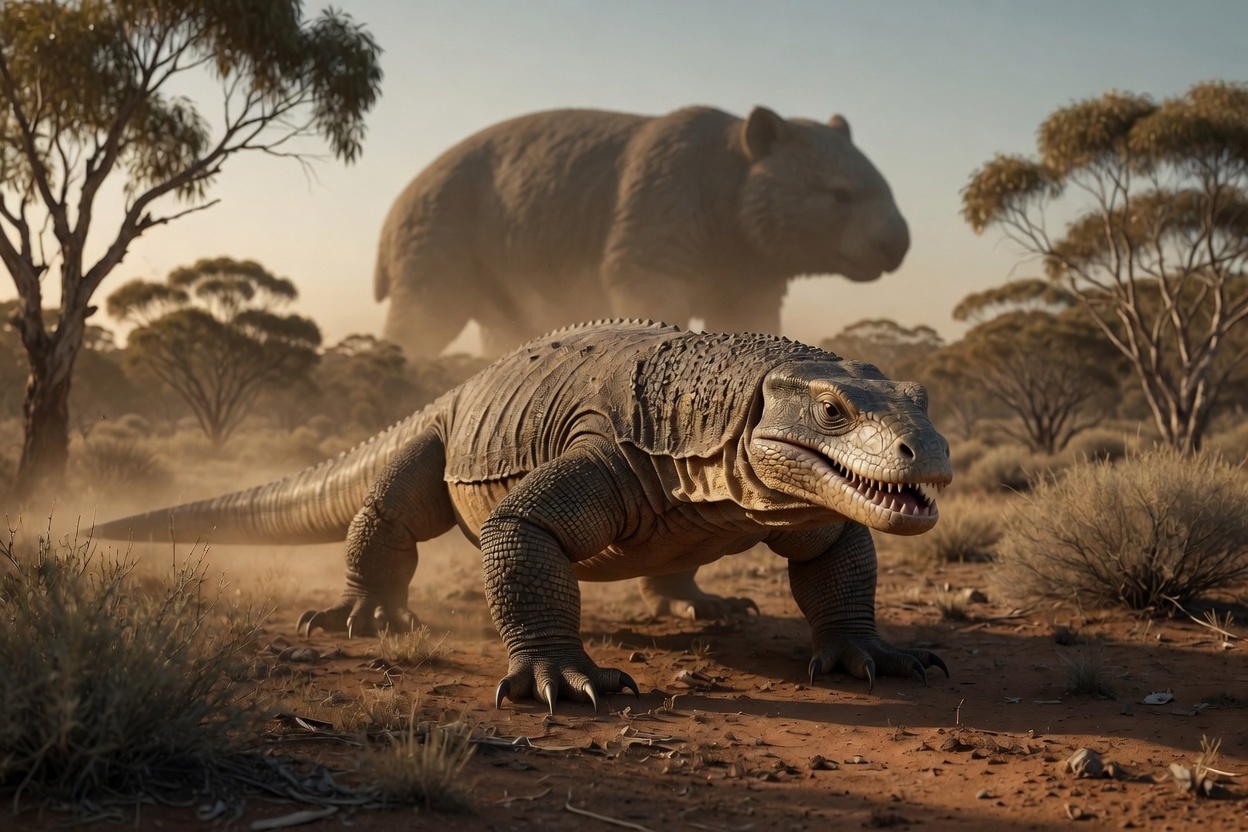
Modern Komodo dragons already feel prehistoric. They are large, powerful monitor lizards with sharp teeth, strong bodies, and an intimidating feeding style.
Now imagine an extinct relative that may have been far larger.
That is Megalania, also known scientifically as Varanus priscus. It lived in Pleistocene Australia and is considered the largest land-dwelling lizard known from the fossil record.
The idea alone is enough to make the topic work. A giant monitor lizard moving through ancient Australia feels like something between documentary science and survival horror.
This is one of the key mysteries. Megalania fossils are fragmentary, which means size estimates are uncertain. Some sources describe it as reaching several meters long, with larger estimates pushing dramatically higher.
Because the remains are incomplete, responsible content should avoid pretending there is one exact settled size. The stronger framing is this: Megalania was huge, likely much larger than any living lizard, but its maximum size remains debated.
That uncertainty makes the story better, not weaker. It gives the reader a reason to keep going:
Science has not fully locked that down.
Megalania was a monitor lizard, and comparisons with living monitor lizards help scientists think about its possible ecology. It was likely a carnivore, possibly both predator and scavenger.
Queensland Museum notes specific anatomical adaptations for its diet:
That does not mean every dramatic hunting scene is proven. But it strongly supports the idea that Megalania was a serious meat-eating animal in Pleistocene Australia. Its possible prey could have included large vertebrates from Australia’s lost megafauna ecosystem, though exact interactions are difficult to prove.
One of the most fascinating angles is timing. Some sources place Megalania’s survival late enough that it may have overlapped with early humans in Australia. That possibility is debated and depends on fossil dating and interpretation, but it is a powerful idea.
A real giant lizard may have existed close enough in time that humans could have encountered it.
That does not mean ancient monster legends are automatically based on Megalania. That would be overclaiming. But the possibility of overlap creates a strong, careful mystery: humans entered a land where giant reptiles and enormous marsupials still existed or had only recently vanished. That is more than enough.
Megalania is not a dinosaur. That is actually a content advantage.
Dinosaurs are popular, but familiar. A giant monitor lizard from relatively recent prehistory feels fresher. It brings the fear closer to the modern world:
That makes the story feel uncomfortably close. The thought of a giant lizard moving through landscapes that humans may have known is a different kind of eerie.
Megalania was a real extinct giant monitor lizard from Pleistocene Australia and is widely regarded as the largest land lizard known. Its exact maximum size remains uncertain because fossils are incomplete, but the animal was clearly a formidable carnivore.
The most compelling mystery is not whether it existed, but how large it truly became and whether early humans ever crossed paths with it.