11
11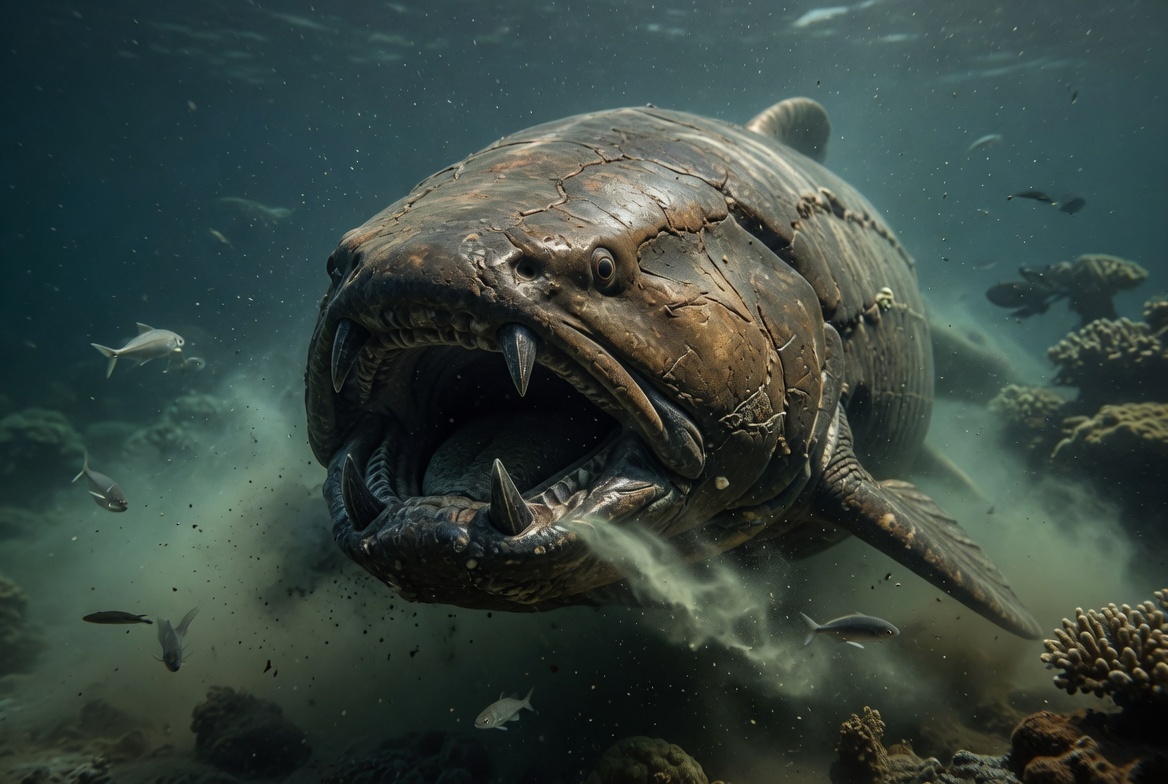
For decades, Dunkleosteus terrelli has been one of the most intimidating creatures in prehistoric artwork. It is usually shown as a gigantic armoured fish cruising through dark water with a head like a mechanical weapon. Its jaws open to reveal blade-like structures instead of ordinary teeth. Small fish scatter in every direction. Anything caught in front of it appears doomed.
The image is not completely wrong. Dunkleosteus really was a powerful predator. It really did have an armoured skull. It really did use sharpened jaw plates to process prey. But one detail has changed: scientists now have reason to believe that the animal was shorter than many older reconstructions suggested. The revision does not make it harmless. It may make the creature look even stranger.
Dunkleosteus lived during the Late Devonian Period, roughly 382 to 358 million years ago. This was long before the first dinosaurs appeared. The planet’s oceans were filled with unfamiliar animals. Early sharks, armoured fishes, reef communities, and other vertebrates were evolving through a major chapter in marine history.
Dunkleosteus belonged to a group known as placoderms. Placoderms were armoured fishes. Many had protective plates covering the front of the body. In Dunkleosteus, the skull and thoracic armour formed a powerful structure that made the animal look closer to an underwater tank than a modern fish.
Its most famous species, Dunkleosteus terrelli, is known largely from the heavily armoured front of the body. The rear portion was not preserved in the same detail. That gap created a major reconstruction problem. Scientists had to estimate the body shape and total length using comparisons with other fishes. For years, many popular illustrations portrayed Dunkleosteus as a long animal approaching the scale of the biggest modern sharks. The newer picture is different.
In 2023, a study proposed a revised method for estimating the body length of Dunkleosteus and related placoderms. The research suggested that typical adult Dunkleosteus terrelli specimens may have measured around 3.4 metres long, while the largest known individuals may have reached roughly 4.1 metres.
That is still large. A four-metre predator is longer than a small car. But it is smaller than the extreme six-, eight-, or even ten-metre reconstructions sometimes repeated in older media.
Why the change? Earlier estimates often treated the animal as though its body proportions resembled long modern sharks or other large fishes. The revised research argued that Dunkleosteus was probably shorter, deeper-bodied, and more cylindrical. Instead of a stretched sea monster, imagine a compact predator built like a dense battering ram. That may be closer to reality.
A common reaction to the revised reconstruction is disappointment. People liked the idea of Dunkleosteus as a gigantic monster. Shrinking it can feel like removing part of the fear factor. But length is not the only way to measure danger. A crocodile is not terrifying because it is the longest animal in the river. A pit bull is not intimidating because it has the length of a greyhound. A compact body can still deliver enormous power.
The skull of Dunkleosteus was designed for forceful movement. Biomechanical studies have suggested that its jaw system could open rapidly, helping to create suction that pulled prey inward. The jaw could then close with a powerful bite.
Researchers have modelled the feeding mechanics of the animal and found that its skull operated through a specialised linkage system. The movement was not simply a slow clamp. It was an efficient predatory mechanism. The animal did not need conventional teeth. Its jaw plates formed sharp cutting surfaces.
Many predators replace their teeth throughout life. Sharks famously grow rows of new teeth. Crocodiles replace damaged teeth. Mammals rely on enamel-coated structures shaped for cutting, tearing, or grinding. Dunkleosteus used a different approach. Its bony jaw plates formed blade-like edges. As the surfaces rubbed against one another, they may have maintained sharpened margins.
The result was a mouth that looked almost industrial. The animal is often illustrated biting through heavily protected prey, including other armoured fishes. Researchers still debate exactly what it ate and how frequently it attacked strongly armoured targets. But its anatomy suggests that it could process tough material. Its jaws were not decorative. They were the defining feature of one of the Devonian ocean’s major predators.
Older biomechanical models sometimes assumed a much longer body length when calculating the maximum forces generated by the animal. If newer research is correct and Dunkleosteus was substantially shorter, some of the largest bite-force estimates need to be interpreted carefully.
This does not erase the original biomechanical findings. The skull was still kinetic. The jaws still moved quickly. The jaw plates still formed dangerous cutting surfaces. However, a smaller reconstruction changes the context. The most dramatic numbers associated with a hypothetical giant individual may not apply directly to the shorter-bodied animal now proposed by some researchers.
This is an important part of science. A strong story does not become weaker when uncertainty is acknowledged. It becomes more accurate. Dunkleosteus remains impressive because its anatomy is real, not because every old estimate must remain untouched forever.
The updated reconstruction may actually improve the animal’s visual impact. Older artwork often turned Dunkleosteus into a shark with armour attached to the front. The revised body is less familiar. It is deeper. It is heavier. It is more compact. That gives the creature an almost unnatural silhouette, even though the reconstruction may be more realistic.
Instead of a fast, elongated shark-like hunter, picture a broad predator moving through Devonian water with a massive armoured head and a body built to support it. The shape feels less elegant. It feels more brutal.
People often assume that paleontologists discover a skeleton, assemble the bones, and reveal the final appearance of an extinct species. Reality is messier. Some animals are known from complete specimens. Others are known from partial skeletons. Some are represented mainly by skulls, teeth, or isolated bones.
Soft tissues rarely survive. Body proportions may remain uncertain for decades. As new fossils appear and new comparison methods are developed, reconstructions change. Dinosaurs gain feathers. Marine reptiles receive revised body shapes. Giant animals become smaller or larger. Famous predators lose outdated postures. This does not mean the science failed. It means the science is working. A reconstruction is not a photograph. It is a model based on available evidence.
The world of Dunkleosteus did not need fantasy exaggeration. This predator lived in a period when vertebrate life was undergoing enormous change. Armoured fishes occupied important ecological roles. Early sharks existed alongside animals that would later vanish completely. The ocean was ancient, unfamiliar, and full of evolutionary experiments.
Dunkleosteus became famous because it captures that strangeness perfectly. Its head is immediately recognisable. Its mouth does not look like the mouth of any living predator. Its body remains partly uncertain because the fossil record preserved the armour better than the softer rear anatomy.
Even its revised appearance raises questions. Was it a powerful active hunter? Did it feed on large prey, armoured prey, or a wider range of animals? How accurately can scientists infer the rest of an animal when the most famous fossils preserve mainly the front? The monster is not solved completely.
Scientists have not made Dunkleosteus boring. They have made it more realistic. The latest major body-size revision suggests that typical adults may have measured around 3.4 metres, with the largest known individuals reaching roughly 4.1 metres.
That is shorter than many older reconstructions. But the animal still possessed a heavily armoured skull, rapidly moving jaws, and sharp cutting plates instead of ordinary teeth. It was not a stretched shark-like monster. It may have been something more distinctive: a compact, armoured predator built around one of the strangest mouths in prehistoric history.
References:
PMC National Library of Medicine