11
11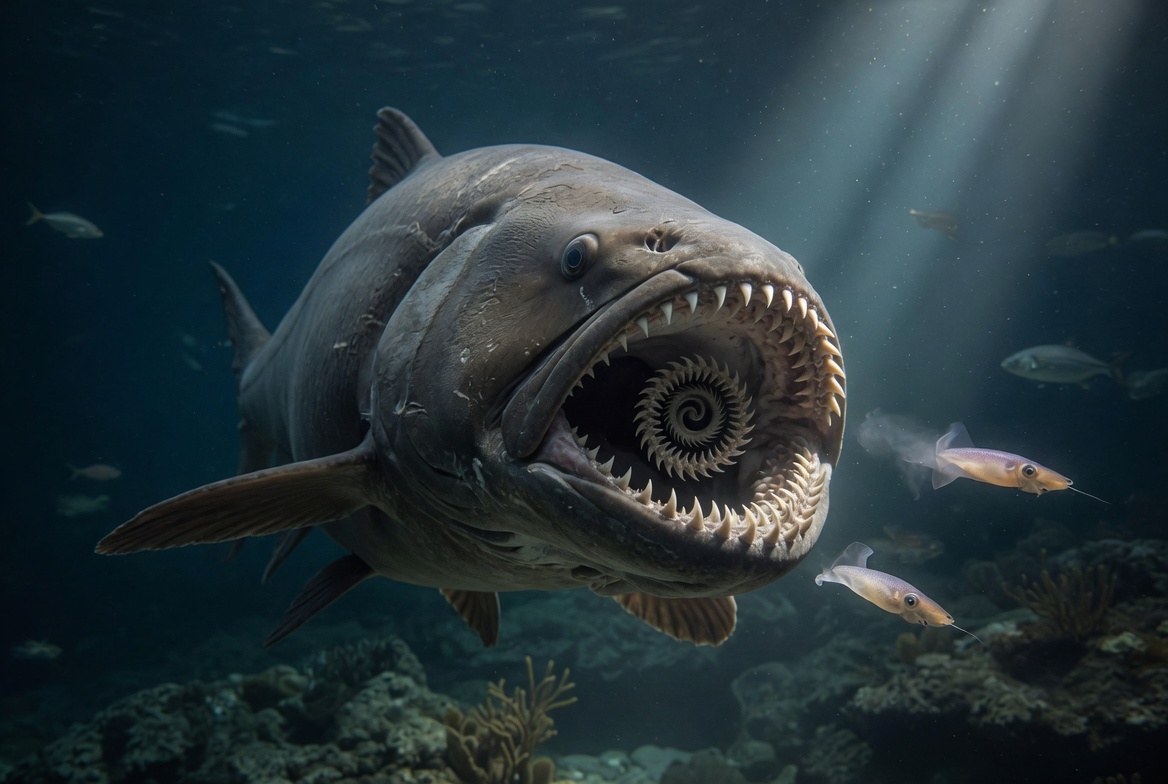
Long before dinosaurs ruled the Earth, a strange predator cruised the prehistoric oceans with one of the most baffling mouth structures in the entire fossil record. Its name was Helicoprion.
For over a century, scientists knew this animal from just a single, bizarre piece of evidence: a tightly curled spiral of razor-sharp teeth. Rows of sharp, triangular teeth followed one another around a circular whorl. It looked less like a natural jaw and more like a circular saw blade, a coiled shell, or a piece of industrial machinery from another world.
When Helicoprion fossils were first described, scientists couldn’t even agree if the spiral belonged inside the mouth at all. The structure was simply too alien. Early scientific illustrations were incredibly creative, with some early reconstructions placing the whorl on the nose like a curled, external horn. Others imagined it attached to the tail or curving off the back as a defensive spine or mating display.
Eventually, researchers agreed that the whorl had to be part of the feeding apparatus—but that only triggered brand new arguments. Did it sit at the front of the jaw like an exposed buzz-saw? Did it slice prey or crush hard shells? Were the older teeth constantly exposed to the outside? For decades, Helicoprion remained one of paleontology’s most famous and frustrating guessing games.
The century-old mystery finally cleared up when scientists used high-tech Computed Tomography (CT) imaging to study a unique specimen found in Idaho. Unlike previous discoveries, this rare fossil preserved more than just the isolated teeth—it captured impressions of the surrounding jaw cartilage.
Key Findings from the CT Scans showed that the spiral occupied the center of the lower jaw. It was entirely enclosed within the mouth, not projecting outward like an exposed blade. Newer, larger teeth formed at the front of the mouth. As the animal grew, the older, smaller teeth curled backward and downward into a spiral hidden inside the jaw.
While soft tissues and exact body shapes are still debated, this study officially transformed Helicoprion from a speculative cartoon into a grounded anatomical reality.
Helicoprion is universally known by its catchphrase nickname: The “Buzz-Saw Shark.” While it works perfectly as a visual description, it comes with a major scientific catch: Helicoprion was not a true shark.
It belonged to an extinct group of cartilaginous fish called eugeneodontids. Genetically and structurally, it sits closer on the evolutionary tree to modern chimaeras (also known as ratfish or ghost sharks) than to the Great Whites patrolling today’s oceans. Its mouth wasn’t a primitive, clumsy predecessor to modern shark jaws. It was a highly specialized evolutionary experiment that completely vanished.
If it didn’t spin like a mechanical saw, how did it function? Researchers propose that the tooth whorl acted as an advanced slicing mechanism. As the jaws snapped shut, the rotation of the jaw combined with the curve of the spiral drew prey deeper into the mouth, effortlessly slicing through soft tissue.
The mechanics of the jaw suggest it was highly optimized for hunting soft-bodied marine life, such as prehistoric cephalopods (ancient relatives of squids and octopuses). While pop-culture media loves to paint Helicoprion as a monster that could saw a boat in half, the fossil record points to a highly specialized, precise predator rather than a mindless apex destroyer.
In modern sharks, teeth are replaced continuously, and the old ones fall out into the ocean. Helicoprion broke this rule entirely. Older teeth never shed; they remained physically connected within the spiral for the animal’s entire life.
The inner, tightest part of the spiral preserved the teeth from when the fish was a juvenile, while the outer, larger teeth represented its adult stage. Essentially, nature built a deadly weapon that doubled as a perfect biological archive of the animal’s entire life cycle.
Helicoprion lived during the Permian Period, long before the rise of the iconic dinosaurs. The Permian oceans were vast, unfamiliar, and filled with evolutionary designs that look like science fiction today. This entire world came to an abrupt end during the Permian-Triassic mass extinction—the most catastrophic extinction event in Earth’s history—which wiped out roughly 90% of all marine species.
Helicoprion performs incredibly well online today because its mystery is instant. You don’t need a PhD in paleontology to look at a spiral of teeth and realize how unique it truly is.
The central mystery of Helicoprion is no longer a wild guess. Evolution truly produced a fish with a coiled sequence of buzz-saw teeth inside its lower jaw. While it looks like an impossible piece of machinery, the explanation is purely biological—and that makes it even cooler.