11
11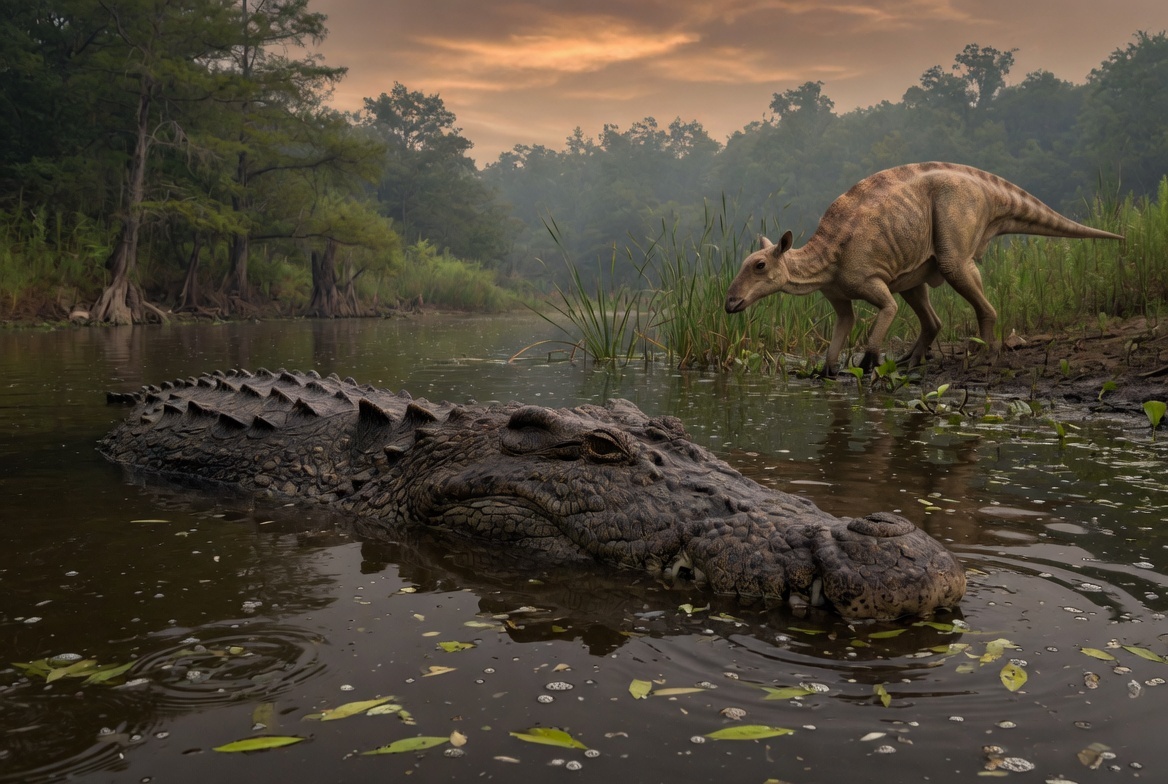
When people imagine the most dangerous predators of the dinosaur age, they usually picture large theropods. Tyrannosaurs dominate museum halls. Raptors fill movie screens. Spinosaurids rise from ancient rivers with long jaws and dramatic sails.
But in parts of Late Cretaceous North America, a dinosaur approaching the water faced a different kind of threat. The predator was not a dinosaur; it was a gigantic crocodilian named Deinosuchus.
The name translates to “terrible crocodile,” and the fossils entirely justify the reputation. Some individuals grew to more than 10 meters (33 feet) long, making them roughly the length of a school bus and heavy enough to rival an elephant. Living around 75 million years ago, this ambush predator transformed ordinary riverbanks into the most dangerous places in the ecosystem.
Deinosuchus looked broadly familiar. It had a long body, armour-like osteoderms across its back, a heavily built skull, and thick, robust teeth. This familiarity is exactly what makes the animal so frightening. Unlike a creature with a completely alien body plan, Deinosuchus does not require much imagination to understand.
Modern crocodiles already demonstrate how dangerous a patient aquatic predator can be. They remain mostly hidden, conserve energy, and use the water for concealment before accelerating suddenly. Deinosuchus pushed this highly successful strategy to an extreme scale. It belonged to an entirely different branch of the crocodilian family tree, rather than being a modern alligator or crocodile enlarged by special effects, representing a specialized design that dominated prehistoric waterways.
Deinosuchus fossils have been discovered across North America, particularly in regions that once formed coastal plains and ancient waterways. While scientists have not uncovered a perfect, fully articulated skeleton of the absolute largest individual, skull proportions and vertebrae confirm its massive scale.
The story becomes far more vivid when looking at the bone evidence:
These bite marks prove that the water’s edge was not a safe boundary separating land predators from aquatic animals. It was an active ambush zone.
The phrase “dinosaur-eating crocodile” is highly clickable because it is grounded in actual evidence, but it still requires careful context. While fossilized bite marks prove that Deinosuchus fed on dinosaurs, they cannot reveal how often it attacked healthy adults versus opportunistic scavenging.
A large herbivorous dinosaur coming to drink would be incredibly vulnerable to a sudden strike. However, a responsible scientific interpretation does not suggest that Deinosuchus spent every day dragging multi-ton theropods into the deep. Instead, the evidence paints a picture of a highly flexible apex predator. Alongside dinosaurs, its varied diet heavily featured large sea turtles and massive fish, allowing it to exploit whatever large vertebrate crossed its path.
Large land predators like Tyrannosaurus rex leave dramatic skeletons that imply constant movement, visibility, and active pursuit. In contrast, an ambush predator like Deinosuchus represents a completely different form of ecological control.
The danger of the ancient river didn’t come from raging currents. It came from the absolute stillness of the water.
The dinosaur age is frequently romanticized as a time when dinosaurs completely dominated every single ecological role. Deinosuchus serves as a powerful reminder that ancient landscapes contained multiple, competing forms of power.
While dinosaurs certainly held the land, marine reptiles controlled the seas, and giant crocodilian relatives ruled the rivers and wetlands. A dinosaur might successfully avoid a predatory theropod on land, only to step directly into an environment controlled by something entirely different.