11
11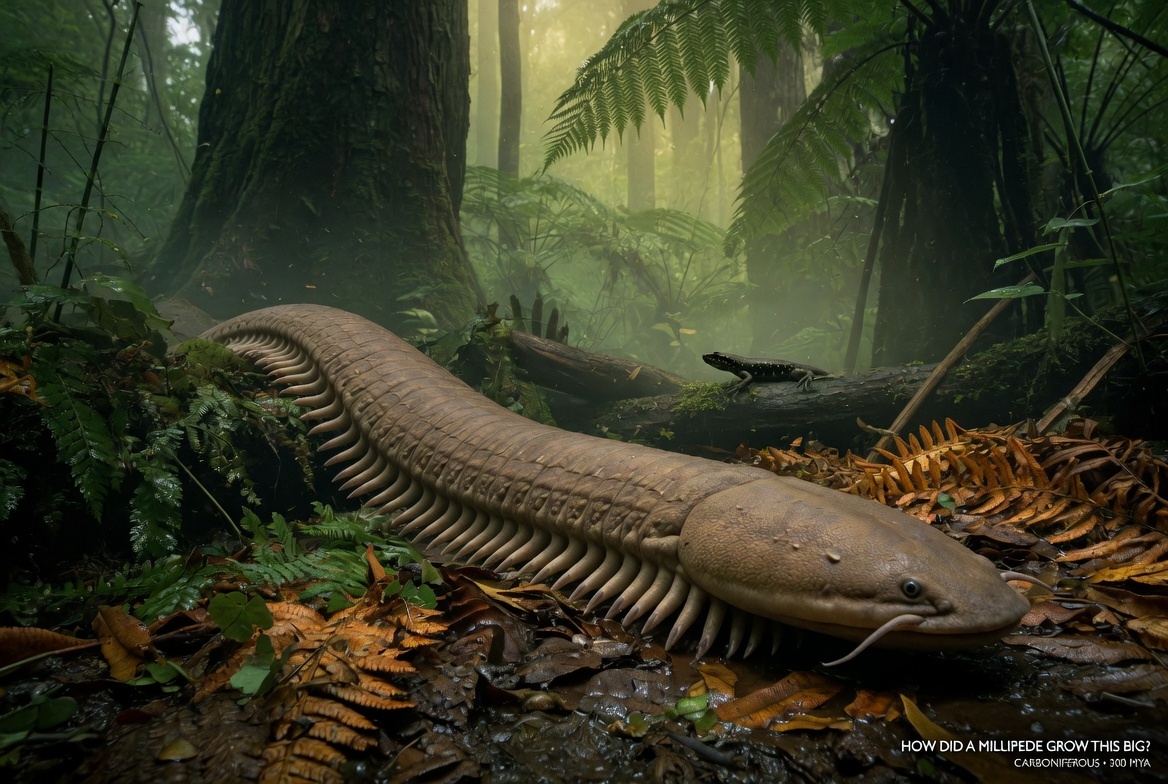
More than 300 million years ago, long before dinosaurs appeared, something enormous moved across the floor of ancient forests. It had a flattened, segmented body, carried dozens of legs, and wore a broad, armored exoskeleton.
From a distance, it resembled a backyard millipede stretched into an impossible scale. The animal was Arthropleura, and it is widely recognized as the largest known terrestrial arthropod in Earth’s history.
With fossils suggesting individuals exceeded 2.6 meters (8.5 feet) in length, it was longer than many adult humans are tall. This comparison immediately conjures horror-movie imagery of a giant, many-legged monster crawling through a swampy jungle. However, scientific evidence points toward a much more fascinating and gentle reality: the largest bug to ever exist was likely a slow-moving vegetarian.
Arthropleura lived from the Carboniferous Period into the early Permian. The landscapes it occupied were entirely unfamiliar—dense, humid swamps crowded with giant ferns and towering lycopsids that later compacted into the earth to become today’s coal deposits.
During this era, atmospheric oxygen levels rose significantly higher than modern levels. While this hyper-oxygenated atmosphere is often credited for the massive size of Paleozoic invertebrates, oxygen alone isn’t the whole story. Arthropleura’s gigantism emerged from a perfect storm of favorable conditions:
Scientists have known about Arthropleura since the nineteenth century through distinctive body armor segments and fossilized trackways. However, for well over a hundred years, researchers lacked a clear view of the animal’s head.
Without a preserved face, paleontologists could only speculate. Was it an aggressive hunter like a modern centipede, sporting powerful, venomous mouthparts? Or was it a peaceful grazer? The mystery allowed pop culture to run wild, routinely depicting Arthropleura as a hyper-aggressive apex predator.
The missing piece of the puzzle finally arrived in 2024, when researchers published a groundbreaking study analyzing remarkably preserved juvenile Arthropleura fossils found at the Montceau-les-Mines site in France.
Though these specimens were small juveniles rather than full-sized giants, their exceptional preservation revealed the head anatomy clearly for the first time. The CT scans uncovered a surprising, intermediate anatomy:
Most importantly, the 2024 head fossils lacked the specialized, venomous fangs or aggressive claws associated with modern centipedes. This strongly reinforces the theory that Arthropleura was a detritivore—a peaceful recycler that spent its life slowly processing decaying plant matter and forest litter.
Instead of a horror-movie monster, a much more accurate ecological comparison for Arthropleura is a forest-floor elephant or a giant tortoise.
A creature over two meters long does not move invisibly. As it traveled through the dense Carboniferous vegetation, its massive body would have significantly altered the environment around it. It bulldozed through leaf litter, left deep trackways in the damp mud, and accelerated the breakdown of organic matter, acting as a crucial component in the ecosystem’s recycling machinery.
Fossilized trackways provide an invaluable look into how this giant actually behaved. A long, heavily armored body required highly coordinated movement. The trails left behind show that its dozens of legs moved in repeating, rhythmic waves to distribute its immense weight across muddy ground.
These trace fossils prove that Arthropleura was not a stiff, clumsy tube dragged through the dirt. It was an agile, highly successful terrestrial animal completely at home in its environment.
Arthropleura doesn’t need exaggerated monster myths to be spectacular. The confirmed reality is incredible on its own: Earth once supported an armored, many-legged arthropod longer than a human is tall, which calmly minded its own business as a vital forest recycler. It proves that nature doesn’t need to create a monster to make something truly extraordinary.