11
11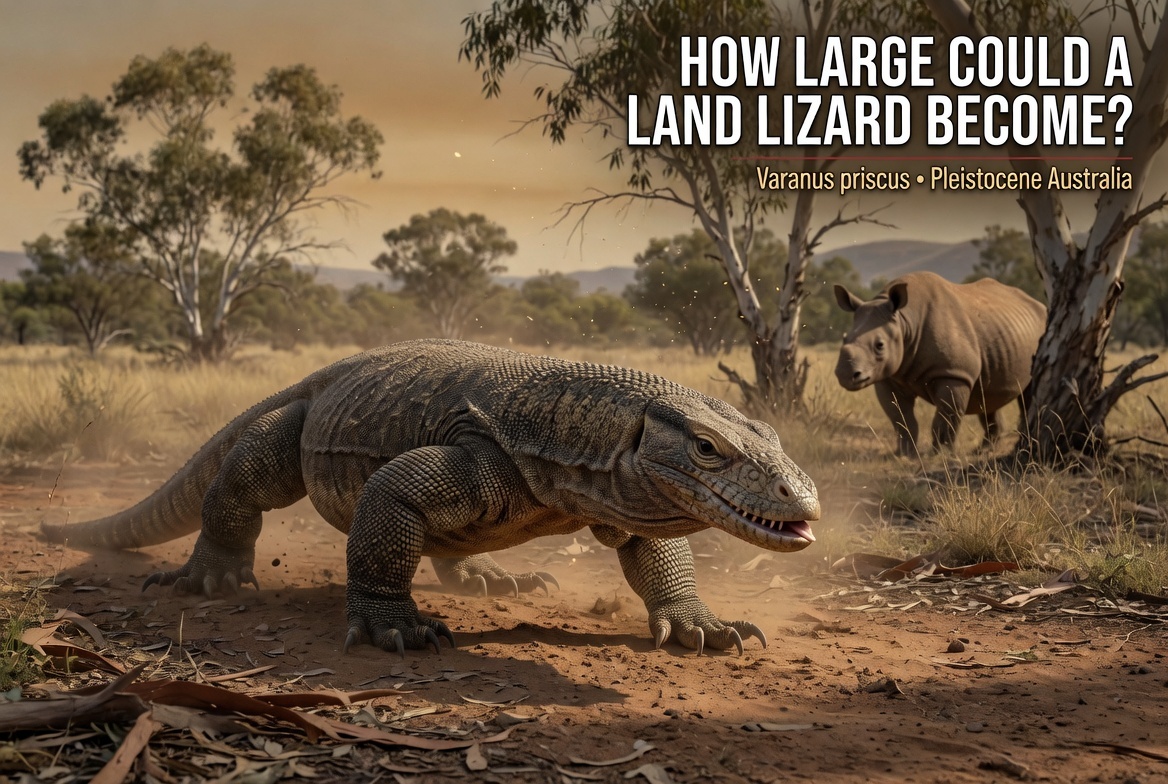
Australia’s prehistoric landscapes contained animals that would feel almost fictional today. Giant marsupials moved across open woodlands, large flightless birds claimed the plains, and unique predators hunted in ecosystems shaped by intense climate cycles.
Among them was a lizard unlike anything alive on land today. Its scientific name is Varanus priscus, though it is far more commonly known by its legendary nickname: Megalania.
Megalania belonged to the monitor-lizard family—the exact same evolutionary group that includes today’s iconic Komodo dragon. Except Megalania was vastly larger. Recognized by museums as the largest known terrestrial lizard to have ever walked the Earth, some reconstructions place large adults at five to six meters (16 to 20 feet) long.
Imagine a Komodo dragon expanded into a heavy-set apex predator patrolling Pleistocene Australia. This real-world dragon didn’t need wings or fiery breath to dominate its world.
Megalania lived during the Pleistocene epoch, sharing the continent with a distinct megafauna community. Its fossils—consisting of jaws, vertebrae, and thick teeth—have been unearthed across central and eastern Australia.
Because scientists lack a single, fully intact skeleton, reconstructing its exact body size requires modeling based on its living relatives. This has led to slight variations among leading institutions:
While much larger, exaggerated figures routinely circulate in pop-culture monster forums, the conservative scientific consensus remains astonishing. Megalania was an absolute titan of the reptilian world.
Megalania’s anatomy leaves no doubt about its predatory lifestyle. It carried sharp, recurved teeth with wrinkled, infolded enamel, specifically adapted for gripping slipping prey and slicing cleanly through flesh. To add to its formidable build, small bones called osteoderms were embedded in the skin around its head and neck, acting as a form of natural chainmail.
Museum records classify Megalania as a heavy meat-eater that operated as both an active predator and an opportunistic scavenger. This mirrors the behavior of modern monitor lizards, which switch seamlessly between hunting live prey and feeding on carrion depending on what the landscape provides.
The phrase “giant venomous lizard” spreads rapidly across the internet, but the real science is more nuanced. Modern research into living monitor lizards has revealed the presence of venom-related proteins and anticoagulants that induce blood loss and shock in their prey.
The Queensland Museum notes that Megalania possibly possessed a similar venomous saliva that acted as an anticoagulant. Because scientists cannot directly sample the saliva of a creature that died out tens of thousands of years ago, this remains an educated inference based on evolutionary relationships. However, a lizard of this scale hardly needed a biological weapon to be terrifying—the sheer crushing force of its jaws and its razor-sharp teeth were more than enough to handle business.
Megalania did not rule an empty wilderness. It belonged to a highly complex, lost ecological community filled with oversized marsupial herbivores. Its primary neighbors included Diprotodon (a massive, rhinoceros-sized marsupial) and various giant short-faced kangaroos.
A reptilian carnivore of this size required an enormous ecosystem capable of supporting its energy demands. Prehistoric Australia provided exactly that. The landscape was not merely a modern bushland with a giant lizard edited into the background; it was a unique, fragile evolutionary theater where reptiles held a level of power usually reserved for mammalian big cats.
This remains one of the most thrilling questions in Australian paleontology. Indigenous humans arrived on the continent tens of thousands of years ago, and museum records indicate that Megalania survived until roughly 40,000 years ago. This timeline strongly suggests that early humans and giant monitor lizards overlapped.
However, a potential overlap is not a confirmed encounter. While it is highly likely that early humans witnessed these real-life dragons, there is no verified archaeological evidence of direct interaction.
Furthermore, despite persistent cryptozoological urban legends, there is absolutely no scientific evidence—no DNA, no photographs, and no skeletal remains—to support the claim that Megalania secretly survives in the remote Australian outback today. It is a true, magnificent relic of the ancient past.
Megalania disappeared alongside most of Australia’s other megafauna during the late Pleistocene. The exact cause of this extinction event remains a subject of intense scientific debate, with researchers pointing to a combination of shifting climate cycles, human-driven environmental changes, and a subsequent collapse of the prey populations that Megalania relied on to survive.
The true story of Megalania doesn’t need sensationalized myths or fictional upgrades to capture our imagination. It stands as a powerful testament to a time when Australia followed a completely different evolutionary path—a world where a giant lizard, using patience, concealment, and raw power, claimed the ultimate title of apex land predator.