11
11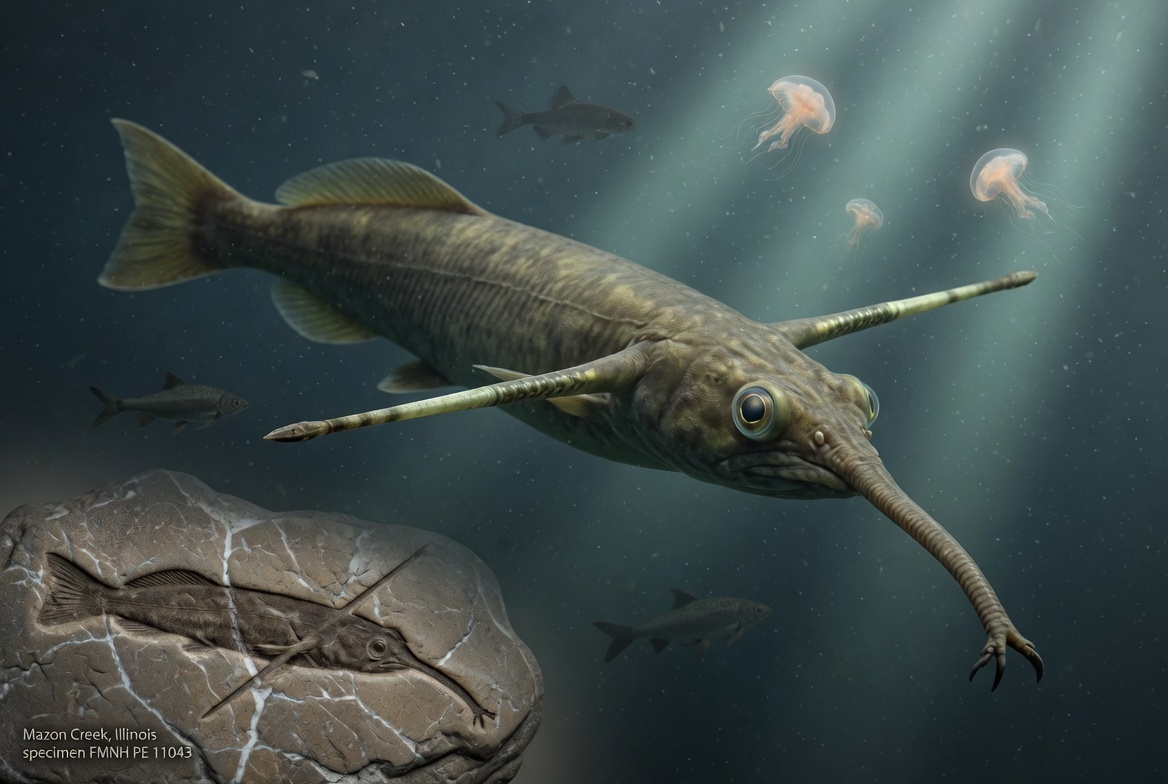
Some prehistoric animals become famous because they were enormous. Others become famous because their anatomy looks dangerous.
The Tully Monster (Tullimonstrum gregarium) became famous because scientists still struggle to decide what it actually was.
It lived more than 300 million years ago in the Carboniferous waterways preserved at Mazon Creek in Illinois. The animal was not gigantic—many specimens measure only several centimetres to a few tens of centimetres. However, its body plan looks like a collection of features assembled from completely unrelated creatures:
The combination feels wrong because modern comparisons fail quickly. Was the Tully Monster a strange vertebrate related to lampreys? Was it an invertebrate? Or a non-vertebrate chordate?
Decades after its discovery, the animal remains one of paleontology’s most compelling identity mysteries.
The story began in the 1950s when fossil collector Francis Tully found an unusual specimen in concretions from the Mazon Creek area of Illinois.
The site is world-famous for exceptional preservation. While soft-bodied animals usually disappear before fossilisation, Mazon Creek conditions occasionally preserved impressions of organisms that would normally vanish.
But exceptional preservation creates interpretation challenges:
Thousands of Tully Monster specimens were eventually collected, and the animal became a local icon, leading Illinois to designate it as the official state fossil in 1989. Yet, celebrity status did not solve the classification problem.
Tullimonstrum does not fit comfortably into any simple modern category.
The eye bar is one of its strangest features, with eyes positioned at opposite ends of a rigid structure extending across the body. The proboscis adds another layer of bizarre complexity, reaching forward from the head region and ending in a mouth-like pincer armed with small, tooth-like structures.
Every trait invites a conflicting comparison:
The Tully Monster became a ultimate test of how scientists classify an organism when the usual anatomical clues are distorted, incomplete, or genuinely unfamiliar.
In 2016, researchers published a major study arguing that the Tully Monster belonged among vertebrates. The analysis examined more than 1,000 fossils and interpreted a pale internal band as a notochord-like structure, connecting Tullimonstrum with jawless fishes like lampreys.
If correct, the Tully Monster would become part of the vertebrate story rather than an isolated evolutionary oddity.
But the debate did not end there. A 2017 critique sharply disputed the vertebrate interpretation, arguing that the supposed vertebrate features had been misidentified or overinterpreted.
Compressed soft-bodied animals can create misleading shapes during decay. A feature that resembles a backbone under a microscope may actually be something else entirely.
In 2023, a University of Tokyo-led team used high-resolution 3D scanning to examine more than 150 Tully Monster fossils, comparing their preserved anatomy with other Mazon Creek animals.
The resulting study raised serious doubts about the vertebrate hypothesis:
The study did not produce one universally accepted final identity. Instead, it narrowed the possibilities differently, suggesting Tullimonstrum may have been a non-vertebrate chordate or belonged among protostomes (the large branch containing arthropods, molluscs, and annelid worms).
The monster moved again—not into a final box, but into a better-defined uncertainty.
Why care whether one small Carboniferous swimmer belonged near lampreys or somewhere among invertebrates?
Because classification changes evolutionary history. If Tullimonstrum was a vertebrate, its unusual features become part of the early experimentation within our own lineage. If it was not, the fossil represents a lost invertebrate body plan unlike anything alive today.
Humans naturally understand unfamiliar objects by comparing them with familiar ones, but evolution does not build animals for easy human classification. Modern biodiversity is only a filtered remnant of everything evolution has produced. The Tully Monster looks impossible simply because its closest relatives disappeared.
The proboscis ending in a claw-like mouth containing small tooth-like elements strongly suggests the animal captured or manipulated food. It likely fed on small prey or organic material in the water.
However, scientists urge caution:
A realistic reconstruction should show a strange, delicate swimmer exploring a prehistoric lagoon, not a monster attacking everything nearby.
The Facts:
The Uncertainties:
The Tully Monster demonstrates how research actually works. A hypothesis is proposed, evidence is analysed, new techniques produce new observations, and the classification shifts. This is not a failure of science; it is progress.
The fossils preserve an animal clearly enough to see its bizarre features, but they do not preserve a simple answer. A state fossil from Illinois remains a global scientific mystery.