11
11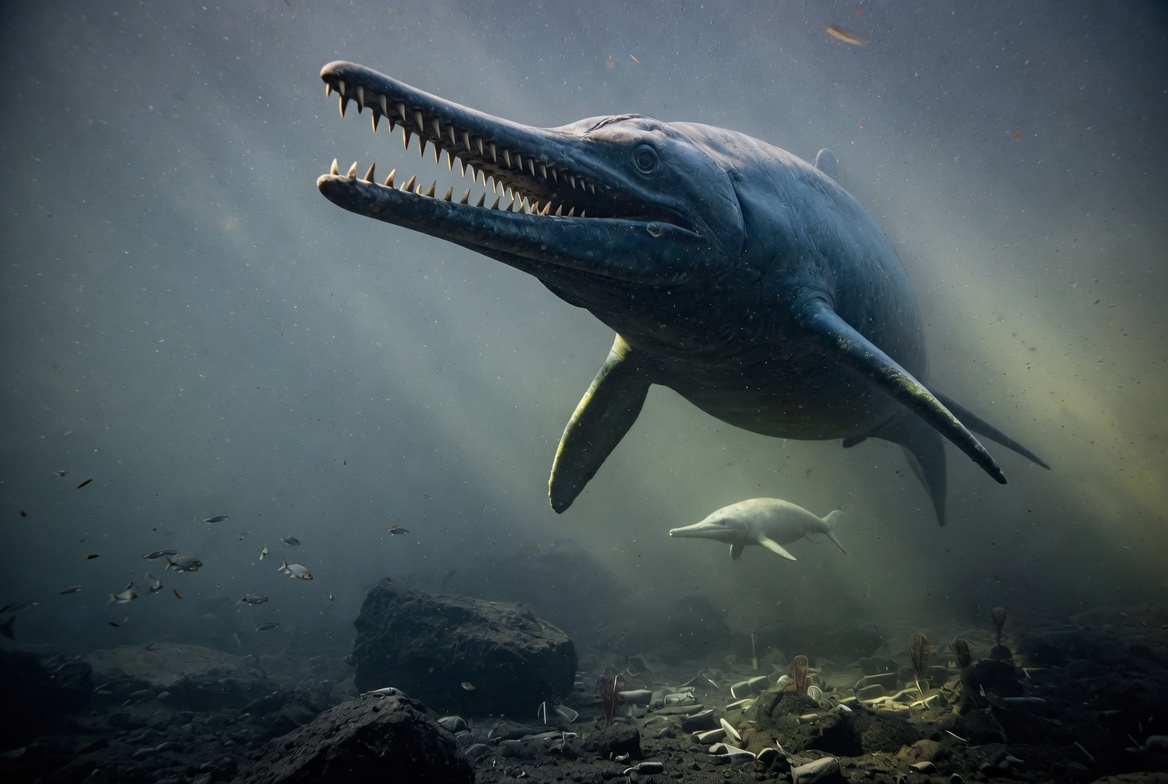
Approximately 252 million years ago, life on Earth experienced its most devastating known extinction event. The end-Permian mass extinction, often called the Great Dying, caused marine ecosystems to collapse. A vast proportion of ocean species disappeared, and ancient food webs broke apart completely.
Recovery took time. Or so we thought.
Then, only around eight million years later, a massive marine predator suddenly appeared in the oceans: Thalattoarchon saurophagis.
The animal was an ichthyosaur—a marine reptile with a streamlined body and four flippers. It lived during the Middle Triassic, and its fossil was discovered in Nevada, where ancient marine rocks now rise inside a dry desert landscape.
Thalattoarchon measured roughly eight to nine metres long, and its jaws carried large teeth with sharp cutting edges. Researchers interpreted the animal as a macropredator capable of feeding on large prey, including other marine reptiles.
The discovery was important for more than just its fear factor. A top predator sits at the peak of an ecosystem, requiring a complex food web beneath it. If Thalattoarchon returned so soon after the Great Dying, complex marine ecosystems may have rebuilt much faster than scientists once assumed.
The fossil came from the Augusta Mountains of Nevada. Today, the location is a dry desert. However, during the Triassic period, these rocks formed in a vibrant ocean environment. This reversal is one of paleontology’s recurring visual tricks: a desert can preserve sea monsters.
Researchers first identified the fossil material in the 1990s and later excavated the partial skeleton, which included a skull and other bones sufficient to reveal a large apex predator.
The name Thalattoarchon saurophagis has an appropriately dramatic meaning: “a ruler of the sea associated with eating lizards or reptiles.”
The animal lived approximately 244 million years ago, entering the fossil record shortly after one of the largest biological resets in Earth’s history.
Later ichthyosaurs reached even larger sizes, with some becoming enormous marine reptiles comparable in scale to modern whales. Thalattoarchon was not famous because it broke every size record; it mattered because of its timing and anatomy.
The animal appeared incredibly early in the Triassic period. Its teeth were large, sharp-edged, and perfectly suited to slicing substantial prey. This places it in a different ecological category from animals that fed mainly on small fish or squid.
A marine ecosystem capable of supporting a large top predator must also support healthy prey populations and lower trophic levels. The discovery therefore became groundbreaking evidence about ecological recovery:
The end-Permian extinction eliminated a huge proportion of marine species and transformed ecosystems globally. While researchers continue to study the exact mechanisms, massive volcanic activity in Siberia played a central role.
Greenhouse gases, extreme warming, ocean acidification, and oxygen loss all contributed to the crisis. The result was not a single dramatic day, but a prolonged planetary biological emergency.
Marine communities suffered severely, and many lineages disappeared forever. However, the surviving organisms entered a world with vacant ecological space. The Triassic recovery that followed involved intense experimentation, expansion, and the rise of new groups—and marine reptiles became a dominant part of that story.
Ichthyosaurs were reptiles completely adapted to marine life:
Across their evolutionary history, ichthyosaurs occupied different feeding roles and reached a wide range of sizes. Thalattoarchon emerged early in that radiation. Its body demonstrates how quickly marine reptiles expanded into high-level predatory niches.
The animal was not a primitive halfway form waiting for evolution to improve it; it was already highly specialised. Its large skull and cutting teeth belonged to a hunter built for serious prey.
The species name encourages an obvious answer: other reptiles. Researchers interpreted Thalattoarchon as a macropredator capable of feeding on animals of comparable size.
Its teeth provide the main clue. They were large and carried cutting edges, differing drastically from the small, conical teeth expected in a predator focused mainly on tiny fish.
Thalattoarchon occupied an apex-predator role broadly comparable to large modern marine hunters such as orcas and great white sharks.
However, since scientists cannot reconstruct a complete diet from a single fossil, the animal may also have eaten fish and other prey when opportunities appeared. A top predator rarely follows one rigid menu, but the careful conclusion remains impressive.
When scientists discuss ecosystem recovery, they do not only count how many species exist. A functioning ecosystem is built on complex relationships:
A giant predator cannot appear sustainably if the lower levels remain empty. That is why Thalattoarchon matters so much. Its fossil suggests that marine trophic networks regained complexity relatively rapidly after stabilization began. The predator becomes a symbol of recovery—not because it was peaceful, but because the ecosystem was productive enough to support something dangerous.
To a human, eight million years feels almost incomprehensible. To evolutionary history, it can be surprisingly quick.
Major ecological restructuring often unfolds across much longer intervals. Because the Great Dying eliminated so much life, scientists once expected a prolonged delay before complex food webs returned.
Thalattoarchon completely compressed that timeline. A large marine reptile with cutting teeth already existed within the Middle Triassic.
That does not mean the recovery was complete everywhere; different regions recovered differently, and some ecosystems remained highly stressed. The fossil represents an important signal, not a claim that the entire planet healed instantly. Still, the signal is remarkable.
Ichthyosaurs are often reconstructed as dolphin-like. While the streamlined silhouette is accurate in a broad sense, the comparison can accidentally make them seem harmless.
Thalattoarchon completely changes the mood:
A realistic reconstruction should not turn the animal into a fantasy dragon, but it should show a marine reptile heavily adapted to an aggressive predatory role. The fear factor comes from the context: the ocean had recently endured a mass catastrophe, and then this silhouette appeared.
While scientists have established the core facts, important details remain open to investigation:
Science can reconstruct the ecological role without pretending to replay every moment. The scientific version stays compelling because it separates evidence from imagination.
A small survivor can persist inside a damaged, broken ecosystem. A large apex predator, however, demands much more. It needs enough prey biomass, and its prey need their own stable food sources. Those lower levels need functioning habitats and healthy nutrient cycles.
Thalattoarchon therefore acts like an ecological stress test preserved in rock. Its existence suggests not only that marine reptiles diversified quickly, but that the surrounding system had rebuilt enough depth to support a demanding hunter.
The fossil transforms recovery from an abstract timeline into a living scene: the ocean was no longer merely surviving; it was becoming dangerous again.
Ecological recovery is easy to imagine as a peaceful, harmonious return of life. Thalattoarchon shows the exact opposite.
A recovered ecosystem becomes highly competitive again. Predators return, prey must adapt, and food webs regain their structural tension.
The appearance of a large marine hunter marks a definitive transition from survival to complexity. The sea was no longer an empty landscape slowly refilling with small organisms; it had once again become a functioning arena where large animals could hunt other large animals.
The Great Dying emptied the oceans, but evolution did not leave them quiet for long.