11
11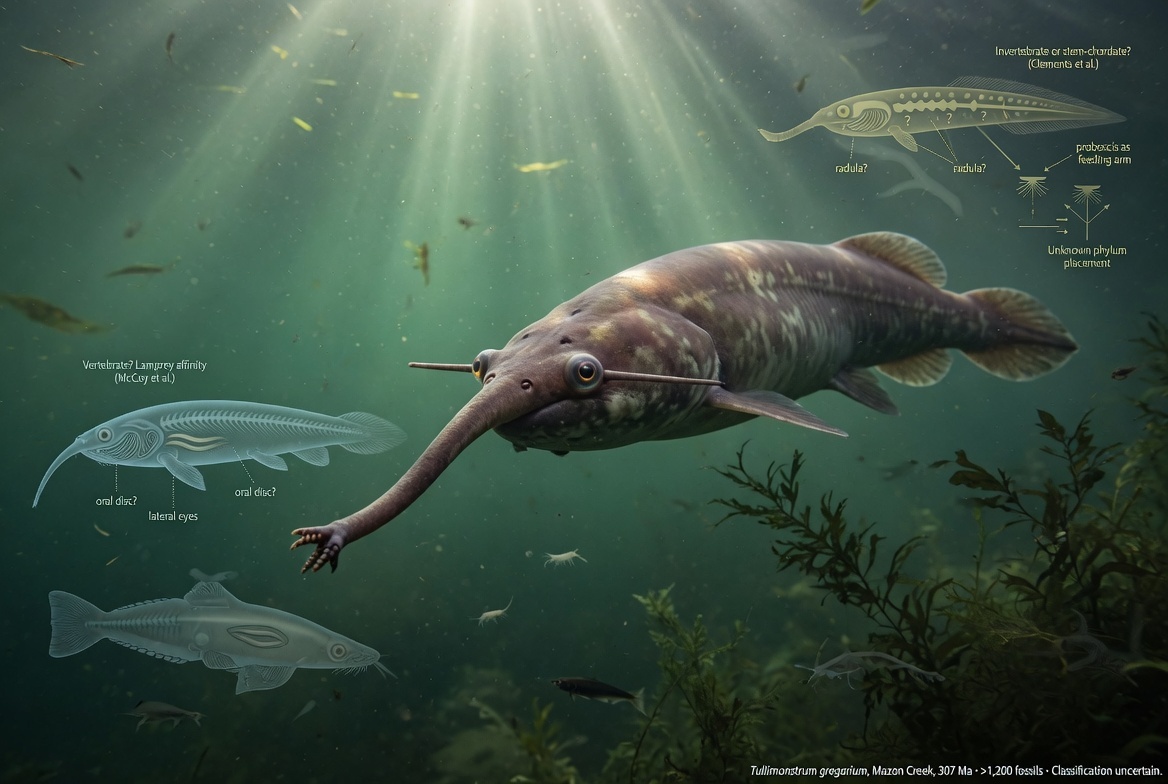
The Tully monster is not terrifying because it was large. It was usually around 30 centimeters long. It is not famous because it dominated an ancient ecosystem.
It is famous because scientists still struggle to decide what kind of animal it was.
More than a thousand fossils have been collected from the Mazon Creek fossil beds in Illinois. Many preserve soft-body outlines in remarkable detail. Researchers can see a long body, a tail region, eyes positioned on a bar-like structure, and a narrow proboscis ending in a claw-like mouth.
The creature looked unlike anything alive today. Its scientific name is Tullimonstrum gregarium, but its nickname remains the Tully monster. Decades after its discovery, the animal remains one of paleontology’s most stubborn classification puzzles.
The first specimen was discovered in the 1950s by fossil collector Francis Tully. The fossils came from Mazon Creek deposits, a famous Illinois site preserving animals from around 307 million years ago.
During the Carboniferous Period, the region looked nothing like modern Illinois. Coastal environments, shallow waters, and sediment-rich conditions created unusual opportunities for fossilization.
This is why the Tully monster became known through so many specimens. The preservation is extraordinary, but the interpretation remains difficult.
Tullimonstrum had a body plan that resists easy comparison:
Some fossils show repeated internal structures. The question is what those structures mean. Are they muscle blocks? Segments? Evidence of a notochord? Tissues distorted during fossilization? Or features produced by decay?
Paleontologists cannot classify a creature based on overall weirdness. They must decide which structures genuinely correspond with known anatomy in other animals.
In 2016, a major study argued that the Tully monster was a vertebrate. The researchers interpreted a pale line running through the body as a notochord—a supportive structure associated with chordates. They identified other features as possible gill pouches, muscle blocks, and anatomy related to lampreys.
Under this interpretation, Tullimonstrum belonged near the lineage containing jawless fishes such as lampreys.
The claim attracted immediate attention. A fossil mystery appeared to be solved: the Tully monster was not a worm, mollusc, or unknown invertebrate, but a bizarre vertebrate relative. The Field Museum even published material explaining this lamprey-related interpretation.
But paleontology did not stop there.
Other researchers challenged the vertebrate model. A 2017 paper argued that the supposed vertebrate features could be products of preservation, convergence, or incorrect comparison, noting that the animal lacked key structures expected in a vertebrate. The debate reopened.
In 2023, a team led by researchers from the University of Tokyo published a three-dimensional anatomical study using more than 150 fossils. The researchers applied laser scanning to examine surface details.
Their conclusion was blunt: the vertebrate hypothesis was untenable.
Features previously compared with vertebrate anatomy did not match closely enough. The team argued that the Tully monster may instead have been a non-vertebrate chordate or a protostome invertebrate. This did not identify the animal perfectly, but it narrowed the debate while preserving the mystery.
The Tully monster exposes a misconception: people often assume that more fossils always create a clear answer. Sometimes they do, but a large sample of the same difficult preservation style may simply repeat the same uncertainty.
Thousands of specimens can improve statistical analysis, but researchers still need a reliable framework for comparison. The problem is not a lack of material alone; the problem is complete biological unfamiliarity.
The words sound simple, but the broad categories do not create an obvious answer for Tullimonstrum. Researchers must compare incredibly fine technical details:
A fossil can look obvious at first glance and remain deeply ambiguous under rigorous scientific analysis.
The creature’s design feels assembled from entirely unrelated parts: eyes on a bar, a long body, a trunk-like feeding structure, a toothed claw at the end, and tail fins. It has no clear modern equivalent.
This visual strangeness has made the Tully monster a symbol of prehistoric uncertainty. Illinois adopted it as the official state fossil—a fitting status for a creature that came from Illinois rock, attracted global scientific attention, and remains completely unresolved.
The proboscis ended in a small tooth-bearing structure, which suggests feeding on small prey or particles in aquatic environments. The animal may have grasped food using the tip of this proboscis.
However, the exact feeding behavior remains speculative. Without a clear classification, ecological interpretation becomes much harder. A lamprey-related vertebrate implies one set of comparisons, while a soft-bodied invertebrate suggests another. The fossils reveal a tool, but they do not provide a recorded feeding sequence.
Tully monster research is not only about naming one odd animal; classification shapes our understanding of evolutionary history.
If Tullimonstrum was a vertebrate, it expanded the known range of vertebrate body plans dramatically. If it was not a vertebrate, researchers need to explain which invertebrate or chordate branch produced such unusual anatomy. Either answer matters.
The fossil record is full of lineages that disappeared completely. Modern animals represent survivors, not the entire history of possible body plans. The Tully monster may belong to a branch with no close living analogue.
Popular storytelling often demands a clean solution: mystery solved, case closed, animal identified.
The Tully monster resists that rhythm. One study pushes toward vertebrates, another challenges the interpretation, and new scanning methods reveal more detail, causing the debate to change shape.
This is not scientific weakness; it is honesty. Some fossils remain unresolved because the evidence does not yet support one final, confident answer.
Tullimonstrum shows why unresolved fossils matter. A confident label can make an animal feel familiar too quickly. Leaving the classification open preserves the real scientific challenge.
The fossil is not a failure of knowledge. It is a reminder that ancient life explored forms the modern world no longer contains.
The Tully monster is one of paleontology’s best reminders that fossils do not always become easier with familiarity. Scientists have examined more than a thousand specimens. They can draw the animal, scan it, and compare its anatomy with vertebrates and invertebrates alike.
Yet the most basic question remains open: What was it?
The mystery survived not because evidence is missing entirely, but because the evidence preserves an animal unlike anything living today.