11
11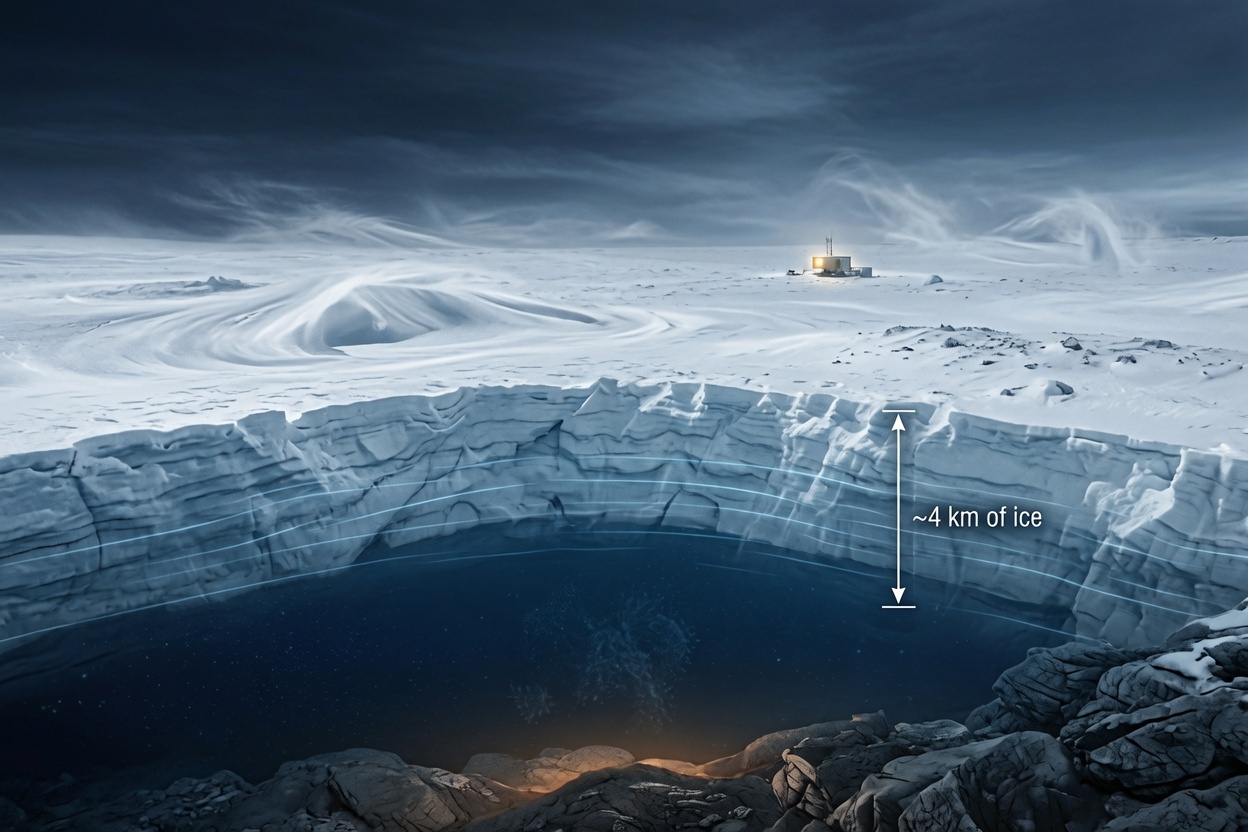
Antarctica hides landscapes. Mountains rise beneath ice sheets, valleys cut through bedrock, and rivers and lakes exist where sunlight never reaches.
The most famous hidden water body is Lake Vostok.
It lies beneath East Antarctica under approximately four kilometers of ice. NASA astrobiology material describes it as the largest known subglacial lake on Earth and one of the largest lakes in the world by surface area.
The scale is difficult to imagine: a freshwater lake comparable in area to Lake Ontario exists beneath a frozen surface that looks flat, barren, and lifeless.
The lake cannot be visited casually. Reaching it requires drilling through kilometers of ice while protecting an environment that may have been isolated from direct surface inputs for hundreds of thousands of years. Lake Vostok is not only a geological mystery; it is an astrobiology question.
If life can persist in dark water sealed beneath Antarctic ice, similar strategies might help scientists think about icy worlds beyond Earth.
Antarctica is cold enough to make liquid water seem impossible, but pressure and geothermal heat change the equation:
Under the right conditions, liquid water persists between bedrock and glacier. Lake Vostok is not an open cavern containing a warm underground sea; it is a subglacial lake shaped by ice, pressure, geology, and slow circulation.
Water may freeze onto the bottom of the ice in some areas and melt in others. This creates accretion ice—frozen material formed from lake water beneath the glacier. Researchers can study that ice for clues without observing the entire lake directly.
Scientists did not discover Lake Vostok by looking through a hole; remote sensing exposed it.
NASA Earthdata describes how researchers used aircraft and radar to examine the landscape beneath Antarctic ice. Radar signals pass through ice and reflect from underlying surfaces—bedrock creates one pattern, while water creates another.
A lake can also influence the surface above it. Ice flowing over rugged ground preserves uneven topography, but ice above a broad water body may appear unusually flat. Satellite data and geophysical measurements helped reveal the enormous hidden lake beneath Vostok Station.
This is one of the most cinematic realities of polar science: researchers can map a buried world from subtle signals crossing kilometers of ice.
Lake Vostok stretches for more than 250 kilometers in length and reaches tens of kilometers across. Different summaries describe the exact dimensions slightly differently depending on the dataset and definition used, but the strongest comparison is simple: it is similar in area to Lake Ontario.
That means the lake is not a small pocket of meltwater. It is a major freshwater body hidden beneath a continent-scale ice sheet, far beyond normal human access.
This point requires careful wording. Lake Vostok is often described online as a perfectly sealed prehistoric capsule isolated for millions of years, but the reality is more nuanced.
NASA astrobiology material notes that studies have estimated isolation from direct surface inputs for around 420,000 years. Water circulation, melting, freezing, and movement beneath the ice complicate the meaning of isolation.
The lake may preserve ancient environmental conditions, but it is not necessarily a motionless, sealed bottle unchanged since one exact date. This distinction matters because dramatic claims can outrun the evidence. Lake Vostok remains extraordinary without exaggeration.
This is the question that transformed Lake Vostok into an astrobiology icon. Liquid water exists beneath ice, and energy sources may come from geothermal processes, minerals, chemical reactions, or slowly cycling material.
Microorganisms can survive in extreme environments elsewhere on Earth. Researchers studying accretion ice above Lake Vostok have reported microorganisms frozen into the ice. NASA astrobiology material describes those findings as evidence that the lake might support a microbial population.
The wording here is important: scientists have not confirmed a hidden ecosystem filled with large, unknown creatures. They are investigating whether microbial life can persist in the subglacial environment. Any claim beyond the evidence becomes pure speculation.
Exploring Lake Vostok creates a paradox: scientists want samples, but drilling equipment, fluids, microbes from the surface, and human activity could easily contaminate the environment they want to study. Once introduced, contamination becomes difficult to separate from native material.
This is why researchers have treated access as a serious engineering and environmental challenge. Clean sampling techniques matter because an untouched environment can answer questions that a contaminated sample cannot.
Lake Vostok captures attention beyond Earth science. Jupiter’s moon Europa and Saturn’s moon Enceladus are believed to contain massive oceans beneath thick ice sheets, and scientists are eager to learn whether those environments could support life.
Antarctica offers an imperfect but highly useful comparison:
Missions to icy moons will face an even more extreme version of this exact challenge.
Lake Vostok has inspired sensational stories. Hidden lakes naturally invite speculation, and some online versions describe unknown giant organisms, prehistoric animals, alien-like ecosystems, or secret military discoveries.
Confirmed evidence does not support those claims. The lake is scientifically exciting because microbes may survive there. A microbial ecosystem can reveal how life persists with limited energy and no sunlight.
That may sound less dramatic than a giant creature, but it is far more important. Extreme microbes expand our understanding of habitability and change the kinds of environments scientists consider when searching for life beyond Earth.
Vostok Station is famous for more than just the lake. Ice cores retrieved from the site preserve records of past climate. Layers of ice trap tiny air bubbles and chemical signatures linked with atmospheric conditions over long periods.
Therefore, the site becomes a magnificent vertical timeline:
One of the most compelling details is the contrast. Above Lake Vostok, the landscape does not announce a hidden world. Snow stretches across the horizon, wind moves over flat ice, and a remote research station sits in one of the most isolated places on Earth.
Beneath that ordinary-looking surface lies an enormous body of water. This contrast explains why remote sensing matters so much; humans often assume visible landscapes tell the entire story, but Antarctica proves otherwise.
Lake Vostok is powerful because the mystery is real and restrained. There is a giant lake beneath Antarctic ice, yet the surface gives almost nothing away. The water remains incredibly difficult to reach, requiring scientists to study signals, ice cores, and carefully collected material to understand an environment completely cut off from sunlight.
The biggest question is not whether monsters live below; it is whether life can survive quietly in one of Earth’s most isolated environments. That answer may eventually help scientists imagine life beneath the ice of worlds far beyond our own.