11
11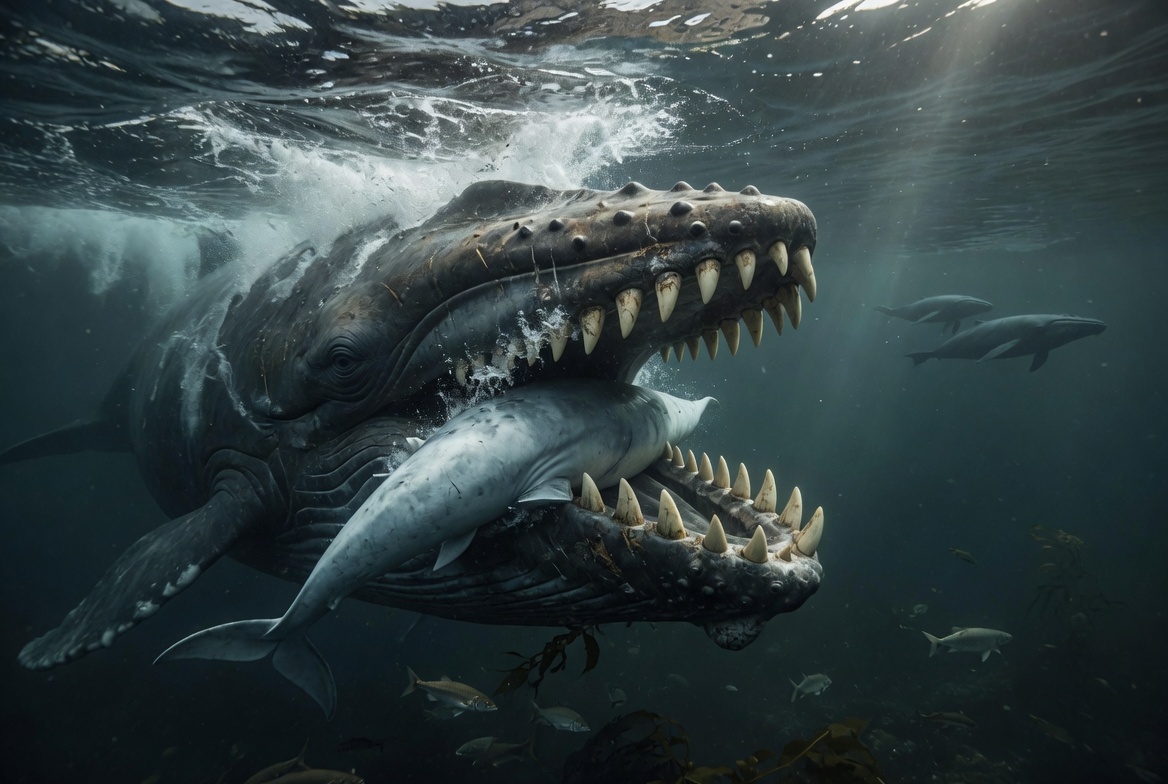
The water is not empty. It is crowded with life, movement, and danger. Somewhere inside that world is a massive Livyatan melvillei surfacing from dark Miocene water, its square-headed skull and huge interlocking teeth clearly visible as it closes in on a smaller baleen whale.
The image feels exaggerated at first glance, almost like concept art designed for a monster film. But the core of the story comes from real fossils, real anatomy, and a scientific question that is still interesting even after the dramatic headlines are stripped away.
A giant Miocene sperm whale with enormous functional teeth may have hunted large marine vertebrates, possibly including baleen whales.
That distinction matters. EdgeCase stories work best when the evidence is already strange enough. There is no need to turn a fossil into fake proof, inflate an uncertain estimate into a fixed measurement, or present one scientific interpretation as the final answer.
The truth is more compelling: researchers are reconstructing a lost animal from incomplete clues, and those clues reveal an ecosystem that no longer exists.
Livyatan melvillei was described from a skull, mandible, and enormous teeth found in the Pisco Basin of Peru. The fossil dates to the Middle Miocene, approximately 12–13 million years ago.
Unlike modern sperm whales, Livyatan had very large functional teeth in both the upper and lower jaws. The original researchers interpreted the animal as a macropredator capable of feeding on large marine vertebrates.
These details are the foundation of the story. They are not rumors, legends, or viral claims copied from an old illustration. They come from physical specimens and published research.
That process can feel frustrating to people who want one clean answer. It is also what makes paleontology so cinematic. The animal is gone. The world around it is gone. Researchers are trying to rebuild both using evidence that survived deep time by chance.
The most clickable feature is not a fictional upgrade. It is the real anatomy.
In this case, the visual focus should remain on a scarred, realistic prehistoric whale with enormous conical teeth, turbulent water, distant silhouettes of smaller whales, and a cinematic low underwater camera. The creature needs to appear credible, heavy, and biologically functional. It should not look like a fantasy monster with random spikes, glowing eyes, or impossible aggression. The frightening part comes from scale, silhouette, and evolutionary design.
Extreme anatomy usually evolves because it solves a problem:
Sometimes the feature is not primarily a weapon at all. Sometimes the weirdest body plan belongs to an animal that was simply adapted to a vanished environment. This is where scientific interpretation begins. Anatomy can strongly support a hypothesis, but it does not replay the animal’s behavior like a video recording.
The fossil record does not preserve a complete skeleton or a direct feeding event. Scientists can reconstruct the weaponry, but the exact hunting style remains partly inferred from anatomy and comparison with other predators.
This gap between fossil evidence and living behavior is not a weakness in the story. It is the story.
Paleontology is full of animals that became more interesting after the easy explanation failed. A fossil may be discovered decades before the tools exist to interpret it properly.
That is why older illustrations should never be treated as photographs. Paleoart is a visual hypothesis. The strongest artwork follows the available evidence, shows uncertainty where it exists, and avoids turning a reasonable reconstruction into false certainty.
The confirmed picture is already strong.
The interpretation that still needs careful wording is this: Researchers have suggested that medium-sized baleen whales could have been among its prey. That is a plausible ecological interpretation, not a filmed or directly preserved event.
That does not mean scientists know nothing. It means the boundary between evidence and inference must remain visible. A fossil tooth can confirm that a structure existed. Wear can suggest how it was used. Body proportions can narrow down possible movement styles. Preserved injuries can support a predator-prey interaction. But a complete hunting sequence, social behavior, color pattern, or exact daily routine may remain uncertain.
This is the line between science mystery and fake mystery. A fake mystery treats uncertainty as permission to invent. A science mystery treats uncertainty as an invitation to look more closely.
A prehistoric animal never existed in isolation.
Its body makes sense only when placed back into its environment: water depth, climate, prey, competitors, vegetation, oxygen levels, coastlines, currents, and the evolutionary experiments happening around it. Modern ecosystems can feel stable because we see them every day. Fossil ecosystems remind us that nature has tried radically different combinations.
The world described here was not a primitive draft of the modern world. It was a complete ecosystem with its own rules.
Some of the animals sharing that environment would look familiar at a distance and deeply wrong up close. Others belonged to lineages that later vanished entirely. The most unsettling realization is not simply that one bizarre creature existed. It is that the creature was normal inside its own world.
Scientific debate is not a sign that researchers are guessing randomly.
Different teams can study the same animal and emphasize different evidence. One reconstruction may explain the anatomy better. Another may fit hydrodynamics, biomechanics, preservation, or evolutionary relationships more convincingly. New specimens can shift the balance. New imaging can expose a structure that earlier researchers could not see. A persuasive idea can remain provisional because the fossil record is incomplete.
That is especially important for viral prehistoric content. Social media usually compresses a debate into a dramatic binary: predator or scavenger, swimmer or wader, shark or not-shark, giant monster or harmless grazer.
Real science is often more layered. An animal may have used multiple strategies. Its behavior may have changed with age. Different species within the same group may have occupied different niches. The goal is not to remove the drama. The goal is to place the drama where it belongs: inside the evidence.
A strong visual for this story should show a massive Livyatan melvillei surfacing from dark Miocene water, its square-headed skull and huge interlocking teeth clearly visible as it closes in on a smaller baleen whale.
The environment should feel cinematic but believable: the coastal waters of Miocene Peru around 12–13 million years ago.
Suspense performs better when the viewer feels like they have discovered a real moment rather than clicked a fake poster. A good thumbnail gives the audience one immediate question: how could this animal have been real?
A good article then answers that question honestly while revealing that the remaining uncertainty is even more fascinating.
The most important takeaway is simple: A giant Miocene sperm whale with enormous functional teeth may have hunted large marine vertebrates, possibly including baleen whales.
The fossil evidence confirms a real animal with a body plan strange enough to stop people mid-scroll. The scientific interpretation adds the deeper layer: why that body may have evolved, how the animal may have lived, and which parts remain unresolved.
That is the EdgeCase sweet spot.
Not supernatural horror.
Not fake proof.
Not a recycled monster claim.
A real piece of natural history that feels almost impossible.