11
11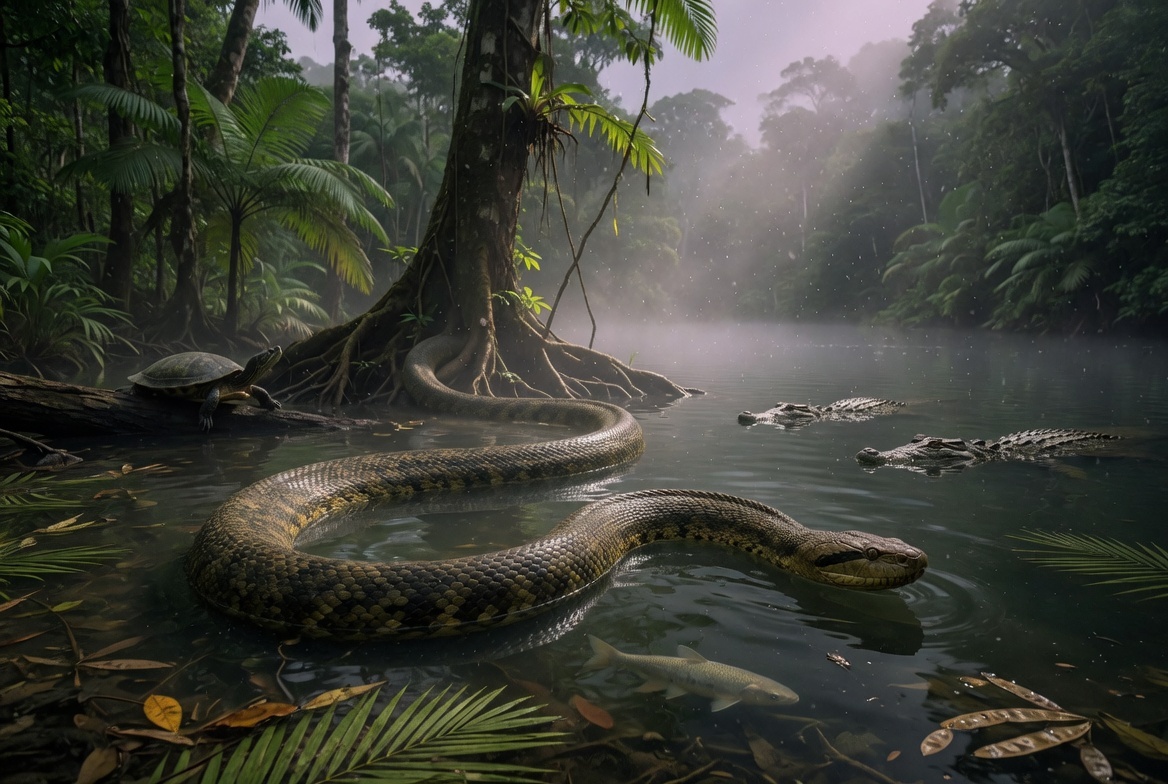
Imagine the Cerrejón rainforest of Colombia around 60 million years ago.
The water is not empty. It is crowded with life, movement, and danger. Somewhere inside that world, a gigantic Titanoboa moves through a flooded Paleocene rainforest, its massive body curving between submerged roots while giant turtles and ancient crocodilian relatives quietly keep their distance.
The image feels exaggerated at first glance, almost like concept art designed for a monster film. But the core of the story comes from real fossils, real anatomy, and a scientific question that remains fascinating long after the dramatic headlines are stripped away.
The truth is more compelling: researchers are reconstructing a lost titan from incomplete clues, and those clues reveal a greenhouse world that no longer exists.
Titanoboa cerrejonensis was identified from fossils pulled from the deep pits of the Cerrejón coal mine in Colombia. It lived during the Paleocene epoch, a critical window of time just after the non-avian dinosaurs disappeared.
Fossils rarely preserve an entire life story. They preserve fragments: bones, impressions, or isolated skeletal structures compressed into stone. Paleontologists compare these fragments with living relatives, build physiological models, and update the picture when stronger evidence appears.
The most striking feature of this jungle predator is not a fictional upgrade. It is the real anatomy.
Extreme anatomy usually evolves because it solves a specific ecological problem. In the case of Titanoboa, its massive body plan was perfectly calibrated to a vanished environment:
Sometimes the weirdest body plan belongs to an animal that was simply perfectly adapted to a specific point in time. Anatomy can strongly support a hypothesis, but it does not replay behavior like a video recording.
Titanoboa’s bones reveal its staggering scale, but not a complete record of its daily behavior. Popular illustrations often show it as a terrestrial monster attacking anything on land, while its exact diet and hunting routine remain subjects of intense scientific interpretation.
This gap between fossil evidence and living behavior is the real story.
Paleontology is full of animals that became more interesting after the easy explanation failed.
That is why older illustrations should never be treated as photographs. Paleoart is a visual hypothesis. The strongest artwork follows the available evidence, shows uncertainty where it exists, and avoids turning a reasonable reconstruction into false certainty.
To understand this Paleocene giant, the boundary between hard evidence and inference must remain visible.
The Confirmed Facts
The Theory
While early models assumed it hunted like a modern land constrictor, later analysis of skull anatomy points toward a specialized aquatic lifestyle focused on fish. Its exact predatory strategies and daily behaviors are still actively debated.
A fake mystery treats uncertainty as permission to invent fantasy monsters. A science mystery treats uncertainty as an invitation to look more closely at how ecosystems adapt to a changing planet.
A prehistoric animal never existed in isolation. Its body makes sense only when placed back into its environment: water depth, climate, prey availability, vegetation, and the evolutionary experiments happening around it.
The Paleocene rainforest was not a primitive draft of the modern Amazon. It was a complete ecosystem operating under its own distinct planetary rules.
Some of the animals sharing those waterways would look familiar at a distance and deeply strange up close. The most unsettling realization is not simply that a 42-foot snake existed—it is that this creature was completely normal and successful inside its own world.
The most important takeaway is simple: Titanoboa was a colossal Paleocene snake from Colombia, and its fossils became a clue to a hot rainforest ecosystem after the dinosaur extinction.
The fossil evidence confirms a body plan strange enough to stop people mid-scroll. The scientific interpretation adds the deeper layer: why that body may have evolved, how the animal lived, and which parts remain unresolved.
This is real natural history.
Not supernatural horror.
Not fake proof.
Just a real piece of Earth’s past that feels completely impossible.