11
11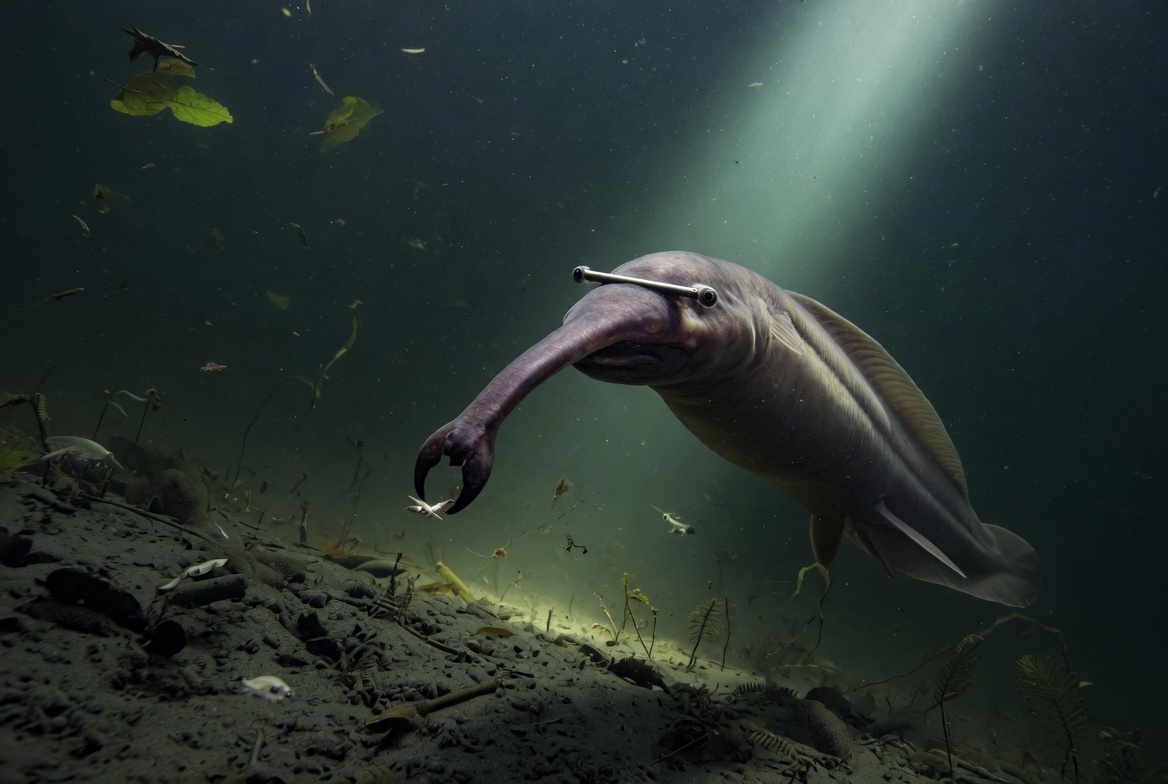
Imagine the ancient coastal waters of the Mazon Creek ecosystem in Illinois, roughly 308 million years ago.
The water is not empty. It is crowded with life, movement, and danger. Somewhere inside that world, a realistic Tully monster (Tullimonstrum gregarium) drifts above a Carboniferous seafloor, its long proboscis, pincer-like mouth, sideways eye bar, and soft body fully exposed.
The image feels exaggerated at first glance, almost like concept art designed for a science-fiction film. But the core of the story comes from real fossils, real anatomy, and a scientific question that remains incredibly interesting even after the sensationalized headlines are stripped away.
The truth is more compelling: researchers are attempting to classify a lost animal from exceptional yet confusing soft-body impressions, revealing an evolutionary puzzle that defies standard biological rules.
Unlike many prehistoric creatures known only from bones or shells, the Tully monster is a completely soft-bodied animal. It fossilized inside ironstone concretions in Illinois, creating beautiful but incredibly cryptic silhouettes.
Fossils rarely preserve an entire life story. They preserve fragments: impressions, chemical signatures, or outlines compressed into stone. Scientists then compare those fragments with related animals, test possible reconstructions, and update the picture when stronger evidence appears. This process is exactly what makes paleontology so cinematic.
The most striking feature of this Carboniferous oddity is not a fictional upgrade. It is the real anatomy.
Extreme anatomy usually evolves because it solves a specific problem. In the case of the Tully monster, its bizarre body plan reflects an evolutionary experiment tailored to a highly specific, vanished environment:
Sometimes the weirdest body plan belongs to an animal that was simply perfectly adapted to a vanished environment. Anatomy can strongly support a hypothesis, but it does not replay behavior like a video recording.
The Tully monster is not mysterious because scientists have ignored it. It is mysterious because exceptionally preserved fossils still allow competing interpretations. Features that look meaningful under one evolutionary tree can be explained completely differently under another.
This gap between fossil evidence and living behavior is the real story.
Paleontology is full of animals that became more interesting after the easy explanation failed.
That is why older illustrations should never be treated as photographs. Paleoart is a visual hypothesis. The strongest artwork follows the available evidence, shows uncertainty where it exists, and avoids turning a reasonable reconstruction into false certainty.
To understand Tullimonstrum, the boundary between hard evidence and scientific inference must remain completely visible.
The Confirmed Facts
The Theory
Whether the Tully monster was a primitive vertebrate, a non-vertebrate chordate, or a highly specialized invertebrate relative remains entirely unproven. Its exact branch on the tree of life is still one of paleontology’s greatest open debates.
A fake mystery treats uncertainty as permission to invent fantasy monsters. A science mystery treats uncertainty as an invitation to look more closely at how nature constructs living things.
A prehistoric animal never existed in isolation. Its body makes sense only when placed back into its environment: water depth, climate, prey, competitors, and the evolutionary experiments happening around it.
The Mazon Creek environment was a highly dynamic, tropical delta where a major river system emptied into a shallow sea. It was a complete ecosystem with its own rules, preserving thousands of delicate organisms—from ancient jellyfish and early horseshoe crabs to primitive sharks.
Some of the animals sharing that environment would look familiar at a distance and deeply wrong up close. The most unsettling realization is not simply that one bizarre creature existed—it is that this creature was completely normal, stable, and highly successful inside its own world.
The most important takeaway is simple: The Tully monster remains one of paleontology’s best identity puzzles, with major studies disagreeing over whether it belongs among vertebrates.
The fossil evidence confirms a body plan strange enough to stop people mid-scroll. The scientific interpretation adds the deeper layer: why that body may have evolved, how the animal lived, and which parts remain unresolved.
This is real natural history.
Not supernatural horror.
Not fake proof.
Just a real piece of Earth’s past that feels completely impossible.