11
11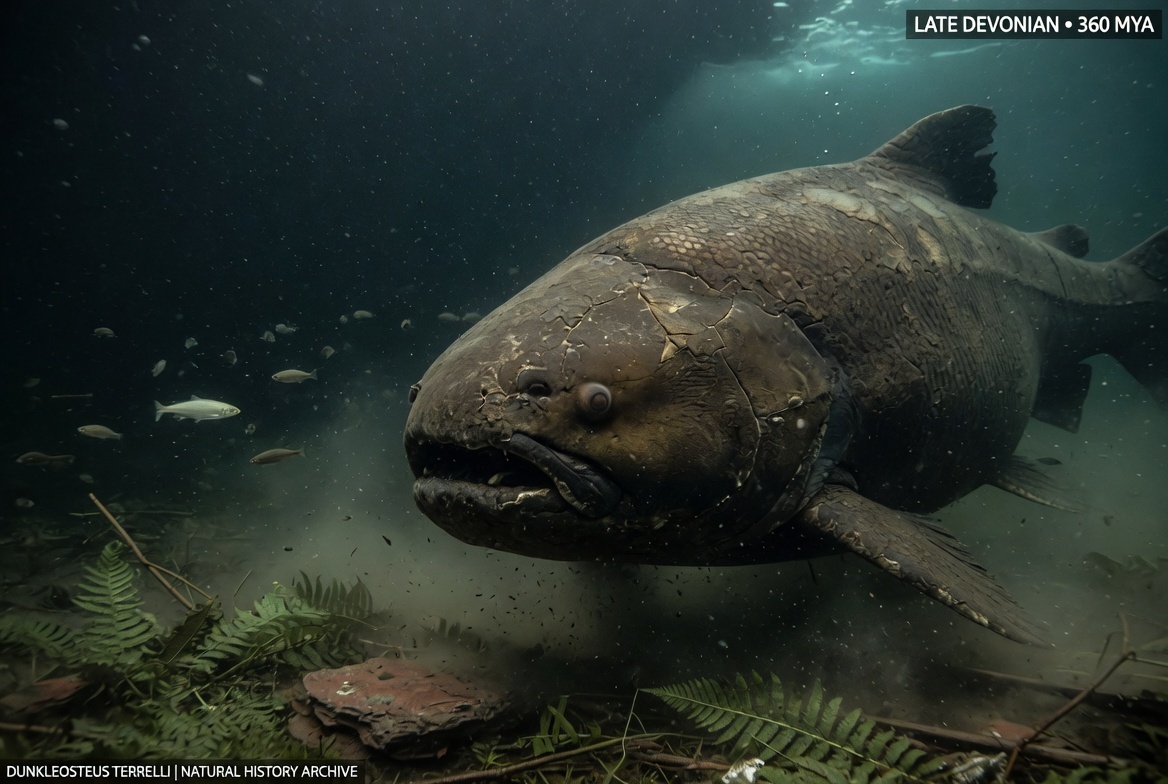
Imagine the murky, shadow-filled waters of a Late Devonian sea roughly 360 million years ago.
The water is not empty. It is crowded with life, movement, and danger. Somewhere inside that world, a realistic Dunkleosteus stands or cruises through the water column, its monstrous armored head dominating the frame. Rather than the long, sleek, shark-like silhouette that filled textbooks for decades, it possesses a deep, compact body—looking less like a biological torpedo and more like a heavy, underwater battering ram.
The image feels exaggerated at first glance, almost like concept art designed for a monster film. But the core of the story comes from real fossils, real anatomy, and a scientific question that remains fascinating long after the dramatic headlines are stripped away.
The truth is more compelling: researchers are reconstructing a top predator from incomplete clues, proving that the corrected version of history is often far stranger than fiction.
Dunkleosteus terrelli is an arthrodire placoderm—an extinct group of heavily armored fishes that ruled the oceans during the “Age of Fishes.” While its fossil record includes spectacular, stone-hard skull plates, the rest of its body has always been a blank canvas for paleontologists.
Fossils rarely preserve an entire life story. Because Dunkleosteus possessed a cartilaginous skeleton behind its shoulders, the soft tissue and post-thoracic anatomy fossilized poorly. Paleontologists must build a plausible whole from the fragments that remain, updating the picture when stronger biomechanical evidence appears.
The most striking feature of this Devonian predator is not a fictional upgrade. It is its genuine, verified anatomy.
Extreme anatomy usually evolves because it solves a specific problem. A long predator is built for high-speed endurance chases across open water. A compact predator, however, is engineered for close-range power and sudden agility:
Sometimes the weirdest body plan belongs to an animal that was simply perfectly adapted to a vanished world. Anatomy can strongly support a biomechanical hypothesis, but it does not replay behavior like a video recording.
Whenever a famous prehistoric animal is downsized, online discussions tend to treat the revision like a defeat—as if the monster has been ruined. This reaction entirely misses the point.
The update does not remove the danger; it changes the style of danger.
Paleontology is full of animals that became infinitely more interesting after the easy explanation failed.
That is why older illustrations should never be treated as photographs. Paleoart is a visual hypothesis. The strongest artwork follows the available evidence, shows uncertainty where it exists, and avoids turning a popular image into false certainty.
To understand Dunkleosteus, the boundary between evidence and scientific inference must remain completely visible.
The Confirmed Facts
The Theory
Because the rear half of the body is missing, the exact tail shape, fin placement, and precise skin contours remain unpreserved. The compact, deep-bodied silhouette is a highly plausible reconstruction based on modern physics, but it remains an ongoing scientific model.
This is the line between a fake mystery and a science mystery. A fake mystery treats uncertainty as permission to invent. A science mystery treats uncertainty as an invitation to look more closely.
A prehistoric animal never existed in isolation. Its body makes sense only when placed back into its environment: water depth, prey availability, competitors, and the evolutionary experiments happening around it.
The Devonian ocean was not a primitive draft of our modern seas. It was a complete ecosystem operating under its own rules. It was a world where sharks were still small, vulnerable underdogs, and armored placoderms were the undisputed kings of the food web.
No modern fish gives us a perfect living comparison. The animal feels close enough to understand, yet distant enough to remain deeply unsettling. The armor and jaw plates belong to a completely vanished evolutionary design.
The most important takeaway is simple: Dunkleosteus may not have been the long armored sea monster many people grew up seeing. It was shorter, deeper, and more powerfully built around its enormous head.
The structural evidence confirms a body plan strange enough to stop people mid-scroll. The scientific interpretation adds the deeper layer: why that body may have evolved, how the animal lived, and which parts remain unresolved.
This is real natural history.
Not supernatural horror.
Not fake proof.
Just a real piece of Earth’s past that feels completely impossible.