11
11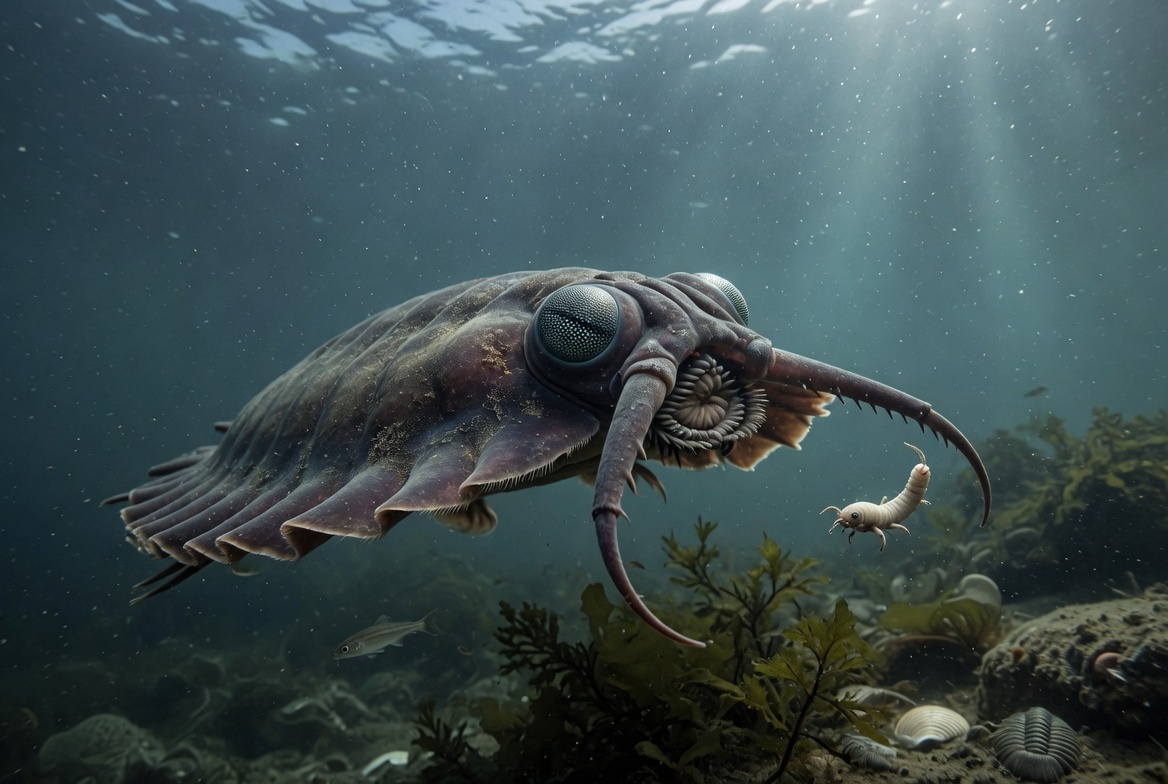
Imagine the sun-drenched, shallow waters of a Cambrian marine ecosystem more than 500 million years ago.
The water is not empty. It is crowded with life, movement, and danger. Somewhere inside that world, a realistic Anomalocaris glides through the blue-green water column, its lateral swimming flaps rippling in a smooth, wave-like motion while its two curved frontal appendages project forward, scanning for an interception.
The image feels exaggerated at first glance, almost like concept art designed for a monster film. But the core of the story comes from real fossils, real anatomy, and a scientific question that remains fascinating long after the dramatic headlines are stripped away.
The truth is more compelling: researchers are reconstructing a top predator from incomplete clues, proving that a deeper mechanical analysis often reveals an animal far more agile than the monsters of our imagination.
The history of Anomalocaris is one of the most unusual puzzles in paleontology. When its fossils were first discovered in the famous Burgess Shale of Canada, different parts of its body were so bizarre that researchers initially interpreted them as completely separate, unrelated animals.
Only decades later did scientists realize that these fragments belonged to a single, extraordinary animal. It became the definitive icon of the Cambrian Explosion—a period when animal life was experimenting with radical body plans that challenged modern biological expectations.
Trilobites are among the most recognizable animals of the Paleozoic Era. Because their heavily mineralized, segmented armor fossilizes beautifully, museum displays are filled with them—and many preserve distinct scars and healed puncture marks from ancient attacks.
For decades, Anomalocaris was the prime suspect. It was massive for its time (reaching up to 60 centimeters in length), carried intimidating grasping appendages, and possessed a circular mouth that looked like a mechanical crushing machine. The story practically wrote itself: Anomalocaris patrolled the seafloor, using its front claws to lift, crack, and grind through hard trilobite shells.
But a visually satisfying story is not automatically a mechanically convincing one.
A landmark 2023 study published in the Proceedings of the Royal Society B put this legacy image to the test. Researchers built precise three-dimensional models of the frontal appendages of Anomalocaris canadensis, analyzing stress, strain, flexibility, and how they moved through water.
The results completely re-evaluated the classic hunting scene:
Why did we get the story wrong for so long? The answer lies in preservation bias. Paleontology studies what remains, and hard shells, bones, and mineralized armor survive deep time far more easily than soft tissue.
The Cambrian sea was teeming with unarmored, soft-bodied creatures that left behind a much quieter record because their tissues decayed rapidly. A trilobite shell with a bite mark draws immediate human attention because it physically endured the fossilization process. A soft animal captured in open water disappears entirely.
By ranking prehistoric predators purely by brute force—the largest bite, the thickest tooth—we miss the evolutionary brilliance of speed, control, and precision. Anomalocaris did not need to act like a biological can opener because the ocean was already full of soft, vulnerable targets.
To understand Anomalocaris without falling into internet mythology, the line between hard evidence and inference must remain visible.
The Confirmed Facts
The Theory
While the physics of its appendages point away from trilobites, scientists cannot prove a definitive weekly menu, nor can they claim Anomalocaris never interacted with an armored animal. Its exact diet remains an ongoing ecological reconstruction based on morphological engineering.
The most important takeaway is simple: Anomalocaris remains one of the most striking predators from the Cambrian sea. Its frontal appendages appear better suited to a fast, flexible hunting style targeting softer prey.
The structural evidence confirms a body plan strange enough to stop people mid-scroll. The scientific interpretation adds the deeper layer: why that body evolved, how it navigated a primordial column of water, and which parts of its ancient life remain open to discovery.
This is real natural history.
Not supernatural horror.
Not fake proof.
Just a real piece of Earth’s past that feels completely impossible.