11
11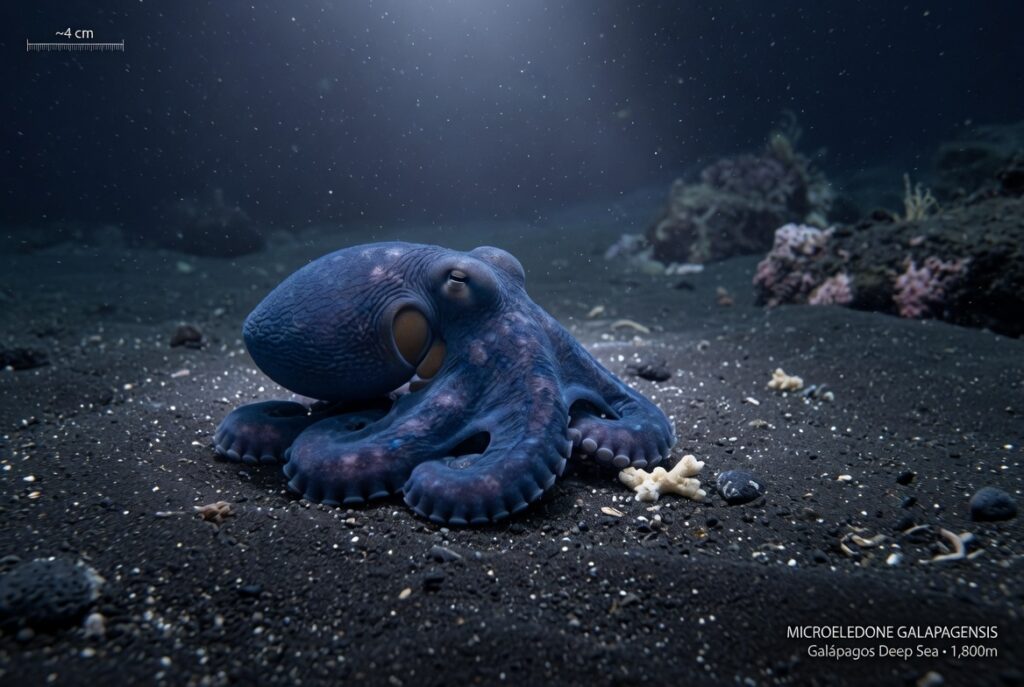
Deep under the Galápagos Islands, nearly 6,000 feet below the surface, scientists have confirmed a new species of octopus.
It is tiny. It is blue. And it looks like something from another planet.
The species is named Microeledone galapagensis. It is roughly the size of a golf ball, with a soft blue-purple body and short arms. The animal was first observed during a deep-sea expedition near Darwin Island, but it has now been officially described as a new species.
That is the part that matters. Seeing a strange animal on the seafloor is exciting. But formally identifying it means scientists have enough evidence to say this is not just a weird individual. It is a species science had not recognized before.
This discovery is not about a giant monster. It is about how even tiny animals can reveal massive gaps in what we know about the ocean.
The deep sea around the Galápagos is difficult to study. It is:
To observe animals there, researchers need submersibles, remotely operated vehicles (ROVs), cameras, and careful sampling. In this case, the specimen was so rare that scientists avoided cutting it apart. Instead, they used micro-CT scanning to study its internal anatomy without destroying it.
That is a very modern kind of discovery. Not the old-school image of scientists breaking open a specimen to see what is inside, but rather scanning a mystery object in 3D, preserving it while still extracting crucial details.
The blue-purple coloration is especially interesting. Some researchers suggest the color may help camouflage the octopus in deep water, especially if it eats bioluminescent prey. That idea is plausible, but it should be treated carefully. Color in deep-sea animals can serve different functions, and scientists may need more specimens or live observations to fully understand it.
There is also a bigger mystery: how many similar animals are still unknown? This octopus came from a deep, difficult-to-access environment. The lack of previous records does not necessarily mean the animal is extremely rare in nature. It may simply be rarely seen by humans. The deep ocean is full of things we do not know because we barely go there.
The Galápagos Islands are already famous for evolution. Most people connect them with Charles Darwin, finches, tortoises, and volcanic islands. But beneath the water, the story continues in a much darker and stranger direction.
The deep-sea Galápagos environment is not the sunny wildlife paradise tourists imagine. It is a cold, pressurized world where animals survive in ways we are still learning to understand. Finding a new octopus there reinforces the idea that the Galápagos is not just a museum of evolution above water. It is still producing scientific surprises below water.
Stories do not always need giant jaws. Sometimes the weirdest discovery is a creature that fits in your palm.
Microeledone galapagensis looks almost cute. But scientifically, it represents something much bigger: the deep sea is still underexplored enough that a tiny blue octopus can remain unknown until now. That is wild. Not because it proves anything supernatural, but because it proves the real ocean is still far from fully mapped.
The new Galápagos blue octopus is small, but the discovery is huge. It reminds us that Earth still has hidden species in places humans barely reach. Some are giant. Some are terrifying. Some are tiny, blue, and strangely beautiful.
And all of them make the ocean feel less familiar than we think.