11
11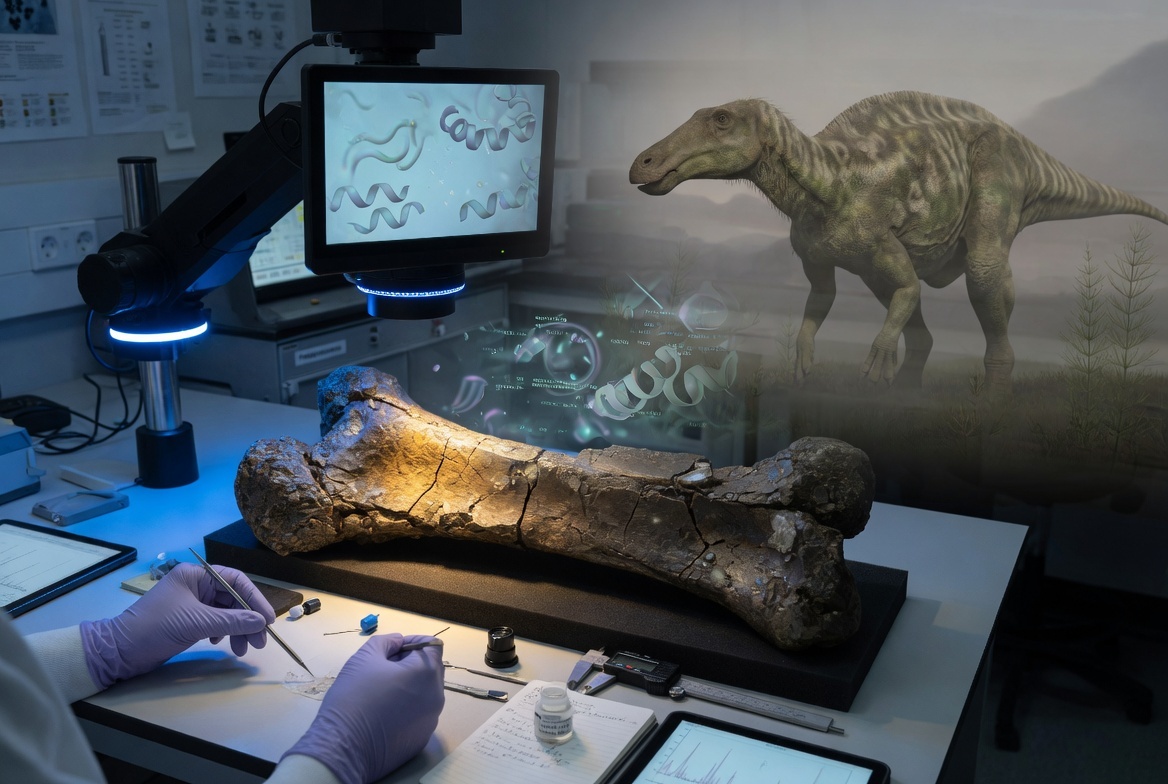
For decades, many scientists assumed dinosaur fossils were basically stone. The original biological material was thought to be gone, replaced by minerals over millions of years. But new research is challenging that simple picture.
Scientists studying a 66-million-year-old Edmontosaurus fossil report evidence that traces of original organic molecules may still survive inside dinosaur bone. That does not mean dinosaur DNA. That does not mean cloning. But it does mean something seriously interesting may be preserved far longer than many people expected.
The study focused on fossil bone from Edmontosaurus, a duck-billed dinosaur from the end of the Cretaceous Period.
Researchers used multiple methods, including microscopy, chemical analysis, and protein sequencing, to look for signs of original collagen. Collagen is a structural protein found in bones and connective tissue.
The important part is not just “they found a signal.” It is that the researchers used several independent methods to reduce the risk of contamination or misinterpretation. That makes the claim more serious. Ancient organic molecules are controversial because contamination is always a concern. Modern proteins, bacteria, handling, or environmental material can confuse results. So the stronger the testing approach, the better.
This is where the internet can get messy.
Organic molecules are not the same as recoverable dinosaur DNA. DNA breaks down much faster than some proteins. There is currently no credible evidence that complete dinosaur DNA survives from the Mesozoic in a usable way. So no, this does not mean scientists are about to bring back dinosaurs.
The real story is more subtle. Some molecular fragments may survive inside fossils under certain conditions, and that could help scientists study ancient biology in ways that were once considered unlikely.
If original proteins can survive in some dinosaur fossils, paleontology changes.
Researchers may be able to learn more about dinosaur biology, evolutionary relationships, preservation chemistry, and how fossilization works at the molecular level. This could also reshape how museums and field teams handle certain fossils. A bone might not just preserve shape. It might preserve chemical traces of the animal itself.
That is wild. Not sci-fi wild. Real science wild.
This field is still debated, and that is healthy.
Extraordinary preservation claims need strong evidence. Scientists will want replication, comparison, and careful contamination control. That does not make the discovery fake. It means this is exactly the kind of claim science needs to test hard.
The mystery is not “can we clone dinosaurs?” The better mystery is: how much of an extinct animal can survive inside stone?
The new Edmontosaurus research suggests dinosaur bones may preserve more than shape. They may hold chemical traces from the original animal.
No cloning. No movie science. Just a fossil quietly carrying biological whispers across 66 million years.