11
11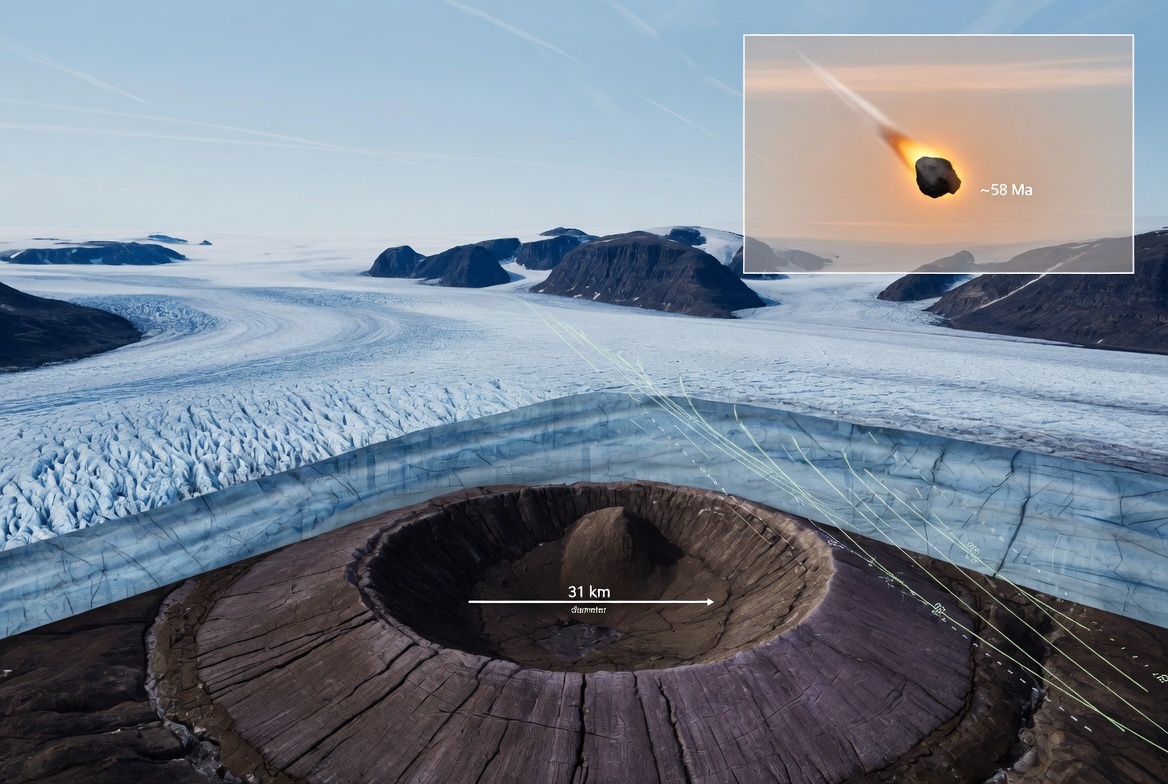
Greenland’s ice sheet looks quiet from above. Vast white surfaces stretch toward the horizon, and glaciers flow slowly through valleys. Wind moves across a landscape that appears empty.
But ice can hide geology.
Beneath Hiawatha Glacier in northwestern Greenland, researchers identified a circular depression approximately 31 kilometers wide. The structure had the shape expected from a large impact crater, lying buried beneath roughly a kilometer of ice.
When the discovery became public in 2018, the crater immediately attracted attention:
Early uncertainty allowed dramatic possibilities to spread. Then researchers dated material associated with the crater, and the answer shifted the story completely.
The impact occurred around 58 million years ago. That places it only a few million years after the asteroid impact associated with the extinction of the non-avian dinosaurs, but long before humans appeared.
The crater could not be identified simply by walking across the glacier. Ice covered the landscape, so researchers relied on radar data and geological evidence.
Radar systems mounted on aircraft can send signals through ice and record reflections from the bedrock below. These returning signals reveal hidden topography. Under Hiawatha Glacier, the data showed a large circular structure where the rim was clearly visible, and the bed beneath the ice carried a pattern consistent with an impact crater.
Meltwater flowing from beneath the glacier also carried sediment that researchers could analyze. This is one of the most powerful aspects of modern Earth science: scientists can map buried landscapes without drilling through every meter of ice. A frozen surface becomes transparent to the right instruments.
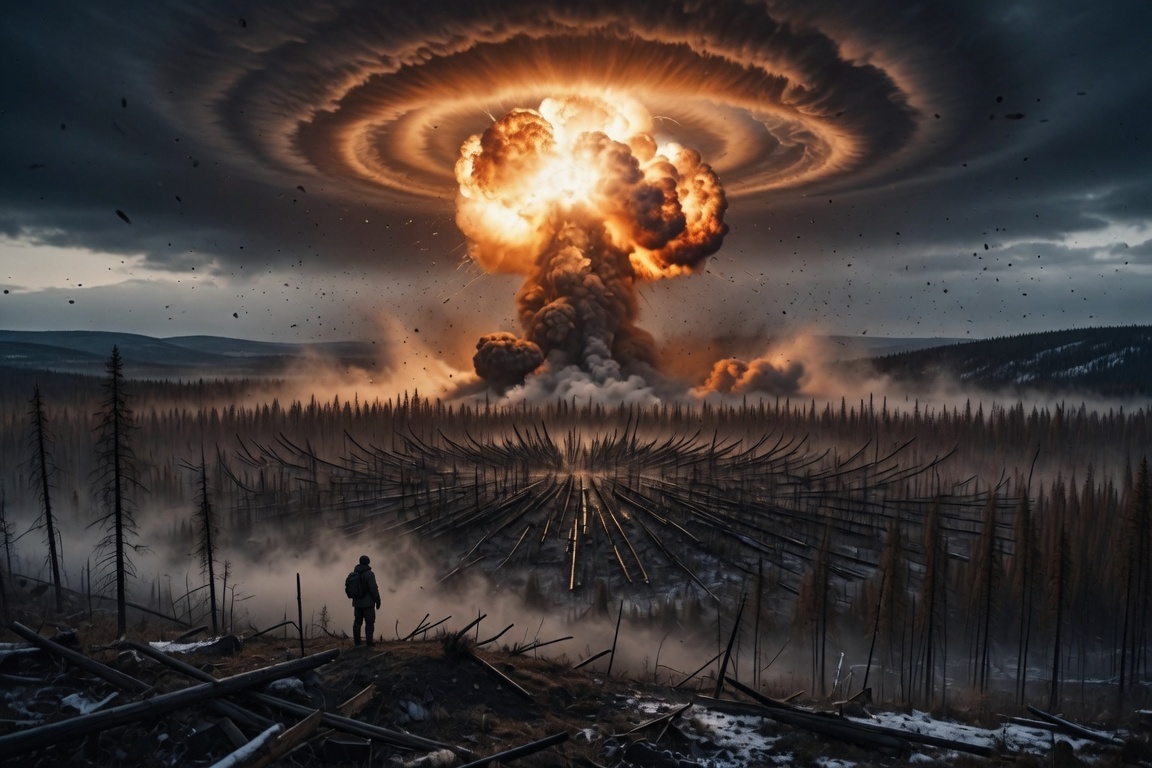
Impact craters carry immediate visual power. They are scars left by collisions with asteroids or comets. Large impacts can release immense energy, reshape landscapes, and affect ecosystems.
The Hiawatha structure was especially intriguing because it was large and hidden. A 31-kilometer crater beneath ice sounded like a secret chapter of Earth history.
At first, the age remained uncertain. Some discussion connected the crater with the Younger Dryas, a cold period that began around 12,900 years ago. The timing would have placed the impact near the age of humans and fueled broader debates about abrupt climate change.
But an interesting possibility is not the same as a dated event. Researchers needed physical evidence.
Dating an impact crater buried beneath ice is difficult. Scientists cannot simply stand on exposed crater rock and collect samples from every feature because the glacier limits access. Meltwater and erosion move sediment, meaning researchers must identify grains that genuinely record the impact event.
A 2022 Science Advances study used two different dating approaches:
The results converged. The researchers interpreted the impact age as approximately 58 million years. Agreement between independent methods matters; it makes the conclusion stronger than a single isolated measurement. The crater was not a recent scar from human prehistory—it belonged to the Paleocene Epoch.
The Hiawatha impact happened around eight million years after the Chicxulub impact associated with the end-Cretaceous mass extinction.
Earth had already changed:
Greenland itself looked different from the frozen landscape people recognize today. The impact should not be imagined as an asteroid crashing into the modern ice sheet exactly as it appears now. Over tens of millions of years, climate, erosion, tectonics, and glacial activity transformed the region. The crater survived beneath later ice, turning it into a hidden record of a much older planet.
No evidence supports that claim.
The crater is large and scientifically important, but it is much smaller than Chicxulub. Chicxulub measures roughly 180 kilometers across and is linked with global consequences at the end of the Cretaceous Period. Hiawatha, by comparison, is approximately 31 kilometers wide.
A collision capable of producing the Hiawatha crater would still be a major regional event that could devastate a wide area. However, the available evidence does not place it in the same category as the dinosaur-killing impact, and it occurred millions of years later. Comparisons can help people understand scale, but they should not erase the differences.
The structure is interpreted as an impact crater caused by an asteroid or similar cosmic body striking Earth.
The impact generated shock pressures strong enough to alter minerals. Shocked zircon grains preserve evidence of that event, while intense heat reset the geological clocks inside other grains. The crater shape, radar data, and mineral evidence all align. Scientists are not relying on a visual circle alone; multiple forms of evidence support the impact explanation.
Ice is an effective cover. Greenland’s ice sheet conceals mountains, valleys, sediments, and bedrock structures. A crater can sit beneath a glacier without leaving an obvious circular shape on the surface because the glacier flows, snow accumulates, and erosion continually modifies the landscape.
Researchers need high-quality geophysical data to identify patterns beneath the ice. The crater remained hidden not because anyone concealed it, but because the environment did. This distinction matters: Earth still contains large geological features that modern science is only beginning to map clearly.
The Younger Dryas is a well-known interval of abrupt cooling near the end of the last ice age. Some researchers and online communities have proposed impact-related explanations for aspects of that climate event. When Hiawatha crater was announced, its unknown age made it tempting to connect the two stories.
Later dating broke that connection. The crater formed around 58 million years ago, not around 13,000 years ago.
This is a useful example of how science handles uncertainty. Researchers did not need to pretend the early possibility never existed; instead, they tested the timeline, and the dates ruled it out. A mystery became more accurate.
Dating the crater solved one major question, but others remain. Researchers continue to study:
The crater also raises a broader question: How many structures remain hidden beneath ice sheets elsewhere? Antarctica contains vast buried landscapes, and Greenland still holds secrets. Radar surveys and new instruments may reveal features completely invisible from the surface.
Hiawatha became less connected with human prehistory after the 2022 dating study, but that did not make the crater less fascinating. It made the story stronger.
The crater is a confirmed impact structure from a world recovering after the age of dinosaurs. It survived for tens of millions of years before later ice buried it, and modern radar brought it back into view. The corrected timeline transforms Hiawatha from a speculative recent catastrophe into a hidden geological archive.
Impact craters preserve a sequence of violence and recovery. An incoming body strikes at extreme speed, pressure waves move through rock, and minerals fracture. Some grains are shocked into new internal structures, while heat alters geological clocks. Material is displaced, melted, or thrown outward.
Then the long recovery begins:
By the time scientists identify a crater millions of years later, they are reading a heavily edited record. Hiawatha is compelling because the ice both concealed and preserved part of that record.
Greenland is not a simple block of ice. Beneath the surface lies a complex landscape of bedrock, valleys, sediments, and ancient geological structures. Radar surveys reveal that hidden world gradually.
Each discovery improves more than one story. It helps researchers understand glacial flow, erosion, past climates, and the history of the land beneath the ice.
Hiawatha crater is dramatic because of its size, but it also symbolizes a broader shift in Earth science. Instruments now allow researchers to study landscapes that cannot be seen directly. The surface is no longer the limit; ice, ocean, forest, and sediment can all hide geological archives waiting for the right technology.
Hiawatha crater is a reminder that Earth can hide enormous stories beneath apparently quiet landscapes. The glacier looked ordinary from above, but radar revealed a 31-kilometer scar below.
Early uncertainty allowed people to imagine a collision during the age of humans, but careful dating changed the answer. The impact happened around 58 million years ago, moving the mystery deeper into Earth history.
A giant crater survived beneath Greenland’s ice for millions of years, waiting for technology capable of seeing through the frozen surface.