11
11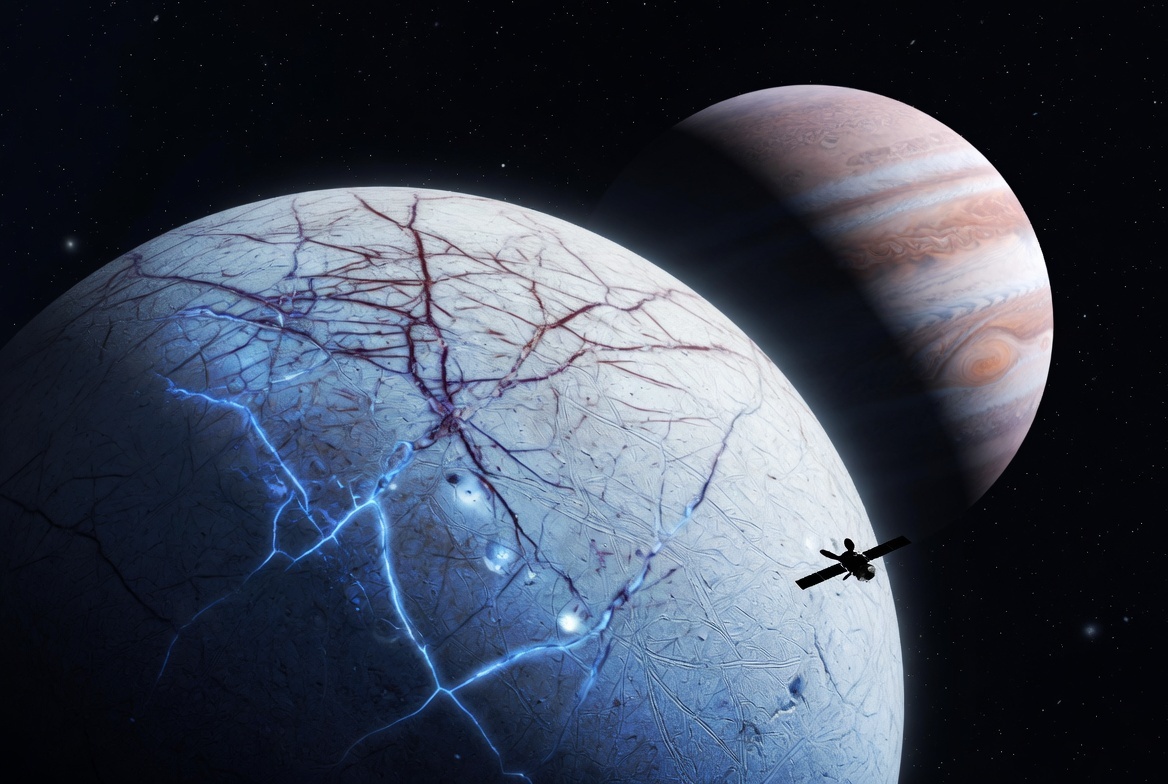
At first glance, Europa looks dead. A frozen moon orbiting Jupiter:
But beneath that icy surface, scientists believe there may be a global ocean.
That single possibility turns Europa into one of the most important places in the search for life beyond Earth.
Not because aliens have been found there. They have not.
Not because NASA has confirmed life. It has not.
Europa matters because it may have some of the ingredients needed for habitability: liquid water, chemistry, and energy.
That is enough to make scientists look twice.
Europa is one of Jupiter’s large moons. Its surface is covered in ice, marked by long cracks and ridges. These features suggest the icy shell has been stressed, moved, and reshaped over time.
The leading scientific idea is that beneath the ice may be a salty ocean.
This ocean could exist because Europa is pulled and squeezed by Jupiter’s gravity and the gravity of nearby moons. That tidal flexing may generate heat inside Europa, helping keep water liquid below the frozen crust.
This is not science fiction.
It is planetary science.
But the details are still uncertain:
These are the questions that matter.
On Earth, wherever there is liquid water, life often finds a way.
That does not mean water automatically creates life. That is a common overstatement. But water is one of the key requirements for life as we know it.
That is why Europa is so interesting. If it has a global ocean, it could hold more liquid water than Earth’s oceans combined, depending on model estimates.
But habitability needs more than water:
This is where Europa becomes both exciting and uncertain.
One theory suggests Europa’s ocean may interact with a rocky seafloor. If that interaction includes chemical reactions similar to those around Earth’s hydrothermal vents, it could create an environment where microbial life might survive.
But this is not confirmed.
Some studies question how active Europa’s seafloor is today. If the rocky interior is too inactive, the ocean may lack enough chemical energy to support life.
That does not kill the mystery. It sharpens it.
Europa might be habitable.
Or it might be an ocean world missing one crucial ingredient.
Science does not know yet.
NASA’s Europa Clipper mission was designed to investigate whether Europa has conditions suitable for life. The spacecraft will not land or drill through the ice. Instead, it will perform repeated flybys, studying Europa with instruments designed to analyze its surface, ice shell, composition, and environment.
This is important because Europa’s surface may contain clues from below.
If material from the ocean or ice shell reaches the surface through cracks or other processes, spacecraft instruments may be able to detect chemistry linked to habitability.
But again, habitability is not the same as life. This mission is not expected to photograph fish under the ice.
It is searching for conditions.
That distinction matters.
Europa is frightening in a quiet way. There are no monsters on the surface. No ruins. No confirmed life.
Just a frozen shell wrapped around a possible ocean in the dark gravity field of Jupiter.
That image is powerful because it flips the usual idea of where life might exist:
If life could exist there, even as microbes, it would expand our idea of biology dramatically. It would suggest that life might not need Earth-like surfaces.
It might only need the right hidden environment.
Europa is not proof of alien life. It is something better for science: a testable mystery.
Scientists have real questions, real instruments, and a real mission designed to investigate them. The most honest answer right now is this:
That uncertainty is the hook. Some mysteries are interesting because they are wild.
Europa is interesting because it is possible.
And if the answer ever comes back yes, even in microbial form, it would change humanity’s place in the universe.
References: