11
11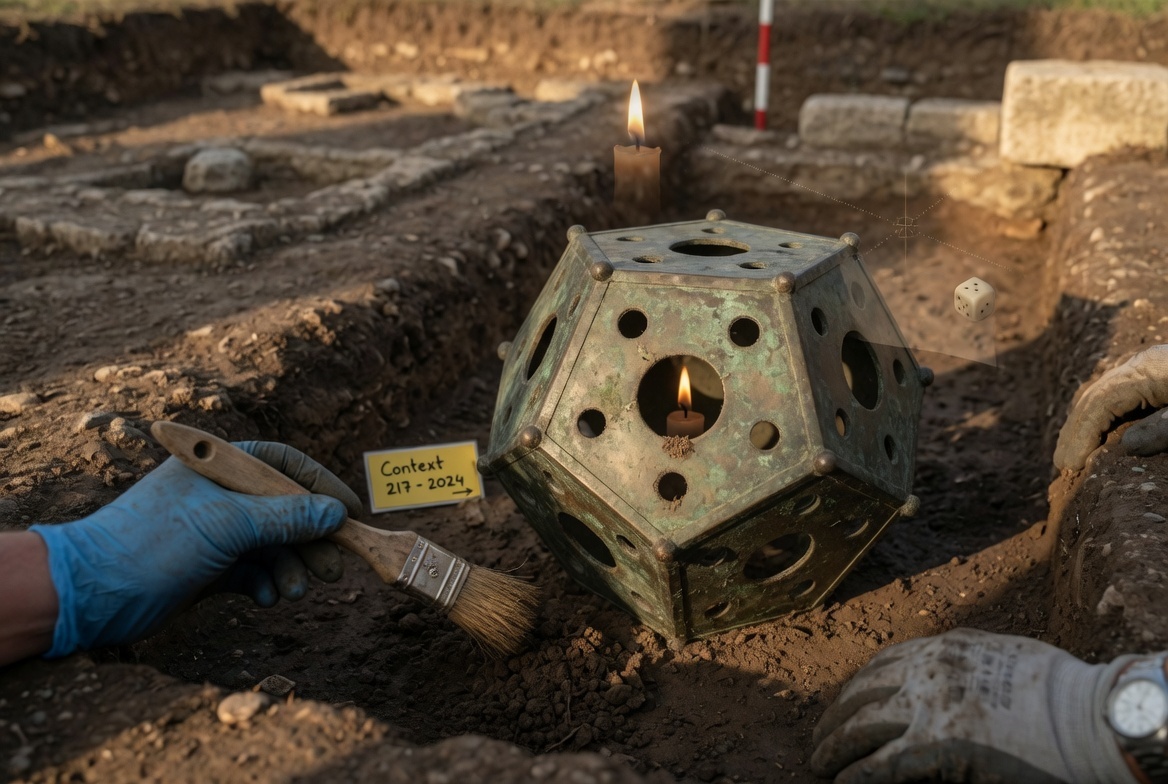
Archaeologists regularly recover ancient objects whose purpose is clear. Coins carried value and imagery. Lamps held oil. Pottery stored food, drink, or household goods. Weapons show wear, and tools fit the human hand.
But Roman dodecahedrons are completely different.
These small, hollow metal objects have 12 pentagonal faces. Each face contains a circular opening, and the holes vary in size. Small rounded knobs sit at the corners. The craftsmanship is deliberate, and the shape is memorable.
The purpose, however, is not.
Across parts of northwestern Europe, archaeologists have discovered approximately 130 examples, according to the Hunt Museum. Yet, no surviving Roman text clearly explains what the objects were for. No confirmed ancient illustration shows someone using one, and no single theory has closed the case.
The Romans left behind a carefully made object and almost no instructions.
A dodecahedron is a geometric solid with 12 faces. Roman examples are usually hollow and made from copper alloy or bronze.
Each face is pentagonal, featuring a circular hole in the middle. Diametrically opposite holes often differ in size. Small knobs project from the vertices, giving the artifact an unusually tactile and complex appearance.
The objects vary and are not identical, mass-produced components:
The overall design feels highly functional. But that impression can be misleading; an object can look engineered without serving one standardized practical task.
Roman dodecahedrons have been recovered across areas that once formed northwestern provinces of the Roman Empire. Examples have been found in places including England, Wales, the Netherlands, France, Belgium, and Germany.
They are not evenly distributed across the entire Roman world.
That regional pattern matters. If the object served a universal Roman household purpose, researchers might expect examples across a much broader geographic range. Instead, the artifacts cluster in particular regions.
This opens multiple possibilities. They could relate to local practices, frontier communities, military life, ritual traditions, or regional identities within the empire. None of these explanations is confirmed—the distribution simply provides a clue.
One particularly important dodecahedron was discovered during an archaeological excavation near Norton Disney in Lincolnshire, England, in summer 2023.
The find drew massive attention because it was complete and remarkably well preserved. Lincolnshire County Council described it as a hollow copper-alloy 12-sided object thought to date from the third or fourth century. It measured around eight centimeters tall and weighed 245 grams.
The artifact had survived approximately 1,700 years underground. Most importantly, it was recovered through a controlled archaeological dig rather than as an isolated object found by chance.
🔍 Why Context Matters: Archaeology is not only about the object. It is about where the object was found, what surrounded it, and how it related to the site.
The Norton Disney excavation offered a rare chance to study a dodecahedron in a more meaningful setting, though the core mystery remained.
Some researchers have suggested that Roman dodecahedrons functioned as measuring or surveying tools.
The Hunt Museum notes that holes on opposite faces are proportionally related, making it possible to look through aligned openings and potentially determine ratios connected with a distant object.
This theory is visually convincing. If you hold the artifact at eye level and look through two holes, the dodecahedron strongly resembles a sighting instrument.
However, problems remain. Dodecahedrons vary in size and do not carry standardized numbers or clear measurement markings. If they were precision instruments used for the same calculations, researchers would expect strict standardization. The measuring-tool theory remains plausible for some scholars, but it is not universally accepted.
Wax residue has been reported in at least one discovered example. That raises a very straightforward, practical possibility: Could the object simply hold a candle?
The holes would allow light to pass through, the bronze shape could create patterned illumination, and the knobs might lift the hot metal safely away from a surface.
This theory is easy to imagine. Yet, a single use does not necessarily explain the entire class of objects. Wax could indicate a ritual use, later reuse, or one specific function among several. An ancient object can live more than one life—the presence of wax is a fascinating clue, but it is not a universal instruction manual.
Ritual explanations have gained major attention because practical theories struggle to explain the variation and lack of physical wear.
Lincolnshire County Council stated that the Norton Disney dodecahedron showed remarkable preservation and that scientific evidence suggested the objects may not have been ordinary practical items, but could have been connected with Roman rituals or religious practice.
This remains an interpretation. The Romans did not leave a surviving caption saying, “This is a ritual object.”
However, symbolic use could explain why the dodecahedron’s geometry mattered more than standardization. A 12-sided form carries visual power. It looks deliberate, balanced, and unusual. Classical traditions also attached deep meaning to geometric forms. The artifact may have communicated identity, belief, ceremony, or status. The challenge is proving which interpretation is correct.
Other proposals include gaming pieces, knitting aids, glove-making tools, calendar devices, and objects used to size or shape other materials.
Some experimental reconstructions show that it is entirely possible to use a replica for these practical tasks. But possible is not the same as proven.
A modern person can invent many uses for a hollow object with holes and knobs. The archaeological question is narrower: What did the Romans actually intend?
To answer that, researchers need context, wear patterns, comparable objects, written descriptions, or consistent evidence across discoveries. The dodecahedrons refuse to provide a clean answer.
The absence of texts is one of the strangest parts of the story. Roman writers meticulously documented military campaigns, engineering, religion, trade, politics, and daily life. Yet, no surviving classical source clearly identifies the dodecahedron.
That silence may have several explanations:
Each answer creates more speculation, but none has been confirmed.
Archaeology becomes immensely difficult when an object lacks context. Many dodecahedrons were discovered before modern excavation methods became standard. Some arrived through chance finds, and others were removed from soil without a detailed record of nearby materials. That weakens any interpretation.
A sword found on a battlefield, in a grave, or in a river tells completely different stories. A dodecahedron found alone tells very little.
This is why the Norton Disney example matters. It was recovered carefully. Researchers can return to the site and ask better questions:
One good archaeological context may be more valuable than several isolated artifacts.
The object does not need a sensational explanation. There is no credible evidence that Roman dodecahedrons were alien technology, supernatural artifacts, or impossible machines.
They were human-made copper-alloy objects produced within the Roman world or regions influenced by it. The mystery is historical, not paranormal.
That is why it works. A civilization can leave behind ordinary-looking technologies whose meaning completely disappears when traditions, users, and instructions vanish. The object becomes strange simply because the human context is missing.
The dodecahedron mystery is a useful reminder that archaeology does not always deliver a neat conclusion. Researchers can compare dimensions, analyze alloys, examine residue, study distribution maps, and return to excavation sites. Even after all that work, the most honest answer may remain uncertain.
That restraint matters. A confident but unsupported explanation can become popular simply because it is easy to visualize:
None has yet explained every example. The surviving evidence allows theories, but it does not yet allow certainty.
Roman dodecahedrons are powerful because they turn a simple object into a genuine mystery. We can hold the shape, measure the holes, analyze the metal, and map where examples were found—but we cannot ask the original owner what it meant.
The Romans created these objects carefully enough that they clearly mattered. Then, the explanation disappeared.
The mystery is not that ancient people built something impossible. The mystery is that an object can survive for 1,700 years while its purpose vanishes completely.