11
11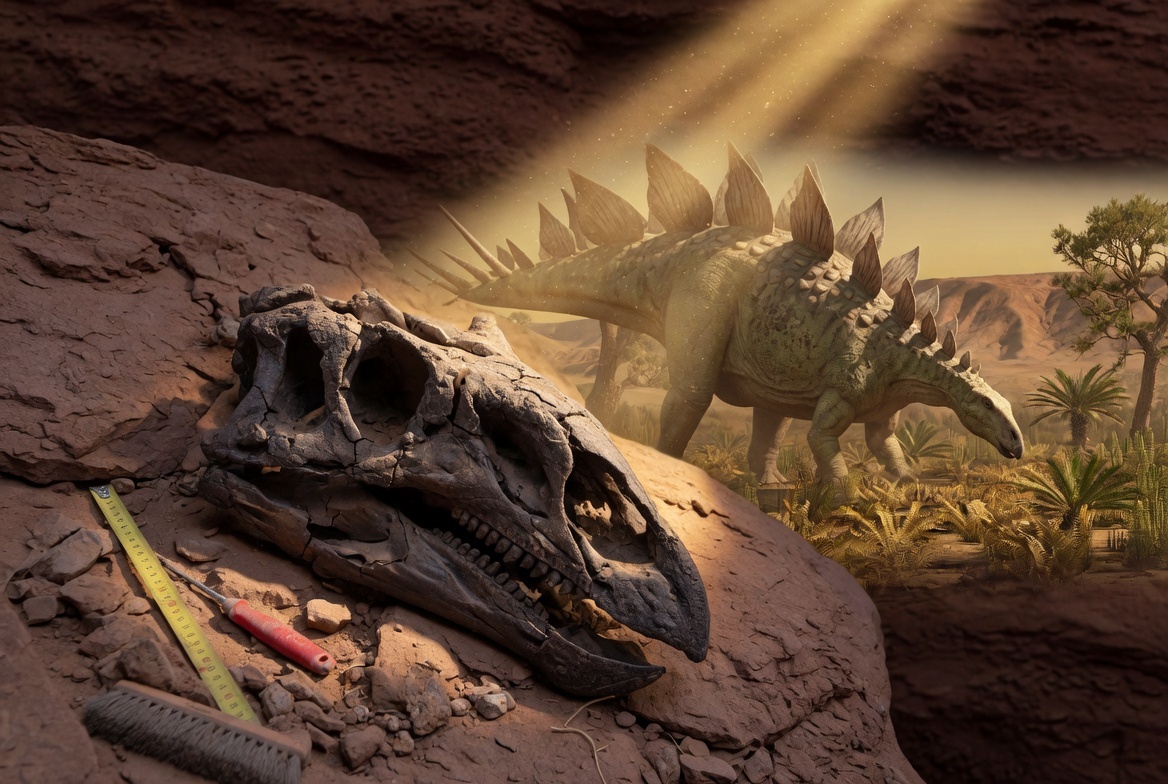
Stegosaurs are famous because of their plates. But their skulls? That is where the mystery gets deeper.
Paleontologists in Spain have uncovered what researchers describe as the best-preserved stegosaur skull ever found in Europe. The fossil belongs to Dacentrurus armatus, a plated dinosaur that lived around 150 million years ago during the Late Jurassic.
This matters because stegosaur skulls are extremely rare. These dinosaurs had relatively small, delicate heads compared with their heavy armored bodies. After death, skull bones could be crushed, scattered, or destroyed before fossilization. That means scientists often reconstruct stegosaurs from plates, limbs, vertebrae, and armor, while the head remains poorly understood.
This new skull gives researchers something they rarely get: a clearer look at the face of one of Europe’s iconic Jurassic dinosaurs.
Dacentrurus armatus was first named in the 19th century, but for much of its history, scientists had to work with incomplete fossils.
That is a problem. When a dinosaur is known from scattered remains, it can become a kind of scientific shadow. Researchers know it existed, but many details stay uncertain. How did its skull compare with other stegosaurs? What did its jaw anatomy suggest about feeding? How did European stegosaurs fit into the wider stegosaur family tree?
A better skull helps answer those questions. The Spanish fossil gives paleontologists new anatomical details, especially about the skull structure and how Dacentrurus relates to other plated dinosaurs.
The bigger interpretation is evolutionary.
Because stegosaur skulls are so rare, one good skull can shift how scientists classify relationships between species. Researchers are using the fossil to better understand how European stegosaurs evolved and how they connect to better-known stegosaurs from other parts of the world.
That does not mean one skull solves everything. But it is a big upgrade. It gives scientists a stronger anatomical anchor for a dinosaur group that is famous visually but still full of gaps.
This discovery is not about the biggest dinosaur. It is about a missing piece.
Stegosaurs are some of the most recognizable dinosaurs on Earth, yet their faces are still weirdly under-known. That is the kind of contradiction EdgeCase loves: a famous animal with a hidden identity.
The plates made stegosaurs iconic. The skull may explain how they actually lived.
A rare skull from Spain is giving scientists one of the clearest looks yet at a European stegosaur.
The discovery does not turn Dacentrurus into a new movie monster. It does something better. It makes a familiar dinosaur stranger, sharper, and more real.