11
11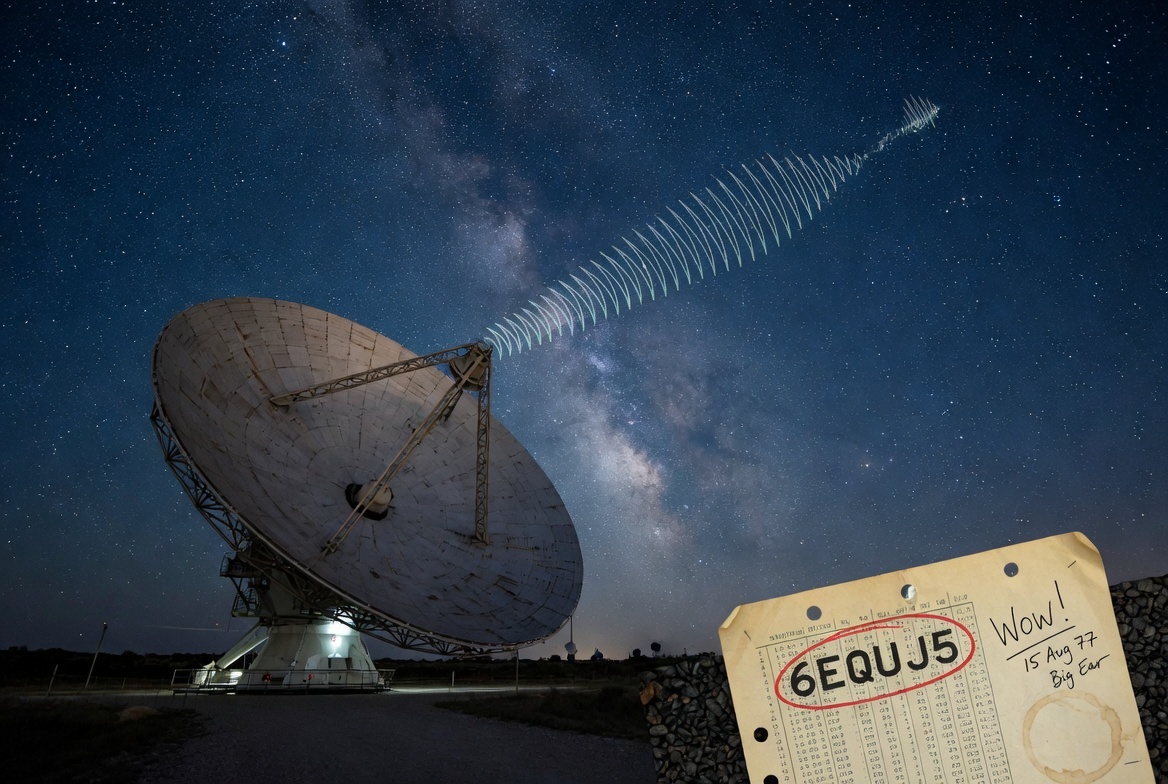
On August 15, 1977, a radio telescope in Ohio detected something unusual.
The telescope was called Big Ear.
It was being used to support the search for extraterrestrial intelligence, commonly known as SETI.
The signal did not arrive with a voice.
It did not contain a decoded message.
It did not repeat a sequence of numbers that obviously revealed an intelligent source.
Instead, it appeared as a strong narrowband radio signal inside a stream of recorded data.
A few days later, astronomer Jerry Ehman reviewed the printout.
He saw an unusually intense sequence.
He circled it.
Beside the code, he wrote one word:
“Wow!”
The name remained.
The famous sequence associated with the Wow! Signal is 6EQUJ5.
It is often misunderstood.
The characters were not an alien message.
They represented the changing intensity of the received radio signal over time.
As the telescope observed the source region, the signal increased in strength and then decreased.
The sequence reflected that rise and fall.
The entire event lasted 72 seconds, matching the window during which the Big Ear telescope could observe a particular point in the sky as Earth rotated.
That detail helped make the signal interesting.
Its pattern was consistent with a source moving through the telescope’s beam in a way expected from a fixed location in the sky.
But consistency is not proof.
A strange signal can fit several explanations.
The Wow! Signal appeared near the frequency associated with neutral hydrogen.
Hydrogen is the most abundant element in the universe.
Because of that, astronomers interested in the search for extraterrestrial intelligence have often considered the hydrogen line an appealing region of the radio spectrum to monitor.
The logic is understandable.
A technologically advanced civilisation seeking a recognisable frequency might choose a part of the spectrum connected with a fundamental feature of the universe.
But nature also produces hydrogen-related signals.
That creates a problem.
A signal near an interesting frequency is worth investigating.
It is not automatic evidence of intelligence.
The signal never returned in the same clear form.
Astronomers conducted follow-up searches.
Researchers examined the region again.
Other telescopes looked for possible repeats.
Nothing provided a confirmed recurrence matching the original event.
That absence is central to the mystery.
A repeating source is easier to study.
Scientists can point instruments toward it, gather more data, test explanations, and compare results.
A one-time signal is much harder.
It leaves a trail of questions without enough evidence to answer them cleanly.
Was it a rare natural event?
A form of interference?
A reflection?
An instrumental issue?
A signal from a technological source that never repeated while scientists were listening?
The honest answer is that no explanation has been confirmed completely.
The Wow! Signal became famous because it looked interesting, not because it passed every standard required for proof of extraterrestrial intelligence.
Extraordinary claims require confirmation.
A signal needs to repeat or provide enough evidence for researchers to exclude ordinary explanations.
The Wow! Signal did not meet that threshold.
No verified alien civilisation was detected.
No spacecraft was identified.
No message was decoded.
No second signal confirmed the source.
The event remains a mystery because it was unusual and difficult to explain, not because scientists proved that aliens contacted Earth.
That distinction matters.
The scientific uncertainty is the real story.
Over the decades, researchers have proposed several possible explanations.
Some suggestions focused on human-made interference or reflections.
Others explored astronomical sources.
In 2024, researchers working with archived observations from the Arecibo Observatory proposed a natural astrophysical explanation involving small cold clouds of neutral hydrogen.
Their hypothesis suggested that a transient energetic event, such as a magnetar flare or another intense source, may have triggered a sudden brightening of hydrogen emission.
In simple terms, the Wow! Signal may have been an unusual natural radio flare.
That interpretation is intriguing because it attempts to explain why the signal appeared powerful, narrowband, and difficult to detect again.
But it remains a hypothesis.
It has not transformed the mystery into a closed case.
A later preprint released in 2025 revisited archival Ohio SETI data and proposed revised properties for the Wow! Signal.
The researchers narrowed the possible source regions and argued that the event may have been more consistent with an astrophysical origin than with ordinary radio interference.
This is useful work.
It may point future observations toward better locations.
It may help scientists compare the Wow! Signal with other narrowband events.
It may strengthen the case for a natural explanation.
However, the analysis remains part of an evolving scientific discussion.
The signal has not been reproduced.
The original event cannot be re-recorded.
Scientists are still working backward from limited historical data.
Humans are naturally drawn to rare events.
A signal appears once.
It looks strange.
It arrives from the sky.
It occurs during a search for extraterrestrial intelligence.
The temptation is obvious.
But unusual does not mean artificial.
Astronomy is filled with signals that initially look mysterious.
Pulsars were once so strange that researchers briefly considered the possibility of extraterrestrial intelligence before identifying them as rapidly rotating neutron stars.
Fast radio bursts puzzled astronomers for years and remain an active research area, although scientists have connected at least some events with highly magnetised neutron stars.
Nature can generate radio phenomena that look dramatic, precise, and unexpected.
The Wow! Signal sits inside that broader lesson.
The universe does not need aliens to produce something astonishing.
Big Ear itself no longer exists.
The telescope operated for years in Ohio and contributed to SETI observations.
It was later dismantled.
The physical location associated with one of the most famous possible technosignature signals in history disappeared.
That adds a strange layer to the story.
The signal was brief.
The telescope is gone.
The source remains uncertain.
The evidence survives largely through records, printouts, and archival analysis.
It feels like a scientific cold case.
Scientists cannot prove that the signal came from extraterrestrial technology.
They also cannot simply replay the event and test every possibility.
An artificial origin has not been confirmed.
A natural origin has not been demonstrated beyond doubt.
The responsible answer is uncertainty.
The Wow! Signal remains interesting because it occupied a narrow space between ordinary interference and confirmed discovery.
It was strong enough to become famous.
It was brief enough to remain elusive.
It was never repeated clearly enough to settle the argument.
The search for extraterrestrial intelligence is not only about dramatic discoveries.
It is also about learning how to identify false positives.
Researchers need to understand unusual natural events, human-made interference, satellites, reflections, instrumental behaviour, and rare astrophysical sources.
A false alarm can still be scientifically valuable.
If the Wow! Signal came from an unusual hydrogen-related flare, it may reveal an astrophysical process worth studying.
If it came from interference, understanding the cause can improve future searches.
If its origin remains unresolved, it becomes a reminder of how difficult confirmation really is.
The signal does not need to prove alien life to matter.
Online discussions often push the story too far.
Some posts describe the Wow! Signal as the best proof of alien contact.
Others dismiss it casually as a solved case.
Neither position reflects the evidence accurately.
The signal remains unexplained in the strict sense that no single origin has been confirmed beyond reasonable doubt.
Natural explanations are plausible.
New research may move the balance toward an astrophysical explanation.
But the mystery has not vanished.
The careful phrasing is important.
There is a difference between “scientists found a possible explanation” and “scientists solved the Wow! Signal.”
The first statement is fair.
The second is premature.
The Wow! Signal was a real narrowband radio event detected by the Big Ear telescope in Ohio on August 15, 1977.
It lasted 72 seconds and appeared near a scientifically interesting radio frequency associated with hydrogen.
It never returned in a confirmed repeat observation.
Researchers have proposed several possible explanations, including newer hypotheses involving natural astrophysical events and cold hydrogen clouds.
No confirmed evidence proves that the signal came from extraterrestrial intelligence.
No final explanation has closed the case completely.
Almost five decades later, the most honest answer remains the most compelling one.
Something unusual appeared in the data.
Scientists are still trying to understand what it was.
References: