11
11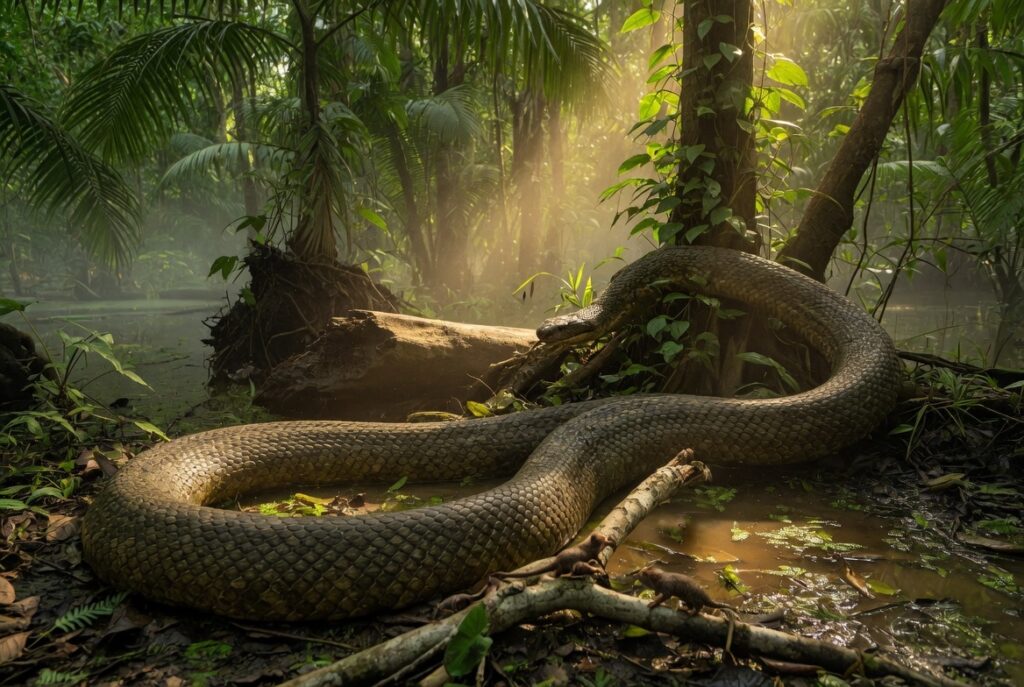
A newly highlighted fossil snake from India has one of the most mythic names in paleontology: Vasuki indicus.
Vasuki is named after a serpent figure from Indian mythology. But the animal itself is not mythological. It was real.
Scientists estimate that Vasuki indicus may have reached around 11 to 15 meters long, or roughly 36 to 49 feet. That would place it among the largest snakes ever known. For scale, that is longer than many buses. And unlike a monster movie creature, this estimate comes from fossil vertebrae, not imagination.
Vasuki indicus lived about 47 million years ago during the Eocene.
Its fossils come from Gujarat, India, in rocks linked to a warm ancient environment. The Eocene was a greenhouse world compared with today. Global temperatures were higher, and many regions supported lush ecosystems.
That matters because giant snakes are closely tied to climate. Modern snakes rely on external heat. Warmer conditions can support larger body sizes, although size also depends on food, habitat, evolution, and competition. Vasuki was part of the extinct madtsoiid snake family, a group that survived for a very long time across parts of the ancient world.
This is where the story gets spicy.
Titanoboa, from ancient South America, is often called the largest snake ever discovered. It may have reached around 13 meters or more, with some estimates around 42 feet. Vasuki’s estimated range overlaps with Titanoboa and may even exceed it at the upper end.
But this does not mean scientists have definitively crowned Vasuki as the biggest snake ever. The responsible wording is: Vasuki indicus may rank among the largest snakes known, and depending on body-length estimates, it could rival Titanoboa.
That is already insane enough. No need to overclaim.
The fossil evidence is mostly vertebrae. That means researchers did not find a complete snake skeleton with a skull, body, and tail laid out perfectly. Instead, they used the size and shape of fossil backbones to estimate the animal’s length.
That is normal in paleontology, but it also means there is uncertainty. Body length estimates from vertebrae depend on comparisons with living and extinct snakes. Different models can produce different results.
So when you see “50-foot snake,” think: possible upper estimate, not a perfectly measured animal. Still, even the lower estimate is enormous.
Scientists suggest Vasuki was probably not a fast active hunter like some modern snakes.
A snake that large may have been more like an ambush predator, relying on stealth, strength, and surprise. It may have waited in warm, swampy environments for animals to come close. That interpretation is based on size and ecological comparison, not direct observation.
We do not know exactly what it ate. But a snake of that scale would have been capable of taking substantial prey.
That separation matters. The fossil is real. The mythic connection is cultural naming, not proof of legend.
Giant snakes trigger a very specific human reaction. They feel ancient, dangerous, and almost impossible. But Vasuki shows that snakes this extreme did exist. Not in fantasy. Not in horror. In Earth’s real climate past.
It also reminds us that prehistoric giants were not only dinosaurs. There were giant snakes. Giant crocodile relatives. Giant marine reptiles. Giant birds. Giant mammals.
The ancient world was basically an arms race of size experiments.
Vasuki indicus may have been one of the largest snakes ever to live. Its fossils come from ancient India, its name echoes mythology, and its size pushes the limit of what people imagine snakes can become.
The scary part is not that it was legendary. They scary part is that it was real.