11
11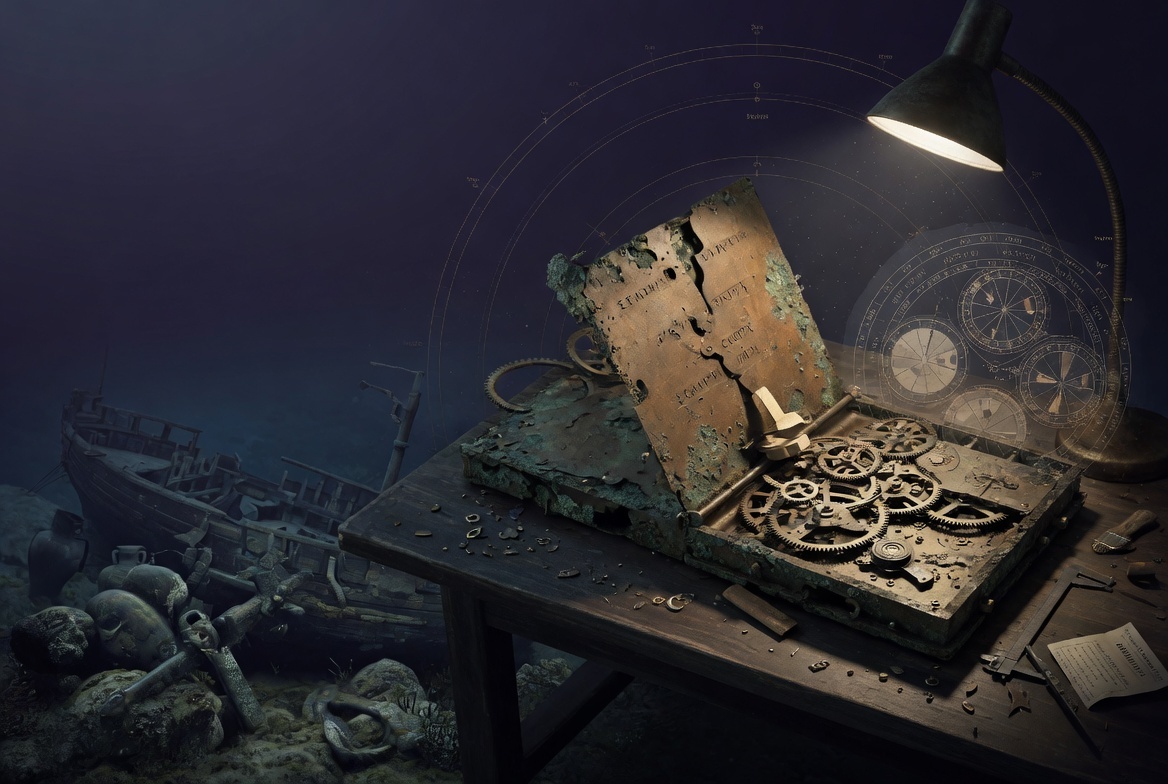
In 1900, sponge divers discovered an ancient shipwreck near the Greek island of Antikythera. The wreck contained sculptures, ceramics, and other cargo from the ancient Mediterranean world.
Among the recovered material was a corroded bronze object. At first glance, it did not look like a revolutionary machine. Time and seawater had broken it into fragments. Surfaces had fused together. Metal had degraded. Parts were missing.
Yet inside the damaged bronze were gears. Not one simple wheel. A complex system of interlocking gearwheels.
The artifact became known as the Antikythera Mechanism, and it has challenged historians, engineers, astronomers, and archaeologists for more than a century.
It is often described as an ancient analogue computer. The phrase sounds dramatic, but the basic idea is grounded in evidence. The mechanism used bronze gears and astronomical cycles to calculate and display information about the sky. It was built around the end of the second century BCE—making it more than 2,000 years old.
The Antikythera wreck lay near a difficult rocky coastline. The vessel was a Roman-era cargo ship carrying valuable objects through the Mediterranean. The mechanism was discovered among the wreckage in 1901 after the initial recovery effort began.
The artifact did not survive intact. According to a major 2021 study published in Scientific Reports, the device is now divided into 82 fragments. Only around one-third of the original survives, including 30 corroded bronze gearwheels.
Those fragments are enough to prove extraordinary complexity, but they are not enough to answer every question. Researchers have spent decades trying to reconstruct the missing sections. Every model must separate preserved evidence from informed interpretation.
The Antikythera Mechanism was an astronomical calculator. Earlier research established that it displayed celestial information, including cycles connected with the Moon and a luni-solar calendar.
High-resolution imaging and X-ray tomography revealed more. The mechanism could:
The 2021 Scientific Reports study described inscriptions connected with the motions of the Sun, Moon, and the five planets known in antiquity.
The device was not a modern computer. It had no electricity, screen, or programmable software. But it mechanized scientific theories through gears. Turning a control could move dials and indicators across calculated cycles. In practical terms, it transformed astronomical knowledge into a compact physical model.
People often imagine technological history as a straight line. Ancient societies build simple machines. Later societies build more complex ones. Eventually, modern engineering appears.
Reality is not that tidy. Knowledge can emerge, spread, disappear, or survive only in fragments.
The Antikythera Mechanism is technically more complex than any known comparable device for at least a millennium afterward, according to the 2006 Nature study that decoded major functions.
This does not mean ancient Greece secretly possessed modern industrial technology. It means skilled craftspeople and scholars achieved something remarkable within their own technological world. They understood gear ratios, astronomical cycles, metalworking, inscriptions, and compact mechanical design well enough to combine them inside one device. That is still extraordinary.
A gear is a simple concept. When one toothed wheel turns another, the second wheel rotates according to the relationship between their sizes and tooth counts. Combine multiple gears, and a machine can model different cycles.
The Antikythera Mechanism used this principle with unusual sophistication. The gears could represent astronomical periods far longer than a single year. They translated mathematical relationships into physical motion.
Researchers examining the fragments have identified gear trains, dials, inscriptions, and mechanical arrangements linked to the Moon and eclipse prediction.
Some details are strongly supported by preserved evidence. Other details, especially on the mostly missing front display, remain subjects of reconstruction and debate. The surviving machine is a puzzle with many missing pieces.
Traditional visual inspection could reveal only part of the artifact. Corrosion covered surfaces. Fragments contained hidden layers. Inscriptions were difficult to read.
Modern imaging transformed the research. High-resolution X-ray computed tomography allowed scientists to examine internal structures without destroying the fragments. Surface-imaging techniques helped reveal faint inscriptions.
These tools did not magically restore the machine. They exposed evidence that had been trapped inside damaged bronze for two millennia:
Each advance narrowed the mystery. None eliminated it completely.
Planetary display is one of the most fascinating parts of the Antikythera story. Inscriptions indicate that the mechanism described the motions of the planets known in antiquity.
Reconstructing exactly how the front display worked is difficult because so much of it is missing. Researchers have proposed models using nested systems and complex gearing to represent planetary motions.
The 2021 model argued that surviving evidence could be explained through a sophisticated reconstruction of the Greek Cosmos. This should not be presented as a perfectly preserved blueprint. It is a model designed to satisfy the surviving inscriptions, astronomical periods, and mechanical constraints.
Another future discovery could refine the reconstruction. That uncertainty is part of the story.
The identity of the maker remains unknown. The device required expertise. Whoever designed it needed access to astronomical theories, mathematical cycles, and advanced craftsmanship.
The artifact may have emerged from a wider tradition of ancient mechanical engineering rather than from one isolated genius. Ancient texts mention complex devices and mechanical models. Most did not survive.
Bronze could be melted down and reused. Delicate machines could corrode, break, or disappear. The Antikythera Mechanism may not have been the only object of its kind. It is the one that survived because a ship sank.
⚓ An Eerie Possibility: The mechanism may be less a unique miracle than a rare fragment of a lost technological tradition.
No.
The artifact does not require an extraterrestrial explanation. Ancient Greeks possessed astronomy, mathematics, metalworking, and a long tradition of mechanical experimentation.
The mechanism is surprising because modern audiences underestimate how sophisticated ancient engineering could become. Presenting the device as alien technology erases the real achievement. Human beings built it.
The more interesting question is how much related knowledge disappeared.
Researchers can describe functions more confidently than daily usage. The mechanism displayed astronomical information, tracked cycles, and predicted eclipses. But who turned the handle?
Some combination of these roles is possible. The machine was compact enough to function as a physical model of the cosmos. In an era when celestial events could carry religious, agricultural, and political significance, that would have mattered.
The Antikythera Mechanism remains mysterious because most of it is gone. Researchers can reconstruct enough to recognize a technological masterpiece, but they cannot recover every gear, inscription, or outer feature with certainty.
The surviving fragments reveal a machine of staggering ambition. The missing fragments prevent the story from becoming fully closed.
That balance is perfect for archaeology. Evidence answers the biggest question: Yes, ancient Greeks created a sophisticated geared astronomical calculator. The remaining gaps ask a harder one: What exactly did the complete machine look like when it still worked?
The mechanism also changes the way people think about lost knowledge.
Modern technology leaves enormous archives, factories, manuals, and digital records. Ancient technologies often survived only when unusual conditions protected them. A shipwreck, desert, tomb, or layer of volcanic ash could preserve what ordinary life destroyed.
This creates a serious bias. Historians know the past through the objects that happened to survive, not through everything people once built.
The Antikythera Mechanism is powerful because it exposes that gap. Its gears survived by accident. The workshops, sketches, teaching traditions, and related machines mostly did not. The artifact may be exceptional, but it may also be the visible tip of a much larger lost tradition.
The Antikythera Mechanism is not fascinating because it proves an impossible theory. It is fascinating because the confirmed evidence is already enough.
More than 2,000 years ago, human beings built a compact bronze machine that translated astronomy into moving gears. It predicted cycles in the sky. It modeled celestial motion. It survived only because a shipwreck carried fragments of it into the sea.
The mystery is no longer whether ancient engineers could build sophisticated machines. The mystery is how much else they built that did not survive.