11
11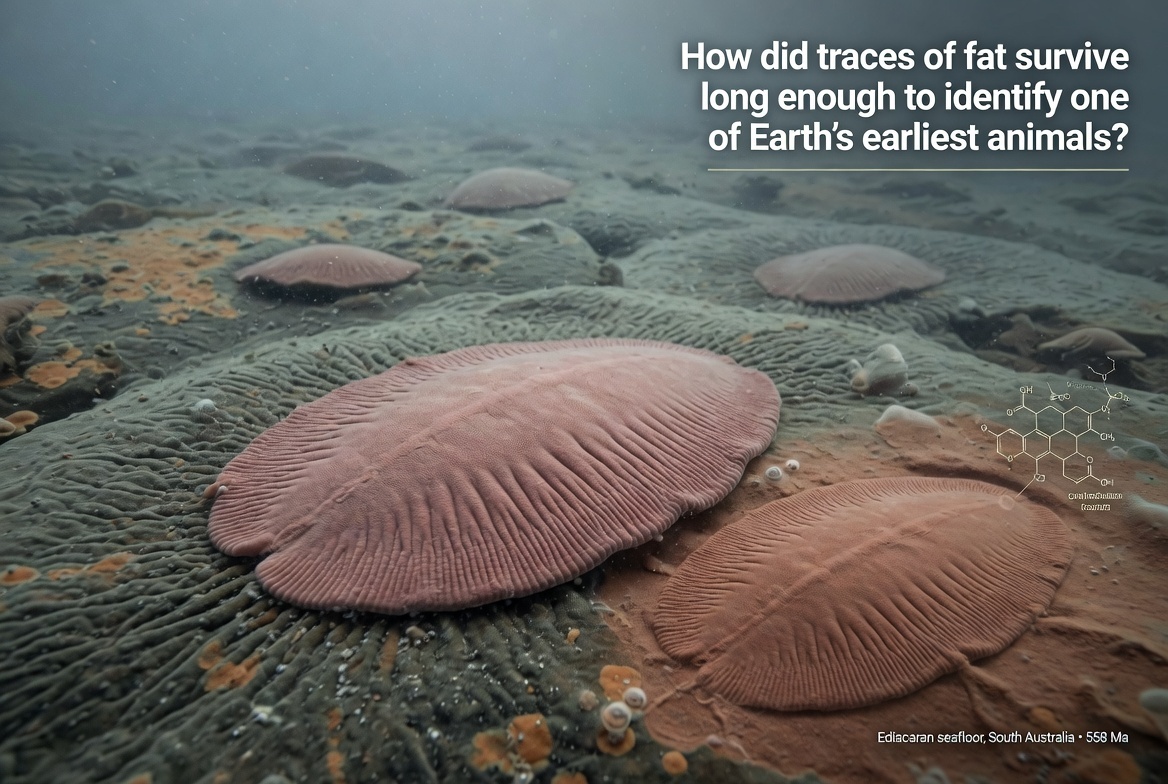
More than 550 million years ago, Earth’s seafloor contained life forms that remain difficult to compare with anything alive today.
There were no dinosaurs. There were no fish swimming through the water in the familiar sense. There were no forests. The animal world had not yet filled the oceans with claws, shells, teeth, and complex hunting strategies.
Instead, soft-bodied organisms rested or moved across ancient microbial mats. One of the most famous among them was Dickinsonia.
The creature looked remarkably simple:
Despite their simple design, some specimens grew surprisingly large. For decades, scientists argued over what Dickinsonia actually was. Was it an animal? A giant single-celled organism? A fungus-like life form? A lichen? Or perhaps a failed evolutionary experiment with no clear modern relationship?
The fossil shape alone could never settle the debate. Then, researchers found something entirely unexpected inside exceptionally preserved specimens: ancient fat molecules. These chemical traces changed the evolutionary story forever.
Dickinsonia lived during the Ediacaran Period, long before the famous Cambrian explosion transformed the fossil record.
The Cambrian explosion, beginning around 541 million years ago, is famous because many major animal groups suddenly became far more visible in rocks. Hard parts appeared, burrows diversified, predation left stronger traces, and body plans became much easier to connect with later animals.
The Ediacaran world came earlier. Its organisms often look quilted, frond-like, disc-shaped, or strangely symmetrical. Because most had soft bodies, they are notoriously difficult to classify.
A soft-bodied fossil may preserve an outline without preserving vital organs. The absence of a visible mouth does not always prove the living animal had none, and the absence of a gut impression does not guarantee there was no digestive system. Preservation filters reality, and Dickinsonia became one of the most important examples of that exact problem.
Dickinsonia fossils are highly distinctive, usually appearing as flattened oval impressions with repeated segments or modules.
The body shows a clear axis. Growth patterns reveal that the organism changed size by adding material in an organised, systematic way. Some fossils even suggest movement across the seafloor to feed on microbial mats.
Yet, the body completely lacks obvious modern features:
This radical simplicity allowed competing interpretations to thrive. Scientists could easily agree that Dickinsonia was real, lived on the seafloor, and belonged to the strange Ediacaran biota. However, its exact relationship to the animal kingdom remained a giant question mark.
A major breakthrough finally came from fossils collected near the White Sea in northwestern Russia, where the preservation conditions were nothing short of exceptional.
Instead of studying only the physical shape of Dickinsonia, researchers extracted organic material directly associated with the fossil and analysed its molecular biomarkers.
In 2018, a milestone study published in Science reported high abundances of cholesteroid compounds linked with animal biology. Because cholesterol-related molecules are a distinct characteristic of animals, this chemical signature provided powerful support to the interpretation that Dickinsonia belonged within the animal kingdom.
The finding was revolutionary because it approached the mystery from a completely different direction. While anatomy had produced decades of endless arguments, chemistry provided definitive, unarguable evidence. The fossil did not need to preserve a recognisable organ; its molecular remains still carried a clear biological clue.
The phrase “558-million-year-old fat” is an incredibly effective hook, but it requires proper context.
Researchers did not cut open a fresh piece of animal tissue. The original body had disappeared long ago; what the fossils preserved were molecular traces and transformed organic compounds derived from lipids.
Scientists analysed biomarkers—chemical signatures that can remain detectable after the original organism is completely gone. The result was not a perfectly intact piece of fat sitting inside stone, but a distinct chemical fingerprint.
This distinction makes the scientific achievement more impressive, not less. Researchers successfully recovered biological information from a soft body that vanished hundreds of millions of years ago.
Headlines often boldly describe Dickinsonia as the oldest known animal, but the statement needs careful wording.
The 2018 biomarker evidence supported Dickinsonia as one of the oldest known animals clearly represented by macroscopic fossils. Earlier animal life may have existed; molecular-clock studies, trace fossils, sponge-related evidence, and other findings all contribute to a highly complicated timeline.
The fossil record is inherently incomplete since soft-bodied animals can disappear almost entirely. New discoveries may always shift the discussion. Dickinsonia is crucial because it provides direct fossil evidence tied to chemical signatures consistent with animal life, but it does not necessarily represent the absolute first animal that ever evolved. Evolution rarely leaves a perfect first chapter.
Modern animals create specific expectations. People automatically imagine movement, mouths, internal organs, nervous systems, and obvious feeding behaviours.
Dickinsonia completely challenges that mental picture. Its body looked quiet, flattened, soft, and almost patterned rather than anatomical.
This does not make it primitive in a dismissive sense; it simply makes the organism difficult to read. An early animal may not resemble later animals strongly enough for immediate recognition because evolution had not yet produced the familiar visual language of the Cambrian world. The mystery is how much biological complexity a simple fossil impression conceals.
Some Dickinsonia fossils appear alongside tracks interpreted as evidence of movement and feeding. The organism may have travelled slowly across microbial mats, absorbing or processing nutrients directly from the surface.
Researchers have compared certain trace patterns with grazing or feeding behaviour. While the details remain debated and Dickinsonia did not leave distinct footprints like a dinosaur, its interactions with sediment were subtle but present.
The idea of movement completely changes our visual reconstruction. The organism may not have been a passive, leaf-like object attached permanently to one location, but an active animal utilizing the ancient seafloor.
Later research explored how Dickinsonia bodies decayed and became preserved. Sediment properties can heavily influence which structures survive as impressions, raising an important warning for paleontologists.
The fossil outline may not reveal every feature of the living animal. Mouths, guts, or other delicate soft structures could easily disappear long before fossilisation occurs. The visible fossil may just be a simplified remnant.
This matters because scientists often build reconstructions from what remains. When preservation erases anatomy unevenly, absence becomes difficult to interpret. A simple-looking fossil may originally have represented a far more complex living organism.
Paleontology is not limited to bones. Scientists study shells, teeth, pollen, footprints, burrows, isotopes, pigments, proteins, and molecular biomarkers. Each type of evidence captures a different part of ancient life.
Chemical fossils are especially important when body fossils remain ambiguous. A single molecule can reveal biological relationships that physical shape alone cannot settle confidently.
The Dickinsonia study became famous because the evidence feels almost impossible:
Dickinsonia often appears in visual collections of “alien-looking” prehistoric life. While the description works well emotionally because the body plan feels entirely unfamiliar, the organism does not require extraterrestrial explanations. It belonged strictly to Earth.
The stronger story is evolutionary. Life on this planet passed through transitional stages that modern ecosystems no longer display. Some body plans vanished completely, while others gave rise to later branches.
Even after biomarker research supported an animal affinity, its exact placement within the animal family tree remains discussed. Calling it an animal does not solve every anatomical question; it simply opens better, more precise questions.
Prehistoric media often focuses heavily on giant apex predators because they create immediate visual tension. Dickinsonia creates a much quieter, more mysterious atmosphere.
There is no attack, no giant jaw, and no chase. This organism existed before the evolutionary arms race became visually obvious—before shells became widespread defensive tools, and before predators filled the oceans with cutting teeth.
The seafloor carried soft life forms with shapes that feel almost abstract. Then the world changed, and the Cambrian fossil record filled with more recognisable complexity. Dickinsonia sits right near that threshold.
What Scientists Know with Confidence:
What Details Remain Uncertain:
The result is a fascinating prehistoric mystery with one major chemical answer and many surviving biological questions.
The fossils still do not reveal every feature of the living organism, but they preserve something truly remarkable: a trace of ancient fat that survived long enough to rewrite the story of animal evolution.