11
11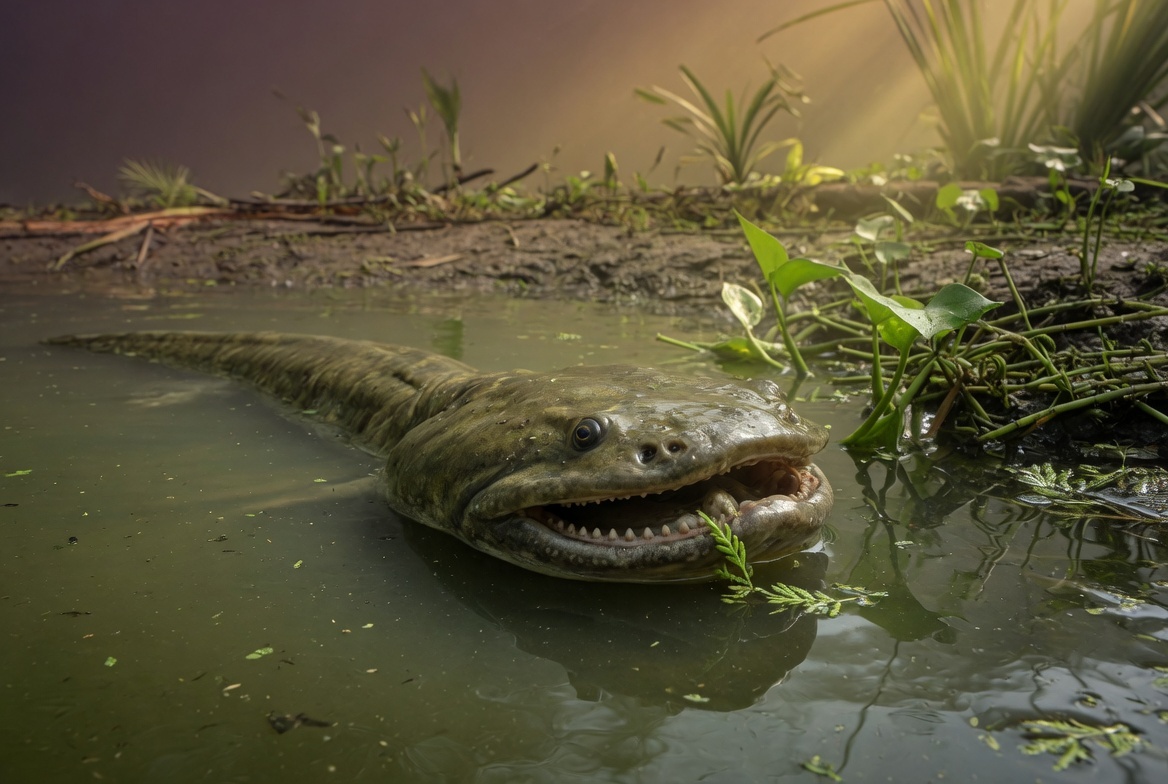
When scientists first looked at the jaw of Tanyka amnicola, it seemed almost wrong. The lower jaw was twisted. The teeth faced sideways. The inside surface was covered with tiny tooth-like structures, almost like a prehistoric grinding tool. At first glance, it could have looked like a deformity.
But then researchers found more jaws with the same strange shape. That changed everything. This was not one injured animal. This was a real anatomical feature.
Tanyka lived around 275 million years ago, during the Permian Period, in what is now Brazil. It was a tetrapod, meaning it belonged to the broad group of four-limbed vertebrates that eventually includes amphibians, reptiles, birds, and mammals.
Scientists currently know it mainly from jaw fossils, so the full body is still partly reconstructed. Based on related animals, it may have looked somewhat salamander-like and lived in freshwater environments.
But the jaw is the star. It was unlike anything alive today.
The twisted lower jaw and sideways-facing teeth suggest Tanyka processed food in an unusual way.
Researchers interpret the jaw as a possible adaptation for grinding plant material. That would make it one of the earlier examples of a tetrapod using a specialized system to process tough vegetation. This matters because herbivory is not simple. Eating plants requires more than biting. Tough plant material often needs grinding, crushing, or fermentation. Many later animals evolved complex teeth, jaws, and digestive systems to handle it.
Tanyka may represent an early experiment in that direction.
Scientists believe the jaw may have helped Tanyka grind plant material.
That interpretation is based on jaw shape and tooth orientation, not direct observation. So the careful wording is: Tanyka was likely herbivorous or at least adapted for processing tough food.
The full body is also not completely known. So reconstructions should stay cautious. It was probably a freshwater animal, but the exact lifestyle may become clearer if more fossils are found.
Researchers have described Tanyka as a kind of “living fossil” for its time. That does not mean it was unchanged forever.
It means it belonged to a lineage that scientists thought had mostly disappeared earlier. Finding it alive in the Permian was surprising because it shows older evolutionary branches were still surviving alongside newer groups.
Ancient ecosystems were not clean replacement stories. Old lineages and new lineages overlapped. Evolution was messier than a straight timeline.
Tanyka amnicola was not the biggest prehistoric animal. But it had one of the weirdest mouths.
Its twisted jaw shows that ancient life was experimenting with body designs long before dinosaurs appeared. Sometimes evolution does not look elegant. Sometimes it looks like a jaw that should not work — but somehow did.