11
11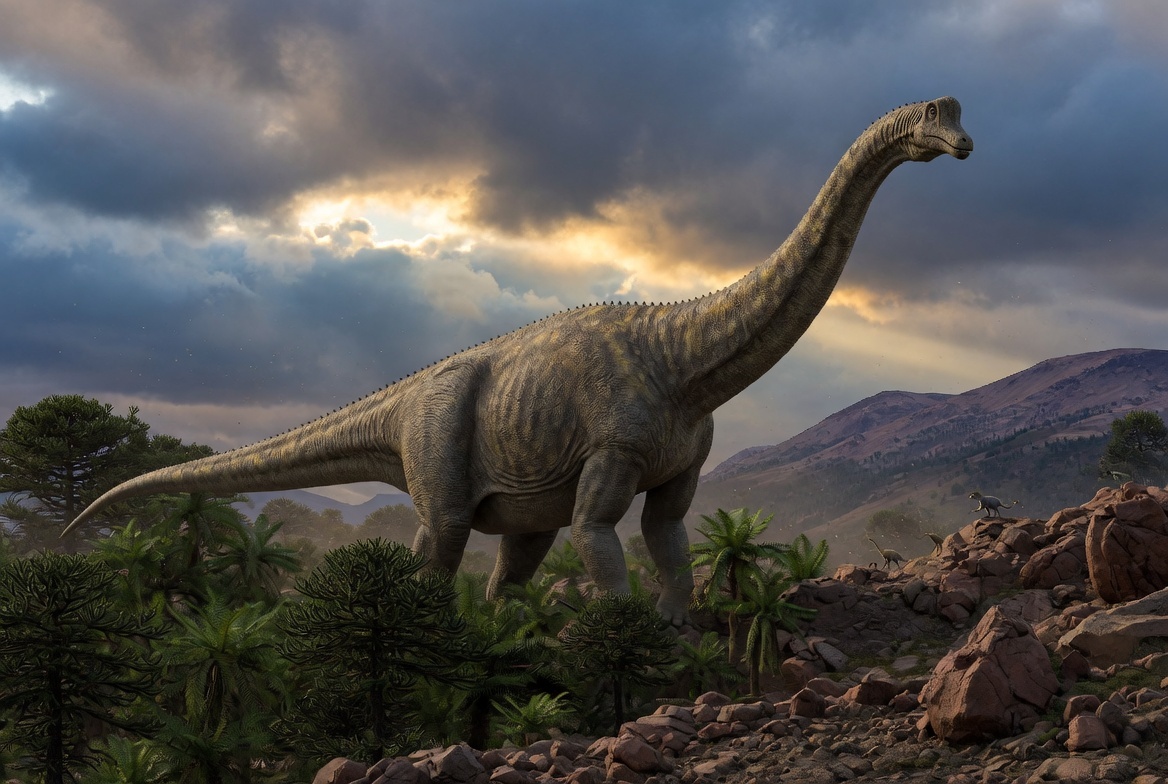
A new dinosaur from Argentina is making scientists rethink part of the sauropod story. Its name is Bicharracosaurus dionidei.
It was a long-necked, plant-eating dinosaur from Patagonia, estimated at around 20 meters long. That is smaller than the biggest sauropods ever found, but still enormous by any normal standard.
What makes it interesting is not just the size. It is the mix.
Researchers say Bicharracosaurus appears to show features connected to different famous sauropod groups, including relatives of Diplodocus and Brachiosaurus. That makes it a strange fossil clue from the Jurassic Period.
Sauropods were some of the most successful giants in Earth’s history. They had long necks, massive bodies, small heads, and huge digestive systems built for plant-eating. Some became the largest land animals ever known.
But their evolution was not simple. Different sauropod lineages spread across different continents, adapted to different environments, and evolved different body shapes.
South America is especially important because it preserves many giant dinosaur discoveries, but the Jurassic record still has gaps. Bicharracosaurus may help fill one of those gaps.
Researchers suggest Bicharracosaurus may represent the first known Jurassic brachiosaurid from South America. That is a big deal if confirmed.
Brachiosaurids are the group connected to famous long-necked dinosaurs with high shoulders and upward-reaching neck posture. Finding a Jurassic member of this group in South America would expand the known history of how these giants spread and evolved.
It would suggest that some sauropod lineages had a more complex Southern Hemisphere story than previously understood.
Dinosaur discoveries rarely give scientists a full animal. Most of the time, researchers work with partial skeletons, comparisons, measurements, and careful anatomical interpretation.
That means a new fossil can be both exciting and incomplete. Bicharracosaurus is not a fully solved puzzle; it is a major clue. Its anatomy gives researchers enough to name it and compare it, but future discoveries could sharpen the picture.
That is how paleontology works. One fossil opens a door. More fossils tell us what was behind it.
This is not a “biggest dinosaur ever” story. It is a “missing chapter” story.
Bicharracosaurus matters because it sits in a strange evolutionary position. It suggests the age of giant dinosaurs in the Southern Hemisphere was more complicated than a simple family tree.
Some creatures do not fit neatly, and those are often the ones that teach us the most.