11
11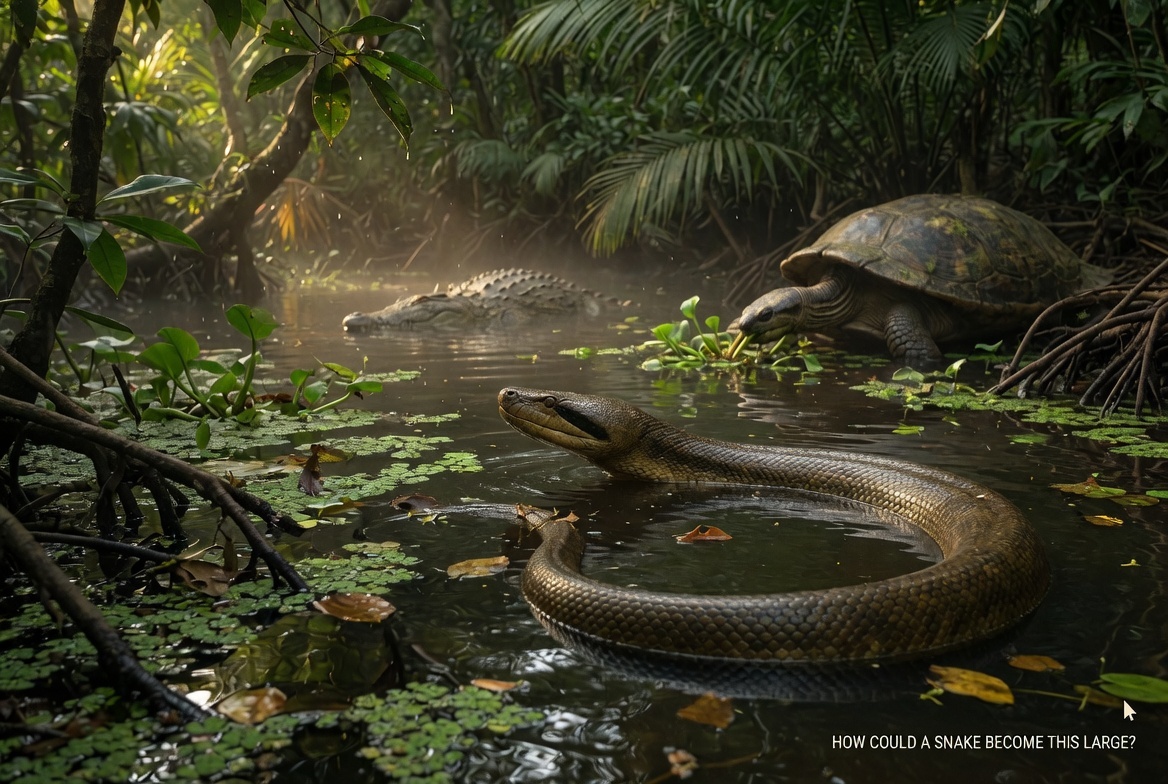
The fossil was not discovered in a jungle.
It was found inside one of the world’s largest open-pit coal mines.
In the Cerrejón region of northeastern Colombia, paleontologists uncovered remains from an ancient tropical ecosystem that existed after the extinction of the non-avian dinosaurs.
Among the fossils were unusually large snake vertebrae.
At first, the bones did not immediately reveal the full scale of the animal.
Snake vertebrae can look repetitive and difficult to interpret. A giant snake does not leave behind a dramatic skull or towering skeleton as easily as a dinosaur. Its body is a long series of bones that must be studied carefully and compared with living species.
But as researchers examined the fossils, the picture became clear.
The snake was enormous.
It became known as Titanoboa cerrejonensis.
When Titanoboa was formally described in 2009, researchers estimated that it reached around 13 metres in length and weighed more than one tonne.
That made it far larger than the biggest reliably measured modern snakes.
The name fits.
Titanoboa essentially means “titanic boa.”
It belonged to a broad snake lineage related to modern boas and anacondas. But its scale pushed the familiar body plan into a different category.
A modern anaconda already creates an intimidating visual.
Now imagine an animal substantially longer, with a body thick enough to dominate a swamp ecosystem.
This was not a dinosaur-era snake.
It lived later, during the Paleocene Epoch, after the catastrophic extinction event that ended the age of non-avian dinosaurs around 66 million years ago.
The world had changed.
Large dinosaurs were gone.
New ecosystems were forming.
Inside those ecosystems, reptiles still reached extraordinary sizes.
The Cerrejón fossils offer a rare glimpse into one of the earliest known tropical rainforest environments after the dinosaur extinction.
The ecosystem was hot, wet, and densely vegetated.
Large turtles lived there.
Crocodile-like reptiles moved through the water.
Fish and other animals occupied rivers and swampy channels.
Titanoboa was part of that world.
It may have lived in a manner broadly comparable with modern large aquatic boas, spending significant time in water and hunting within river or swamp habitats.
The exact details of its behaviour remain uncertain.
Scientists cannot watch a living Titanoboa hunt.
They must infer its ecology from anatomy, sediment, related animals, and the surrounding fossils.
But the environment gives the animal a convincing setting.
A massive snake did not need to chase prey across open ground.
It lived inside water, mud, vegetation, and shadow.
A creature this large immediately creates dramatic images.
People imagine Titanoboa crushing crocodiles or swallowing enormous prey whole.
Some of those ideas are plausible in a broad sense.
A snake weighing more than one tonne would have been capable of interacting with large animals.
However, the exact diet remains uncertain.
Large living snakes consume fish, birds, mammals, reptiles, and other prey depending on species and habitat. Aquatic snakes may focus heavily on animals available in rivers and wetlands.
Some researchers have suggested that Titanoboa may have been especially adapted to eating fish.
Others picture a broader diet.
The fossil evidence does not support turning every illustration into a battle scene.
There is no need.
A 13-metre snake moving through a swamp is already one of the most intimidating animals in the fossil record.
The discovery of Titanoboa became important for another reason.
Snakes are ectothermic animals.
Their body temperature and metabolism depend heavily on environmental conditions.
Researchers argued that an animal reaching Titanoboa’s size could provide clues about the temperatures of its ancient tropical habitat.
The original study suggested that equatorial South America during the Paleocene may have been hotter than modern tropical regions.
The logic sounds straightforward: if warmer environments support larger ectothermic reptiles, an enormous snake may point toward extreme heat.
But this interpretation became debated.
Later researchers questioned whether the relationship between climate and maximum snake size was simple enough to support precise temperature estimates.
Other biological and ecological factors may also influence body size.
The fossils confirm the snake’s enormous scale.
The climate calculation is more complicated.
This is an important distinction.
The animal is real.
The exact temperature reconstruction remains a scientific discussion.
There is no single confirmed answer.
A warm climate may have helped.
Abundant prey may have supported a large predator.
A swampy aquatic environment may have reduced some of the physical constraints of moving a heavy body.
The disappearance of non-avian dinosaurs may also have reshaped ecosystems, creating opportunities for other groups.
But giant size is not automatic.
Many warm environments do not produce 13-metre snakes.
Many ecosystems contain plentiful prey without producing record-breaking reptiles.
Titanoboa appears to have emerged from a specific combination of conditions.
The snake represents an evolutionary extreme.
The Paleocene rainforest contained elements that would look recognisable today.
There were rivers.
There were plants.
There were reptiles.
There were snakes.
But the scale changed the atmosphere completely.
A familiar swamp becomes unsettling when a snake longer than a bus can move beneath the surface.
The tension comes from realism.
Titanoboa was not a dragon.
It did not breathe fire.
It did not require supernatural explanations.
It used a body plan that still exists.
Nature simply pushed that body plan far beyond modern expectations.
The Cerrejón mine became one of the most important fossil sites for understanding tropical ecosystems after the dinosaur extinction.
Researchers recovered multiple large vertebrae belonging to Titanoboa.
Additional discoveries helped strengthen the reconstruction, including material from different individuals.
The fossils were not merely a single isolated bone accidentally interpreted as a giant.
They represented a real population of enormous snakes.
That point matters.
This was not one abnormal animal.
Titanoboa belonged to an ecosystem where giant snakes genuinely lived.
The swamp did not contain only one monster.
It supported a species.
Stories about enormous snakes still circulate today.
Photos are miscaptioned.
Camera perspective makes ordinary snakes appear gigantic.
Unverified claims describe animals reaching impossible lengths deep inside remote forests.
Titanoboa often gets mixed into those discussions.
But the fossil species should not be used as proof that 13-metre snakes survive in modern jungles.
There is no confirmed evidence that Titanoboa survived beyond its prehistoric time period.
There is no confirmed evidence that modern rainforests hide a living population of snakes matching its size.
The fossil record proves something more grounded and still remarkable.
A snake this large existed once.
Nature has already produced the animal people keep imagining.
Many extinct animals feel distant because they have no obvious modern equivalent.
Titanoboa feels different.
Everyone understands what a snake is.
Everyone can picture a swamp.
Everyone can imagine the discomfort of watching ripples move across muddy water while the animal itself remains hidden below the surface.
The creature is easy to understand and difficult to forget.
Its fossils also connect several major scientific questions.
What happened to tropical ecosystems after the dinosaur extinction?
How did climate affect reptile evolution?
How much larger could familiar animal groups become under different environmental conditions?
What was moving through the world’s earliest rainforests?
Titanoboa cerrejonensis was a real prehistoric snake discovered from fossils in Colombia’s Cerrejón region.
Researchers estimated that it reached around 13 metres in length and weighed more than one tonne.
It lived during the Paleocene Epoch, after the extinction of the non-avian dinosaurs, inside a hot tropical ecosystem filled with large reptiles.
Scientists continue to debate exactly what its size reveals about ancient climate and precisely how it lived.
But the central fact remains solid.
Long after the dinosaurs vanished, a snake longer than a bus moved through the swamps of South America.
References: