11
11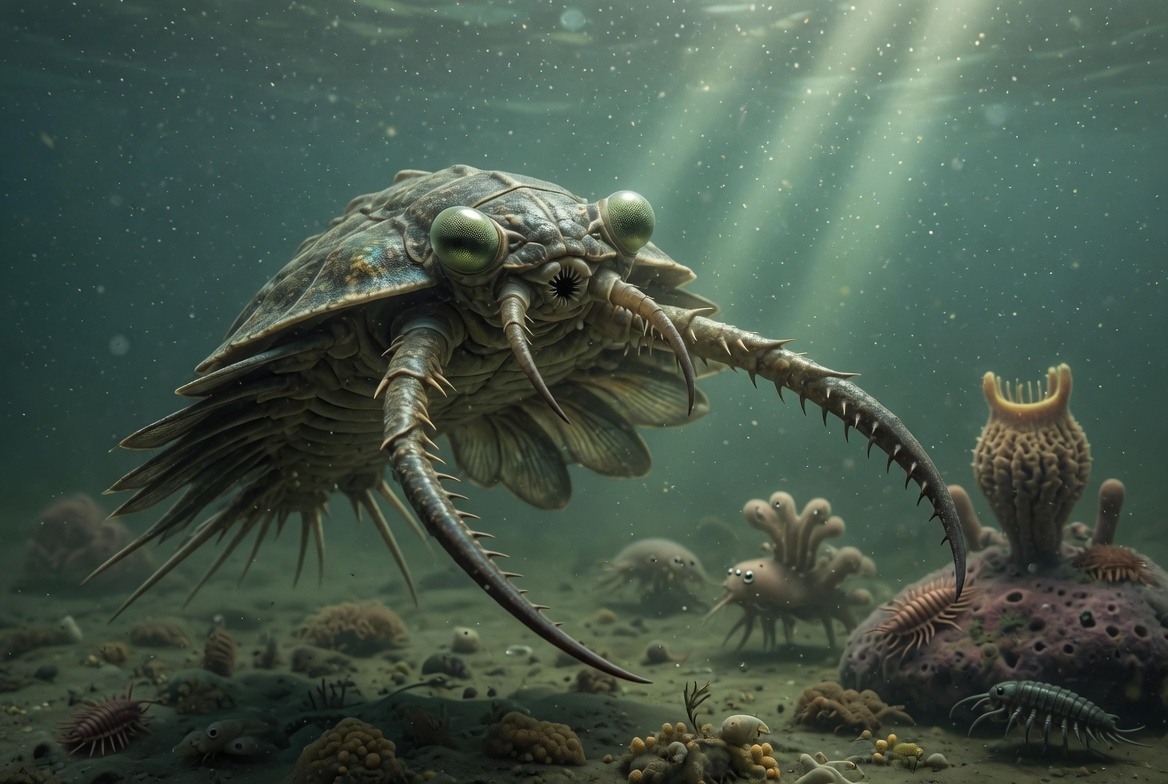
More than 500 million years ago, Earth’s oceans looked nothing like the oceans we know today.
There were:
Instead, the Cambrian seas were filled with strange evolutionary experiments: spiny animals, soft-bodied creatures, early arthropods, and body plans that look almost impossible now.
In the middle of that alien-looking world lived Anomalocaris.
Its name means “unusual shrimp,” which is honestly one of the biggest understatements in paleontology. Anomalocaris looked like a creature assembled from ideas that evolution later abandoned: side flaps for swimming, large eyes, grasping appendages, and a circular mouth that has been compared to something mechanical.
It was real. And for a long time, it was seen as one of the top predators of the Cambrian ocean.
One of the most interesting parts of the Anomalocaris story is that scientists did not immediately understand it as one complete animal.
Different parts of its body were once interpreted as separate creatures. The appendages, mouthparts, and body fossils confused researchers because they were unlike familiar modern animals. That already tells you how strange this creature was.
It was not simply “an old shrimp.” It was part of a group called radiodonts, early arthropod relatives that dominated many Cambrian marine ecosystems.
For EdgeCase, this is a perfect angle: a real animal so bizarre that even scientists had to assemble its identity piece by piece.
Anomalocaris is often described as an apex predator of the Cambrian seas. That broad idea is supported by its size for the time, its large eyes, and its forward appendages, which seem adapted for grabbing prey.
But the details are more debated. Older reconstructions often imagined Anomalocaris crunching trilobites with ease. More recent interpretations suggest it may have focused more on softer prey, because some studies question whether its mouthparts were strong enough to break heavily mineralized shells.
That does not make it weak. It makes it more interesting. The real story is not “this creature ate everything.” The better story is that scientists are still refining what kind of predator it actually was.
The mystery is not whether Anomalocaris was important. It clearly was. The mystery is what kind of hunter it truly was.
One of the creepiest details about Anomalocaris is its vision.
Fossil evidence suggests it had large compound eyes, giving it impressive visual ability for its time. In a Cambrian sea filled with animals still evolving defenses and new ways to survive, strong vision would have been a serious advantage.
Imagine being a small soft-bodied creature on the seafloor while a large predator with huge compound eyes glided overhead. That is the kind of scene that makes the Cambrian feel less like a simple early ocean and more like a dangerous alien ecosystem.
Anomalocaris works because it occupies two feelings at once. It feels primitive because it comes from early animal history. But it also feels futuristic because its shape is so unfamiliar.
Its swimming flaps look like something designed for another planet. Its mouth does not resemble normal jaws. Its appendages give it a mechanical, almost robotic profile.
This is why the creature performs so well visually. People do not need to know paleontology to feel the hook. They see it and instantly ask: “What is that?”
Anomalocaris was a real Cambrian predator from more than 500 million years ago, and it remains one of the strangest animals in early Earth history.
Scientists broadly recognize it as an important hunter of its time, but its exact feeding behavior is still debated. That mix of confirmed reality, alien appearance, and scientific uncertainty makes Anomalocaris one of the strongest sci-mystery creatures for EdgeCase-style content.