11
11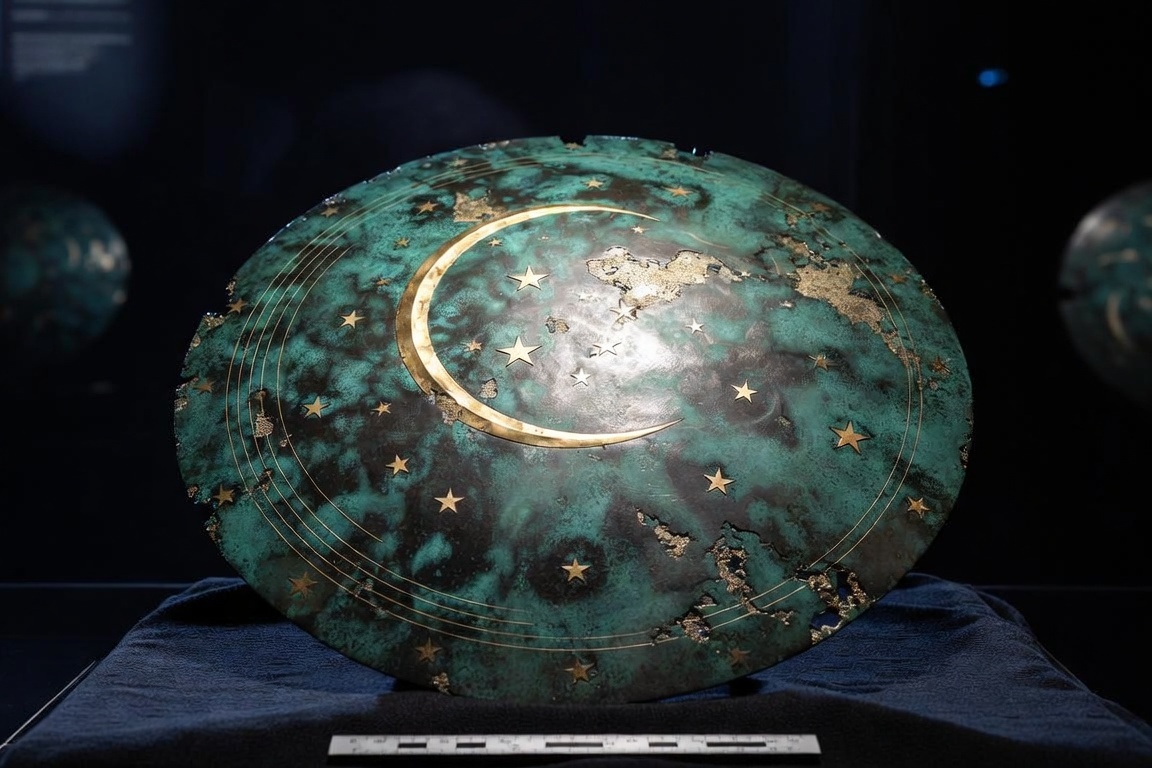
The Nebra Sky Disc is one of the most important archaeological finds of the twentieth century.
The core of the story is not invented. It is a real subject supported by evidence. UNESCO describes it as the oldest concrete depiction of cosmic phenomena worldwide.
That distinction matters. EdgeCase works best when the confirmed version already feels cinematic enough to carry the story.
The bronze disc contains gold elements commonly interpreted as stars, a crescent, a bright circular object, horizon arcs, and a lower arc often described as a solar boat.
The evidence is incomplete, but it is not vague. Researchers can measure, compare, observe, scan, sample, date, or document specific details. The strongest version of the article begins with those details rather than the loudest internet interpretation.
This matters because strange subjects attract exaggeration quickly. A fossil becomes a monster. A deep-sea animal becomes an attack story. An endangered species becomes a hidden-survivor myth. An ancient object becomes impossible technology. A natural event becomes a conspiracy. A cosmic anomaly becomes proof of aliens.
The evidence deserves a cleaner frame.
The object feels modern because it compresses sky observation into one portable surface. Gold symbols float across green-blue bronze.
The visual hook is immediate, but it is not the entire story. Anatomy, environment, history, and scientific context explain why the feature exists and why researchers still care.
A credible reconstruction should make the viewer curious before making any claim.
The disc was buried with valuable objects near Nebra in Germany. The State Museum of Prehistory explains that the object changed through multiple phases.
Without context, the subject becomes a random oddity. With context, it becomes a window into a larger system: evolution, extinction, deep-ocean adaptation, archaeology, geology, conservation, or cosmic structure.
That wider frame is what gives the topic weight.
The disc is sometimes presented as a perfect modern star chart. The imagery combines observation, interpretation, and symbolic meaning.
The mistake is understandable. Humans interpret unfamiliar evidence using familiar categories. A strange silhouette becomes a monster. A geometric surface becomes a machine. A rare sighting becomes proof of survival. A data anomaly becomes proof of intelligence.
Good science storytelling does not mock that reaction. It corrects it.
These points create the stable foundation. They are the facts strong enough to anchor the headline, thumbnail, Reel, and caption without inflation. The article becomes more compelling when uncertainty is placed around the facts rather than mixed into them.
These questions remain open because the evidence has limits. Fossils preserve fragments. Deep water hides behavior. Rare animals are difficult to count. Ancient records disappear. Natural systems leave incomplete traces. Distant objects cannot be inspected directly.
An unresolved detail is not a failure. It is the edge of the current evidence.
The symbols are visible. Their full social meaning is harder to recover.
This is where the story stays alive. A complete answer would close the file. A specific unanswered question invites better surveys, deeper dives, improved scans, genetic work, field research, or more careful analysis.
The mystery remains credible because it is defined.
The Reel should move from close-up metal texture to night sky. The connection becomes intuitive without oversimplifying.
The thumbnail should create one clear question. The Reel should reveal the evidence step by step. The article should reward the click with a factual explanation that remains cinematic. That sequence works because the real subject is already strong enough.
The artifact is sophisticated human knowledge, not impossible technology.
This line should remain visible throughout the article. Speculation can be discussed. It cannot be disguised as proof.
The Nebra Sky Disc remains powerful because ancient observers transformed the sky into an object that survived after the original explanations disappeared.
The final image is simple. Gold stars remain fixed on bronze while the real sky moves above them.
The subject remains memorable because the real explanation does not shrink the mystery. It turns the mystery into evidence.
The subject also reveals how easily important details can hide in plain sight. A fossil can remain misread for decades. A species can survive beyond scientific attention. A strange object can preserve its shape while losing its meaning. A signal or landscape can look simple until the right tool reveals the deeper pattern.
Better evidence does not remove wonder. It sharpens it.
The restrained conclusion is enough: The disc preserves ancient celestial imagery, while its complete meaning remains partly unresolved.
References: