11
11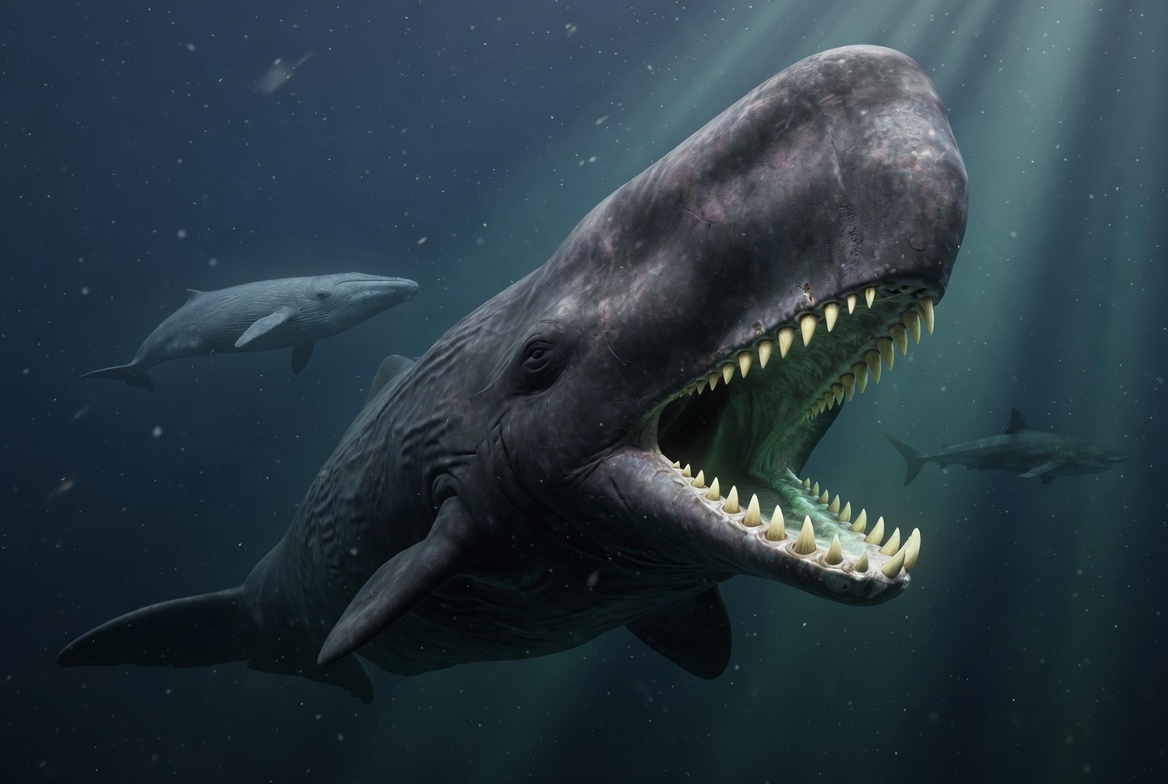
Modern sperm whales are already extraordinary animals. They dive into the deep ocean, navigate through darkness, and hunt squid using a body plan unlike almost anything else alive today.
But millions of years ago, the oceans contained a sperm-whale relative with a far more visibly brutal feeding system. Its name was Livyatan melvillei.
Livyatan had a massive head, robust jaws, and enormous functional teeth in both the upper and lower jaws. Some teeth exceeded 36 centimeters in length—which is longer than many well-known Tyrannosaurus rex teeth.
Note: The animal was not a dinosaur. It was a whale, and researchers proposed that it hunted other whales.
The story began with fossils discovered in the Pisco Basin of Peru. Today, the region is a dry desert. However, millions of years ago, it preserved marine environments filled with whales, sharks, fishes, and other ocean animals.
Researchers described Livyatan based on a skull with teeth and a lower jaw. The fossil came from the Miocene Epoch, approximately 12 to 13 million years ago according to the original scientific description.
This detail matters because living sperm whales are different. Modern sperm whales largely lack functional upper teeth and use suction while feeding on squid. Livyatan appears to have followed another strategy: it was built to bite.
The animal’s name was inspired by the biblical sea monster Leviathan and by Herman Melville, the author of Moby-Dick.
The original genus name was spelled Leviathan, but scientists later changed it to Livyatan because the earlier spelling had already been used for another organism. The corrected name preserved the intended meaning while following taxonomic rules.
It was an unusually fitting choice. Livyatan was not a mythical sea monster, but its fossil anatomy showed that the Miocene ocean contained a predator worthy of a sea-monster name.
Livyatan’s teeth were not delicate. The largest exceeded 36 centimeters in length and reached roughly 12 centimeters in diameter. These were thick, powerful structures.
The researchers who described the fossil interpreted Livyatan as a raptorial predator. In simple terms, it actively seized and bit large prey rather than relying mainly on suction feeding.
The skull supported that interpretation. Livyatan had robust jaws and a large area for jaw-muscle attachment. Its feeding system looked suited to forceful bites.
The original study proposed that the whale fed mostly on medium-sized baleen whales, which would have provided high-energy prey. This remains a scientific interpretation rather than a preserved video of a hunt, but the anatomy makes the idea credible.
The phrase sounds almost exaggerated. A whale hunting whales feels like the setup for a fictional monster movie.
But living oceans already contain examples of cetaceans preying on other marine mammals. Orcas hunt seals, dolphins, and whales. Livyatan may have occupied a similar ecological role on a much larger scale.
Researchers have described it as a giant raptorial sperm whale. Its body length has been estimated in a range comparable to large modern sperm whales, though exact values depend on reconstruction methods.
The key difference was not simply size. It was equipment. Livyatan had a mouth designed for active biting.
Livyatan lived during a period when another giant predator occupied the oceans. The massive shark commonly known as Megalodon lived during overlapping geological time.
That fact has inspired endless illustrations of the two animals fighting. A giant whale with enormous teeth facing a giant shark is an irresistible visual concept.
But the evidence requires restraint:
They may have targeted some of the same prey. They may have encountered one another. They may also have avoided unnecessary risk. Predators do not always fight simply because they share an ecosystem.
The honest version remains dramatic: Miocene oceans supported multiple giant predators capable of targeting large marine animals.
The Miocene was a major period in whale evolution. Baleen whales diversified, and marine ecosystems contained a wide range of prey sizes.
The original Livyatan study suggested that the appearance of giant raptorial sperm whales coincided with the increasing diversity and size range of baleen whales.
📌 Ecological Connection: Large prey can support large predators. As whale communities expanded, specialized hunters may have evolved to exploit them.
Livyatan was not a random monster. It was part of an ecosystem. Its enormous teeth make sense when placed in a world with substantial prey.
Scientists can reconstruct Livyatan with greater confidence in some areas than others. The skull, jaws, and teeth provide strong evidence. The rest of the body is less complete.
Livyatan likely resembled a sperm whale relative, but artists must interpret missing details such as body proportions, soft tissue, coloration, and fin shape.
The fossil supports a powerful head and formidable mouth. It does not preserve an exact skin texture or facial expression. That distinction matters when separating science from visual storytelling.
The comparison needs careful wording. Livyatan teeth exceeded 36 centimeters in length according to the original description. That makes them longer than many well-known Tyrannosaurus rex teeth.
However, comparisons can vary depending on whether researchers measure the visible crown, the complete tooth including the root, or specific specimens.
The strongest accurate statement is simple: Livyatan possessed some of the largest known biting teeth among tetrapods. They were enormous by any standard.
The point is not to turn paleontology into a competition. The point is to understand what those teeth reveal: Livyatan evolved to bite large prey.
The exact extinction story of Livyatan remains uncertain. Marine ecosystems changed over millions of years.
Giant predators can become vulnerable when their prey base changes or when ecological conditions no longer support their specialized lifestyles.
Livyatan did not suddenly vanish because of one confirmed event known to science. Its disappearance belongs to a broader story of environmental and evolutionary change.
That uncertainty is normal. Fossils show where an animal existed and what parts of its anatomy looked like. They do not always preserve a clean final chapter.
Livyatan is a reminder that prehistoric oceans were not dominated by sharks alone. A giant whale relative evolved into an active hunter with a massive head and teeth larger than many dinosaur teeth. It may have pursued other whales through Miocene seas.
The animal was real. Its jaws were real. Its shared ecosystem with Megalodon was real.
The dramatic battles often imagined online remain unconfirmed. Reality is still cinematic enough. Millions of years ago, the ocean contained a sperm-whale relative built less like a deep-diving squid hunter and more like an enormous marine ambush predator.