11
11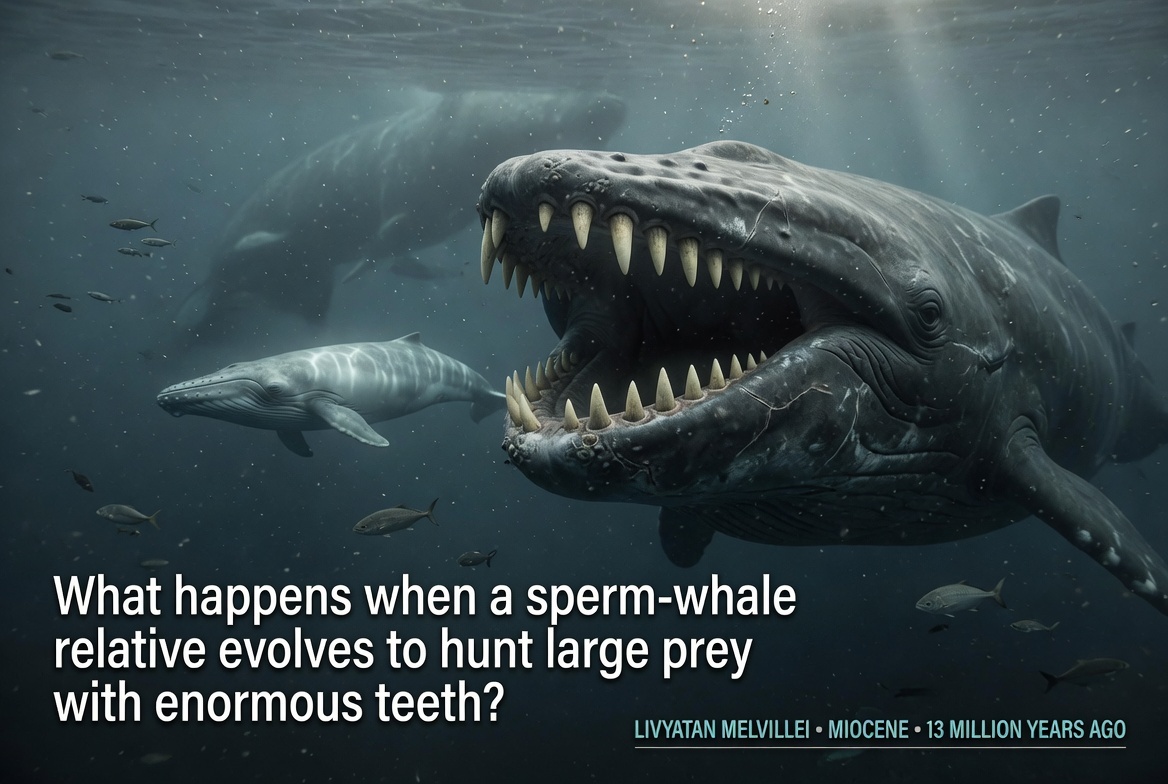
Modern sperm whales are already difficult to imagine at full scale. Adult males can become enormous. They dive into deep water, hunting squid and fish in an environment humans can barely observe directly.
But millions of years ago, the sperm-whale family contained a predator with a very different mouth: Livyatan melvillei.
Livyatan carried enormous teeth in both the upper and lower jaws. Some reached around 36 centimetres in total length, including the root. These teeth were not delicate; they were thick, deeply anchored, and belonged to an animal built for pure force.
The fossil skull was discovered in Peru and described in 2010. Original researchers presented Livyatan as a giant raptorial sperm whale from the Miocene Epoch. While its body length was broadly comparable to large living sperm whales, its most dramatic feature was its ecological role.
Livyatan may have hunted large vertebrate prey, including medium-sized baleen whales.
While giant sharks moved through the water, this toothed whale was evolving into something equally intimidating.
The fossil came from the Pisco-Ica Desert of southern Peru. Today, the landscape is dry and exposed. But during the Miocene, the region formed part of a marine environment filled with whales, sharks, fish, and other ocean life.
The Livyatan specimen included a massive skull, jaws, and teeth. That combination mattered.
Isolated giant sperm-whale teeth had been found before, but teeth alone can be difficult to assign confidently to a specific animal. A skull changes the story. It allows researchers to study the proportions of the head, the placement of the teeth, and the design of the feeding apparatus.
Unlike the modern sperm whale—which has prominent lower teeth while the upper jaw contains sockets—Livyatan possessed large, functional teeth in both rows. This was not simply a modern sperm whale made more aggressive for a movie; it represented a highly specialised predatory branch.
Teeth reveal how an animal interacts with the world:
Livyatan’s teeth were robust, deeply rooted, and large enough to grip struggling vertebrates. Wear patterns and skull anatomy support the picture of a predator capable of biting into substantial prey.
Researchers suggested that medium-sized baleen whales formed part of its diet. This interpretation is plausible because Miocene seas supported a range of smaller baleen whales.
However, since fossils rarely preserve a complete menu, scientists cannot prove that every Livyatan regularly attacked whales. The animal may also have eaten fish, sharks, and other marine mammals.
The careful conclusion remains powerful enough: Livyatan was adapted for macropredation—feeding on large animals.
The name Livyatan melvillei carries a deliberate reference. “Melvillei” honours Herman Melville, the author of Moby-Dick, while the genus name draws from a biblical sea-monster tradition.
The naming choice fits the visual impact of the fossil, but the scientific animal should remain separate from fiction:
Its importance comes from evolution, not legend. Whales are often framed as gentle giants, but Livyatan reminds us that the whale family tree also produced formidable predators.
Livyatan lived during a period famous for another marine predator: the giant shark commonly known as Megalodon.
The overlap creates one of the most irresistible prehistoric images—two enormous apex predators occupying the same ocean. One was a giant shark with a devastating bite; the other was a toothed whale with a massive skull and deeply rooted teeth.
Did they fight?
Popular illustrations love that scenario, but the answer is less dramatic and more honest: There is no confirmed fossil evidence documenting a direct battle between Livyatan and Megalodon.
They may have targeted some of the same prey, competed indirectly, or scavenged from similar carcasses. They may also have occupied different hunting niches at times. While the fight scene remains speculation, ecosystem-level competition is highly plausible.
Modern oceans still contain highly intelligent whale predators. Orcas hunt fish, seals, sharks, and other whales, while sperm whales remain powerful deep-diving hunters. Yet, the specific Livyatan-style combination of giant body size and enormous gripping teeth disappeared.
The extinction story is complex and not fully solved. Marine ecosystems shifted through the later Miocene and Pliocene:
A large predator depends entirely on a stable food supply. If prey communities become less favourable, extreme hunters become highly vulnerable. Livyatan belonged to a marine world that simply no longer exists.
Internet posts often compare Livyatan teeth with those of Tyrannosaurus rex. The comparison is clickable, but it requires context.
A tooth measurement often includes the root, while the visible crown is only part of the structure. Furthermore, a whale tooth and a theropod tooth are not interchangeable weapons.
However, the comparison still communicates scale effectively. A Livyatan tooth could be longer than a human hand, sitting inside a skull built to withstand powerful feeding forces. The animal did not need exaggerated claims; its anatomy was already extreme.
Livyatan is famous, but its fossil record remains limited. The holotype skull from Peru provides the central evidence.
While other large macroraptorial sperm-whale teeth have been discovered worldwide, researchers must remain cautious. A large isolated tooth does not automatically belong to Livyatan melvillei; it may represent a related animal.
The fossil record shows a broader guild of macroraptorial sperm whales, but Livyatan remains the most iconic member because its skull reveals the architecture behind the teeth.
Sharks carry an immediate fear factor. Their silhouettes are simple, their teeth are familiar, and their movement feels silent and efficient.
Livyatan creates a different reaction because it was a mammal. Whales breathe air and occupy a mental category often associated with intelligence, communication, and social behaviour.
That makes the predatory anatomy feel more unsettling. A giant whale with a blocky skull and massive teeth does not look like an oversized fish—it looks like a marine mammal transformed into a top predator. The animal feels both familiar and wrong.
What We Know:
What Remains Uncertain:
The scientific version stays compelling because it successfully separates evidence from imagination.
Livyatan changes the way prehistoric whale evolution is imagined. Whales are not a single fixed design moving steadily toward modern forms. Their history contains branches adapted for very different jobs.
Some filtered tiny prey, some hunted squid, and some carried teeth capable of damaging large vertebrates. Livyatan shows that marine mammals entered ecological roles often associated mentally with giant sharks.
Different evolutionary lineages can arrive at similar solutions when ecosystems reward powerful macropredators. It reveals how incomplete the modern ocean is as a guide to the past.
Before modern whales inherited the oceans, evolution produced a whale with the teeth and skull of a sea monster.