11
11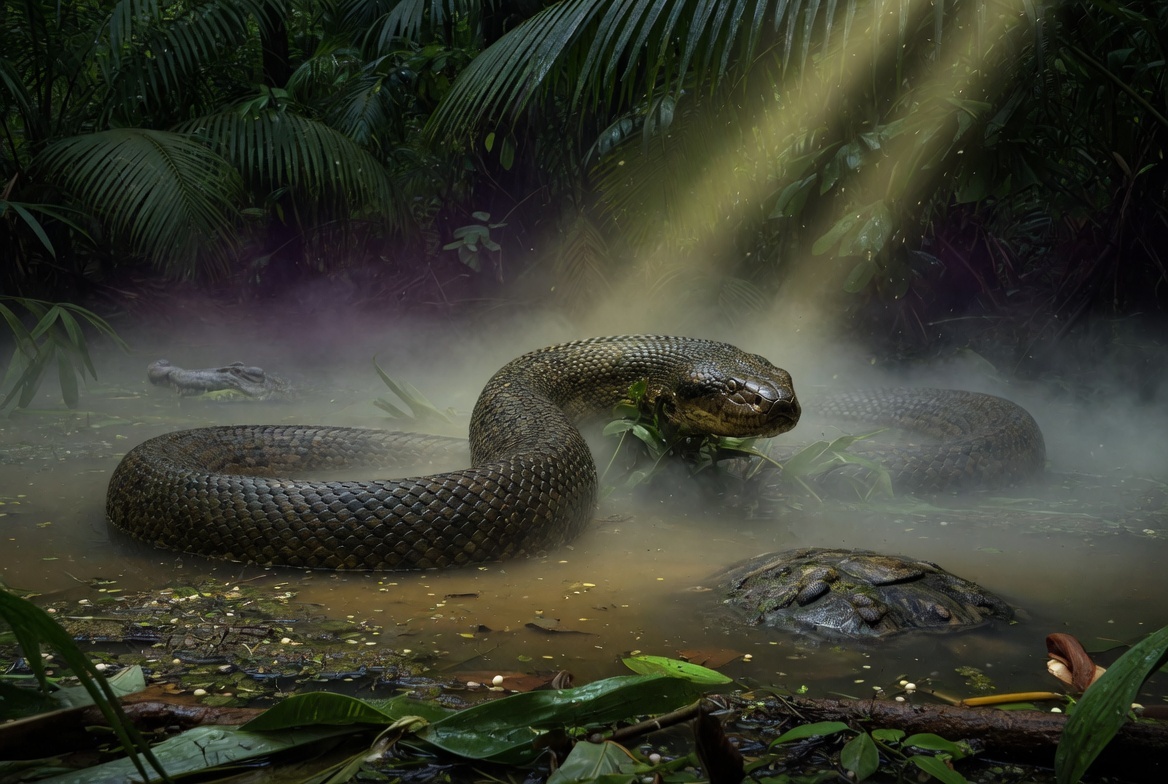
When people imagine the world after the dinosaurs died, they often picture emptiness:
But life did not stop.
In the hot, humid rainforests of ancient South America, something enormous moved through the water. Not a dinosaur. Not a crocodile.
A snake.
Its name was Titanoboa cerrejonensis, and it may be the largest snake ever discovered.
This animal lived around 60 million years ago, after the asteroid impact that wiped out the non-avian dinosaurs. In a world rebuilding itself, Titanoboa became one of the most terrifying predators of the tropical swamps.
It was not a monster from folklore.
It was real.
And its fossils suggest a world far hotter and stranger than our own.
Titanoboa is often described as around 40 to 50 feet long, with some reports placing it near 48 feet. Its weight has been estimated at more than a ton.
That means this snake could have been longer than a school bus.
Modern anacondas are already powerful enough to feel almost unreal. But Titanoboa was on another level. Its fossilized vertebrae were massive, and scientists used them to estimate the animal’s length and body size.
This is important because snakes do not fossilize easily. Like many ancient animals, Titanoboa is known from incomplete remains. But those remains were enough to shock paleontologists. The bones were not just big.
They belonged to a snake so large that it changed the conversation about ancient climate.
Titanoboa was discovered in the Cerrejón coal mine of Colombia, an area that once held a lush tropical rainforest.
Because snakes are cold-blooded animals, their body temperature depends heavily on the environment. A snake as huge as Titanoboa likely required a very warm climate to survive and grow.
That makes Titanoboa more than a giant predator.
It is also a climate clue.
Its size suggests the ancient tropics may have been hotter than modern tropical environments. This has created scientific discussion, because body size, temperature, and ecology are all connected.
In simple terms, Titanoboa may be telling us that the post-dinosaur world was not just recovering.
It was steaming.
Titanoboa lived in a wet, swampy ecosystem filled with large reptiles, turtles, fish, and crocodile relatives.
It probably spent much of its life in water, like modern anacondas. A snake of that size would have been slow on land but powerful in aquatic environments.
Some reconstructions show Titanoboa ambushing prey from murky water. This is plausible, but we have to be careful. Scientists cannot watch Titanoboa hunt. They infer behavior from anatomy, environment, and comparisons with living snakes.
The safest interpretation is this:
Titanoboa was likely a large ambush predator in a warm tropical wetland.
Could it have eaten crocodile-like animals? Possibly.
Could it crush large prey? Very likely.
But the exact menu remains partly speculative.
Titanoboa hits a strange psychological nerve because snakes already carry fear for many people.
Now scale that fear up to the size of a bus.
A 48-foot snake moving through dark swamp water feels like something from a nightmare. But unlike many creature legends, Titanoboa is backed by fossils.
That is the EdgeCase zone: the place where reality becomes stranger than fiction.
Earth really did produce a snake this large. And it did so shortly after one of the biggest extinction events in planetary history.
Titanoboa’s existence raises a bigger question:
What kind of planet allows reptiles to grow this large?
The answer seems to involve heat, humidity, food supply, and ecological opportunity. After the dinosaurs disappeared, ecosystems opened up. In tropical South America, reptiles flourished in a hot, wet world.
Titanoboa was not just a random giant. It was the product of its environment—a living sign that Earth’s past was not simply an older version of today.
It was different. Hotter. Wilder.
More alien than we usually imagine.
Titanoboa did not live with Tyrannosaurus rex. It came after.
And that makes the story even better.
When the dinosaurs vanished, the age of monsters did not fully end. It changed shape. In one ancient rainforest, the new nightmare had no legs.
It waited in the water.
And it was real.
References: