11
11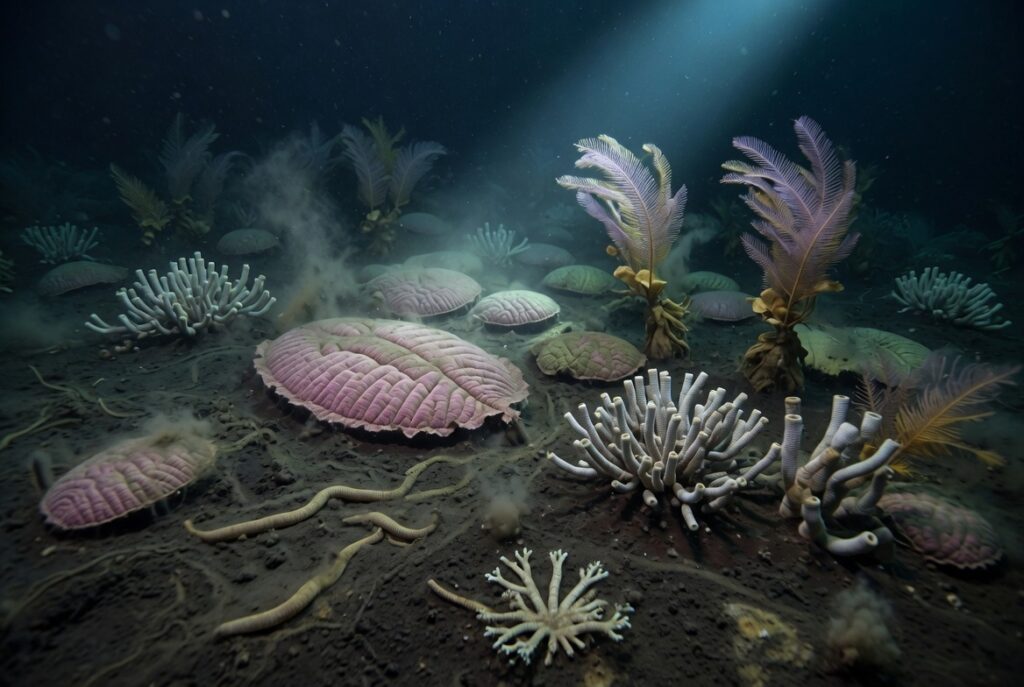
A fossil discovery in northwestern Canada may change how scientists understand the early rise of complex animal life.
The fossils come from the Ediacaran Period, a strange chapter in Earth history before the Cambrian explosion. This was long before dinosaurs. Long before mammals. Long before forests. Life existed, but it did not look familiar.
Many Ediacaran organisms were soft-bodied, flat, quilted, frond-like, or tube-shaped. Some looked almost like living leaves. Others resembled mats, discs, or strange impressions pressed into sediment.
Now, newly studied fossils from Canada suggest complex animals may have evolved 5 to 10 million years earlier than previously thought in North America. That is a big shift. In early life history, a few million years can reshape the timeline.
Researchers uncovered more than 100 fossils at a remote site in northwestern Canada.
The fossils include several taxa not previously found in North America. Some are connected to famous Ediacaran forms such as Dickinsonia, Funisia, and Kimberella.
These names may not be familiar to general readers, but they matter:
Together, these fossils suggest a surprisingly complex ecosystem existed earlier in North America than scientists had recognized.
One of the most interesting parts of the discovery is the environment.
Many classic Ediacaran fossils are associated with shallower marine settings. But this new site may represent deeper-water conditions. That raises a major possibility: complex animal life may not have started only in shallow seas. It may also have developed, spread, or survived in deeper, more stable marine environments.
That does not mean the deep sea was the only birthplace of animal life. The science is more careful than that. But it does mean the old picture may be too simple.
Scientists interpret the fossils as evidence that early complex life was more geographically widespread and ecologically varied than previously assumed.
The deeper-water context is especially important. If these organisms lived in deeper marine settings, then early animal ecosystems may have been more flexible than older models suggested.
That changes the story from “complex life suddenly appeared in familiar shallow places” to something more mysterious: Complex life may have been experimenting across different ocean environments before the Cambrian explosion made animals far more visible in the fossil record.
Ediacaran life is difficult to interpret.
Many of these organisms do not have modern equivalents. Some may be early animals. Some may represent extinct groups with no living descendants. Some classifications remain debated.
So the correct framing is not “scientists found the first animals.” The better framing is: scientists found evidence that complex life was already diverse, widespread, and possibly behaviorally advanced earlier than expected.
That is still huge.
The Ediacaran world is one of the strangest in Earth history because it sits between microbial worlds and animal-dominated worlds.
It is like opening a book before the main characters arrive. The shapes are unfamiliar. The ecosystems are quiet. There are no sharks, no trilobites, no dinosaurs, no forests.
But something important is happening. Life is becoming larger. More organized. Possibly mobile. Possibly reproductive in new ways.
The world is preparing for animals as we understand them.
The Canadian fossil discovery may push the story of complex animal life back by millions of years in North America. It suggests early life was not simple, boring, or limited to one environment.
Long before familiar animals appeared, Earth’s oceans were already filled with strange forms testing what life could become.
That is the real mystery of evolution. Not where monsters came from. Where complexity began.