11
11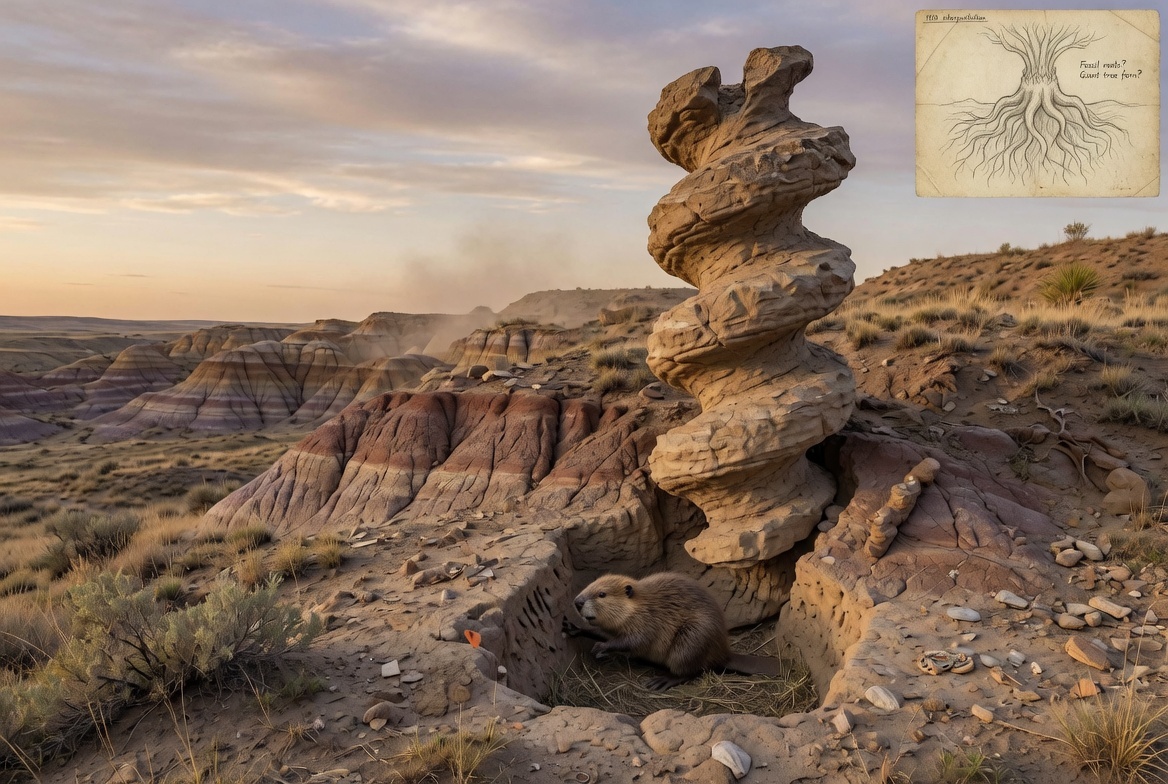
In the late nineteenth century, scientists examining fossil-rich land in Nebraska encountered structures that seemed almost impossible to explain.
They were tall spirals preserved in rock. Each one twisted downward like an enormous corkscrew, with some extending several meters through ancient sediment.
The formations were too regular to ignore. They looked engineered. They looked biological. They looked like the petrified remains of giant roots from an unfamiliar prehistoric plant.
Erwin H. Barbour of the University of Nebraska studied the structures and gave them a dramatic name: Daemonelix. The word is commonly translated as “Devil’s Corkscrew.”
The name survived, but the original interpretation did not. Later research revealed that the spirals were not plant roots; they were fossilized burrows dug by an ancient dry-land beaver called Palaeocastor.
The explanation solved one mystery while creating another: Why would a small burrowing mammal build an underground spiral staircase?
The Daemonelix structures are strongly associated with Agate Fossil Beds National Monument in Nebraska. Today, the landscape is open high plains, but millions of years ago, the region supported a very different ecosystem.
The National Park Service describes fossil deposits preserving Miocene mammals, including:
The fossil beds offer more than isolated bones; they preserve traces of behavior. While a skeleton can show anatomy, a burrow shows how an animal interacted with its environment.
Daemonelix is especially valuable because the structure is visually dramatic and surprisingly specific: a spiral tunnel descends through the ground and often connects with a lower chamber. The burrow records movement, preserving the path an animal repeatedly carved into sediment more than 20 million years ago.
When Barbour examined the corkscrews in the 1890s, he interpreted them as fossilized plant structures. The idea was understandable, as spiral forms can appear in roots and vines, and the surrounding rock represented ancient soil.
Barbour imagined a large prehistoric plant with a massive twisting taproot. The name Daemonelix captured this strange appearance, sounding like an object from folklore.
But paleontology depends on testing interpretations, and new evidence gradually weakened the plant-root idea:
The animal responsible was Palaeocastor. It was a prehistoric beaver, but it did not behave like the dam-building beavers familiar today. Palaeocastor lived on dry land and burrowed underground, its body uniquely adapted for digging.
The National Park Service identifies these spirals as fossilized burrows made by Palaeocastor, turning Daemonelix into a trace fossil.
A trace fossil preserves evidence of activity rather than simply preserving a body. Footprints, nests, and burrows can all fossilize, and Daemonelix records an ancient animal’s engineering in three dimensions.
The exact reason for the spiral design remains open to interpretation. Digging downward in a tight helix creates a longer tunnel than digging straight down, which may offer distinct advantages:
It may also simply reflect the body mechanics of the digging animal. While researchers can study the architecture and compare it with living burrowers, they cannot watch Palaeocastor make decisions underground. The careful conclusion is that the spiral was functional, though its exact advantages remain debated.
Palaeocastor was not a giant animal, and it does not attract attention because of enormous teeth or terrifying claws. Instead, the burrow made it famous.
Daemonelix changes the scale of the animal mentally. The spiral structure rises through rock like a monument, created by a small mammal digging repeatedly through ancient soil. The fossilized burrow often looks larger and stranger than the animal itself.
This is why behavior fossils matter. Extinct species were not static skeletons; they built homes, hunted, migrated, and interacted with soil, water, climate, and predators.
Fossilization requires the right conditions. A burrow can easily collapse soon after abandonment, erode away, or be filled with sediment and vanish without leaving a trace.
But under favorable conditions, minerals and sediment fill the empty tunnel. Over immense spans of time, the infill hardens. As the surrounding softer material erodes away, the former burrow becomes visible as a preserved spiral inside the hillside.
The structure is not the original empty tunnel; it is a cast. The animal dug a void, geology filled the void, and erosion revealed the final result.
Daemonelix belongs to a useful category of fossils that fooled researchers because the evidence was real but unfamiliar. The mistake was not unreasonable, as a spiral structure in ancient soil could plausibly suggest a root.
The correction came from additional evidence: mammal remains appeared inside the corkscrews, burrow chambers made sense, and scratch patterns improved the interpretation.
Science advanced by changing the explanation. This is a stronger story than pretending experts instantly understood everything. Fossils do not arrive as clean illustrations; they preserve fragments of processes, and researchers must work backward.
The Palaeocastor explanation is well established for the Agate corkscrew burrows. Fossils of the animals have been found within the structures, and the architecture matches an underground mammal burrow more convincingly than a root system.
Still, not every spiral-shaped geological structure in the world should automatically be labeled Daemonelix. Natural processes can produce curves, casts, and repeating patterns. Context matters, and a true interpretation depends on location, sediment, associated fossils, and detailed structure.
Miocene Nebraska supported an ecosystem unlike the modern plains. Beardogs occupied predatory roles, while rhino-like herbivores, camels, and smaller animals used the landscape. Dry periods frequently affected the environment.
Palaeocastor survived by going underground. Surface conditions can change rapidly—heat rises, cold winds arrive, predators scan open ground, and drought reduces food and cover. An underground chamber creates a more stable refuge.
The long spiral entrance may have separated the living space from sudden changes above while creating a protected route that was difficult for a larger predator to navigate quickly. Palaeocastor invested energy in architecture because underground shelter mattered.
A body fossil tells us that an animal existed, but a trace fossil can reveal what the animal did:
Daemonelix is powerful because the animal’s movement became part of the fossil. Each spiral is a path through ancient soil. The structure records persistence: a small mammal dug downward, circled again and again, reached a chamber, and repeated a behavior shaped by millions of years of evolution.
The phrase “Devil’s Corkscrew” remains memorable because the fossil still looks impossible at first glance. The scientific explanation does not remove that feeling; it replaces folklore with behavior.
A small mammal repeatedly carved a geometric route through the ground, and geology preserved the design long after the animal vanished.
The Devil’s Corkscrew is a perfect scientific mystery because the answer does not make the fossil less strange. Giant twisting shapes really do rise through the rock, and researchers really did mistake them for roots.
The corrected explanation is even better. More than 20 million years ago, small dry-land beavers carved spiral tunnels into Nebraska soil. Sediment filled the burrows, geology turned them into stone, and erosion revealed an ancient underground design.
The mystery is no longer what built the corkscrews. The question is why evolution led a small mammal to dig such an extraordinary home.