11
11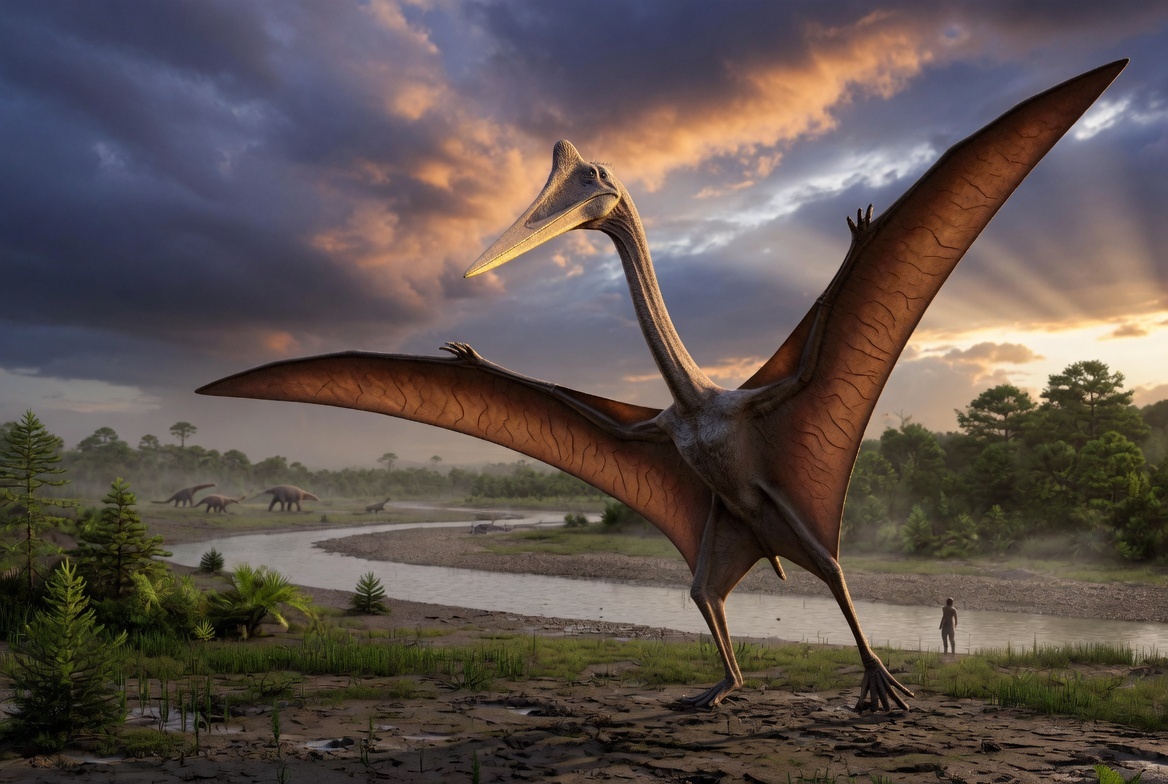
Flight is expensive. An animal must lift its body against gravity, generate enough power to launch, control its wings, and survive the strain of landing.
Small birds make the process look effortless. Quetzalcoatlus makes it look almost impossible.
This giant pterosaur lived during the Late Cretaceous Period in what is now Texas. The largest species, Quetzalcoatlus northropi, is widely recognized as one of the largest flying animals ever known.
National Park Service material describes it as the world’s largest flying creature, with a wingspan around 39 feet in some public-facing estimates. Scientific discussions often place the wingspan closer to roughly 10 or 11 meters depending on the reconstruction. That is comparable to the wingspan of a small aircraft.
Yet Quetzalcoatlus was a living animal. It walked, it hunted or foraged, it launched from the ground, and somehow, it flew.
Quetzalcoatlus is often called a flying dinosaur. That label is convenient but inaccurate. Pterosaurs were flying reptiles related to dinosaurs within the broader archosaur family tree; they were not dinosaurs themselves.
This distinction matters because pterosaurs evolved flight independently from birds:
Quetzalcoatlus belonged to a group called azhdarchids. These pterosaurs developed long necks, long limbs, and large heads with toothless beaks. On the ground, the biggest individuals may have stood as tall as a giraffe.
Fossils of Quetzalcoatlus were discovered in Big Bend National Park in Texas. The landscape preserves a rich Late Cretaceous ecosystem where dinosaurs moved across floodplains, rivers cut through the terrain, and pterosaurs occupied both the skies and the ground.
The National Park Service highlights Quetzalcoatlus as Big Bend’s most famous fossil.
This creates an important caution: scientists do not have one complete skeleton of the largest individual standing in perfect anatomical position. Reconstructions combine direct fossil evidence, related specimens, and biomechanical reasoning. The animal’s scale is real, but the fine details remain interpreted.
Popular estimates often describe a wingspan approaching 11 meters. That number is dramatic enough, but the animal’s mass is more difficult to reconstruct.
Pterosaur bodies were lightly built for flight, but the largest species still needed enough muscle to launch and control enormous wings. Different models can produce different estimates.
The important point is not a single perfect number. Quetzalcoatlus occupied the upper edge of vertebrate flight. It shows that biological structures can scale farther than intuition suggests—a pterosaur could become tall enough to look down on a human while still remaining capable of leaving the ground.
Launching is the most famous question. A large bird may run along the ground, jump from a height, or flap powerfully to become airborne. Quetzalcoatlus, however, had completely different proportions.
Researchers have debated whether giant pterosaurs launched through a four-limbed vault (using the forelimbs and hind limbs together) or through another sequence involving a powerful jump and wing movement.
A 2021 functional-morphology study examined feeding, flight, walking, and launching. While the exact launch model remains debated across pterosaur research, what matters is that pterosaurs were not oversized birds. Their winged forelimbs could contribute to launch in ways unavailable to birds, meaning the animal’s anatomy must be judged on its own terms.
The strongest evidence says yes.
Quetzalcoatlus belonged to a lineage shaped for flight. Its bones, wings, and muscular attachments all support aerial capability. The debate concerns how it launched, how often it flew, and how it moved through the landscape, not whether the animal was secretly flightless by default.
Some researchers have questioned the performance limits of the largest pterosaurs, while others have modeled flight as plausible under realistic conditions. Paleontology often works at the edge of incomplete evidence. The animal did not leave behind a flight recording, but its anatomy makes far more sense as part of a flying lineage than as a giant grounded reptile carrying useless wings.
Older popular reconstructions sometimes portrayed giant pterosaurs as scavengers circling above carcasses like oversized vultures, or skimming fish from water like seabirds.
However, research increasingly supports a different ecological picture for azhdarchids:
The comparison often made is not an exact copy of a modern bird, but something loosely similar to a large terrestrial stalker such as a heron. It could search for small vertebrates, invertebrates, and other prey while moving on the ground.
This interpretation makes the animal stranger: the largest flying creature may also have been a tall walking predator scanning the floodplain from above.
Pterosaurs moved differently from birds. Fossil trackways show that many pterosaurs walked quadrupedally, using both hind limbs and folded forelimbs on the ground. Quetzalcoatlus likely did the same.
This is important for visual reconstruction. The animal should not be shown standing like a giant bird with useless wings hanging beside the body. It used the same limbs for walking, launching, and flight; the anatomy linked land and air together. A giant pterosaur moving on all fours would have looked unfamiliar even before it opened its wings.
Quetzalcoatlus carried an unusually long neck. Pterosaur neck vertebrae were shaped to manage stress while reducing unnecessary weight, meaning the neck needed to support the head and resist bending without becoming too heavy for flight.
This is one of the most impressive parts of pterosaur engineering. Evolution did not simply enlarge a small animal evenly; it changed proportions, hollowed bones, redistributed strength, and produced a structure capable of operating near the limits of flight. The body was a compromise where weight had to stay low and strength had to remain high.
Quetzalcoatlus combines features that modern animals keep separate:
Quetzalcoatlus blended height, terrestrial movement, and flight into one single body plan. That is why reconstructions can feel like fantasy art even when they remain scientifically grounded. The animal did not need fire, scales, or dragon anatomy—reality had already created something stranger.
Giant pterosaurs force scientists to ask where biological flight reaches its practical limits. Muscles must generate power, bones must remain strong without becoming too heavy, wings must produce lift while surviving stress, and landing must not destroy the limbs.
Launch may be the hardest stage because the animal begins with no forward speed. Quetzalcoatlus matters because it pushed all of those requirements toward an extreme. It was not a magical exception to physics; it was an animal whose anatomy evolved within physics. The mystery lies in the details of how the system worked so effectively.
Quetzalcoatlus changes the meaning of “giant animal.” It was not large only because it stood tall; it carried wings capable of spanning a small aircraft.
It walked across Late Cretaceous floodplains on all fours, scanned the landscape from a giraffe-like height, and somehow launched into the sky. The fossil record confirms that the animal existed. The ongoing mystery is biomechanical: How did evolution push powered flight so close to the edge of what seems possible?