11
11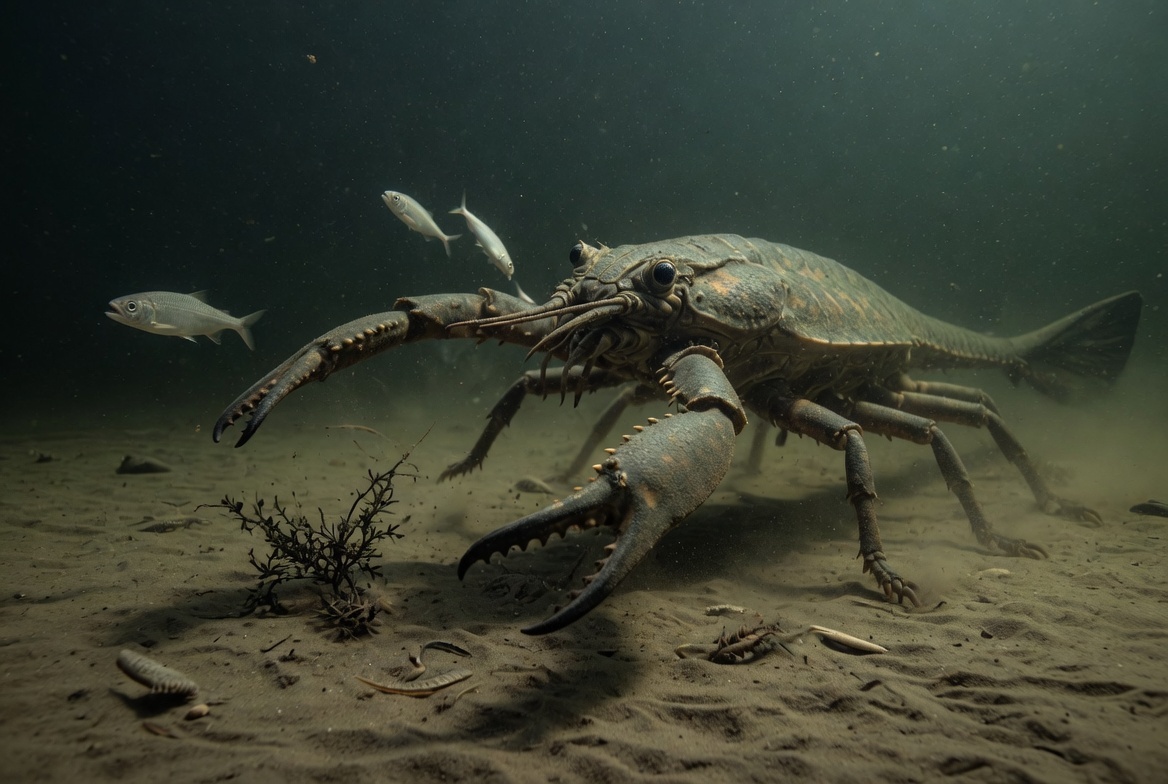
A fossil discovered in Germany changed the scale of one of Earth’s strangest extinct predators. The fossil was not a complete body; it was merely a fragment of a claw-like appendage.
The piece measured roughly 46 centimetres. But that was enough.
Researchers compared the fragment with better-known relatives and reconstructed an animal reaching approximately 2.5 metres in length.
The creature was Jaekelopterus rhenaniae, belonging to an extinct group of eurypterids often nicknamed “sea scorpions.”
The nickname is irresistible. An armoured arthropod with large claws moving through ancient water sounds like a creature designed for a monster film. But the fossils are real. Jaekelopterus lived hundreds of millions of years before dinosaurs, representing one of the largest arthropods ever known to science.
The phrase “sea scorpion” is useful but imperfect. Eurypterids were aquatic chelicerate arthropods belonging to the broader evolutionary neighbourhood containing arachnids and horseshoe crabs. They were not modern scorpions swimming through the ocean.
Different eurypterid species occupied different environments:
Jaekelopterus fossils are associated with environments interpreted as freshwater or marginal aquatic systems.
The animal should not be imagined automatically as a deep-ocean monster. It may have moved through waterways where visibility was limited and sediment filled the water. This setting makes the predator more believable; a large armoured animal does not need an endless ocean—it just needs prey, cover, and an ecosystem capable of supporting its body size.
Arthropods include insects, spiders, scorpions, crabs, and lobsters. Their body plan is enormously successful: they carry external skeletons, grow by moulting, and occupy almost every major environment.
But modern arthropods face strict physical limits. A two-and-a-half-metre aquatic arthropod feels extreme because living examples rarely approach that scale.
Jaekelopterus became famous after a 2007 study used the large claw fragment to estimate its total body length, describing it as the largest arthropod yet recorded.
While scientists have not uncovered one perfect, complete Jaekelopterus stretched from claw to tail, later work continues to treat the animal as one of the most extreme examples of arthropod gigantism. The conclusion remains striking: this was an arthropod larger than a human.
Jaekelopterus carried large chelicerae—appendages near the mouth equipped with claw-like structures. These were central to the animal’s feeding system, and their shape suggests a terrifying ability to seize prey.
Biomechanical research on these claws reveals important details about how this apex predator operated:
Jaekelopterus appears suited to capturing relatively softer prey rather than crushing heavily armoured shells.
Popular imagery sometimes depicts giant sea scorpions as indestructible machines capable of tearing apart anything nearby. However, the real predator was likely more specialised. Its claws were weapons evolved for particular jobs, such as catching fish or other vulnerable animals, which remains frightening without inventing a shell-crushing superpower.
Eurypterids had compound eyes, and research suggests they possessed surprisingly capable visual systems. Jaekelopterus and related forms had large eyes that could help detect prey and movement in murky aquatic environments.
Vision matters because the animal was not simply a slow bottom-crawler. An active predator needs information:
The combination of large compound eyes and forward-facing claws creates a complete picture. Jaekelopterus was an active, visual participant in its ecosystem, not merely an oversized fossil curiosity.
Gigantism rarely has one simple explanation. Researchers have discussed several evolutionary factors:
It is tempting to use one dramatic sentence: “More oxygen created giant bugs.”
But reality is messier. Jaekelopterus lived during the Early Devonian, not the peak Carboniferous world usually associated with giant insects. Its size emerged from a particular aquatic ecosystem and a lineage already capable of producing massive bodies.
Jaekelopterus lived long before dinosaurs, mosasaurs, or the famous Megalodon shark. The animal belonged to an earlier chapter of prehistoric predation.
Modern audiences often treat prehistoric life as a straight progression toward familiar giants: first small creatures, then dinosaurs, then giant mammals. But evolution does not move in a straight line.
Different periods produced different biological experiments. Eurypterids were once dominant aquatic animals, but their lineage vanished completely as ecosystems changed. Nothing alive today recreates the exact combination of segmented armour, swimming paddles, giant claws, and a human-scale body length.
A realistic Jaekelopterus reconstruction is far more effective than an exaggerated one. It does not need a fantasy stinger raised over its back, oversized mandibles invented for drama, or glowing eyes.
The accurate body plan already feels deeply unsettling:
The animal fits its environment perfectly. It was not an impossible Hollywood monster; it was a highly successful, real-world predator.
Paleontology often works through proportional reasoning. While a complete skeleton is ideal, fragmentary fossils are far more common. Researchers identify the preserved body part, compare it with complete skeletons of smaller relatives, and estimate the likely dimensions.
The 46-centimetre claw fragment provided the crucial scale anchor. Closely related eurypterids offered the proportional comparisons that produced the famous estimate of approximately 2.5 metres.
Every reconstruction includes a degree of uncertainty. The fragment may represent an unusually large individual, and different proportional assumptions can shift the final number. But uncertainty does not erase the discovery. Even a slightly smaller reconstruction leaves us with an extraordinary, record-breaking arthropod.
Calling Jaekelopterus a “bug” is informal and technically inaccurate in a strict biological sense, but the comparison works because audiences understand the emotional point.
Most people encounter arthropods at a scale measured in centimetres. Jaekelopterus forces a radical mental shift: an animal with an external skeleton, multiple jointed legs, and massive claws, but at the scale of a human adult.
This unique scale explains why sea scorpions remain so popular in prehistoric storytelling. They create a direct, thrilling bridge between familiar small animals and lost ecological extremes.
What the Fossils Confirm:
What Details Remain Open:
The scientific version stays compelling because it separates evidence from imagination. Jaekelopterus was a real arthropod beautifully adapted to ancient aquatic ecosystems.
Jaekelopterus was not the only eurypterid. The group contained many species with different sizes and ecological roles. Some were small, while others carried highly specialised appendages suited to different feeding strategies.
This diversity matters. One giant claw can create a misleading impression that every sea scorpion was a human-sized super-predator. In reality, Jaekelopterus occupied the absolute extreme end of a highly successful lineage, revealing how varied ancient aquatic arthropods became before they disappeared forever.
The fossil record usually creates a sense of immense time and distance, but Jaekelopterus does the opposite. A claw fragment provides a scale comparison that people understand instantly.
The creature feels close enough to a modern scorpion or horseshoe crab to visualise clearly, yet it is large enough to break every everyday expectation. The result is uniquely uncomfortable and fascinating.