11
11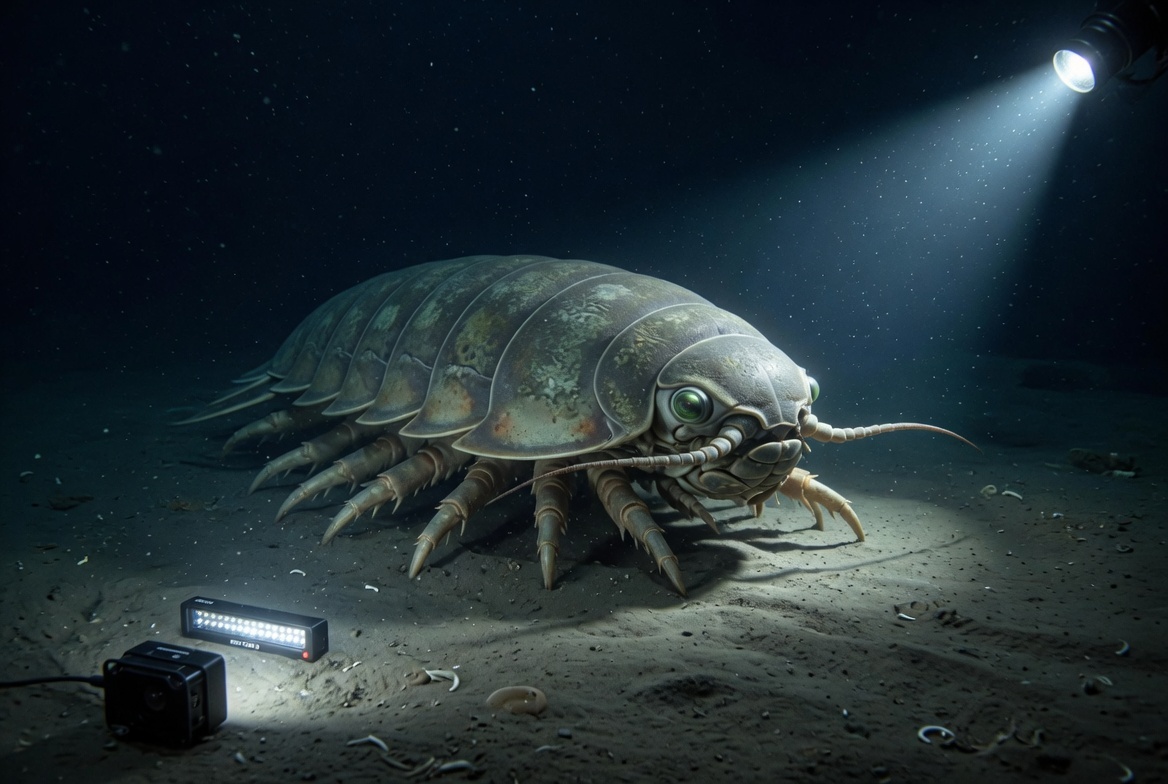
Few animals trigger the same instant reaction as the giant isopod. People see one image and immediately ask whether it is real, edited, or from a science-fiction movie.
But giant isopods are real deep-sea crustaceans, and their appearance is one of the best reminders that the ocean does not need help looking alien. These animals are related to ordinary isopods, the small pill bugs or woodlice many people have seen in gardens. The difference is scale, habitat, and mood.
Move that basic body plan into the deep sea, enlarge it, and suddenly something familiar becomes deeply unsettling.
Giant isopods have a segmented armored shell, many legs, curved body shape, and a face that often looks more mechanical than animal. Their proportions seem almost too clean, too symmetrical, and too unlike the mammals people instinctively trust.
That alone gives them visual power. But there is also a scientific reason they look the way they do.
They are adapted for life on the deep seafloor, where food can be scarce and the environment is cold, dark, and high-pressure. Giant isopods often feed as scavengers, consuming dead animals and other organic material that sinks to the bottom.
This gives them another useful content angle. They are not just creepy-looking. They are part of the deep ocean cleanup system.
Giant isopods are frequently discussed as examples of deep-sea gigantism, a pattern where some deep-sea animals grow much larger than their shallow-water relatives.
Scientists continue to study why this happens, and explanations may involve:
The key point is that the deep sea does not just host “weird creatures.” It hosts creatures shaped by environmental rules that differ greatly from surface life.
Giant isopods are not giant because the ocean randomly makes things scary. They are giant because evolution in extreme environments often produces unfamiliar outcomes.
One of the most interesting things about giant isopods is how they cope with a habitat where meals may be rare. Deep-sea scavengers cannot rely on regular food sources the way surface animals often can.
So giant isopods are known for low-energy lifestyles and an ability to endure long periods without eating. This detail makes them even more compelling.
They are not hyperactive monsters. They are patient survivors: slow, efficient, armored, and adapted to one of the least understood environments on Earth.
Giant isopods are ideal EdgeCase material because they hit several triggers at once:
The giant isopod is fascinating by itself, but it also represents something bigger.
The deep ocean is full of animals that challenge our expectations. Many of them look bizarre not because nature is trying to scare us, but because survival in darkness and pressure produces forms that surface-dwelling humans find unfamiliar.
The mystery is not whether giant isopods are real. They are. The deeper mystery is how many other strange survival strategies still exist beyond our regular view.
Giant isopods are real deep-sea crustaceans related to pill bugs, but adapted to one of the harshest environments on Earth. Their strange appearance, armored bodies, and deep-sea lifestyle make them perfect examples of how reality can look more alien than fiction.
They are not monsters, but they are exactly the kind of creature that keeps deep-ocean curiosity alive.