11
11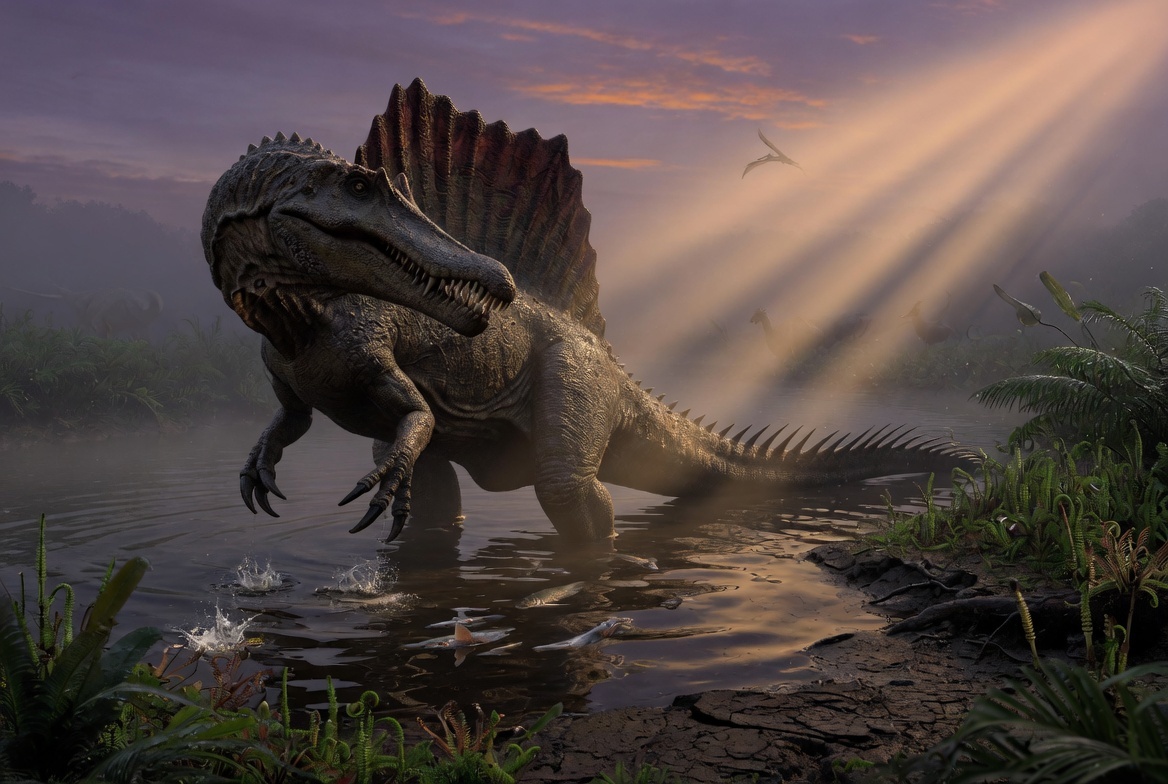
Most people imagine predatory dinosaurs as land animals:
Then there is Spinosaurus:
Spinosaurus is one of the strangest large predatory dinosaurs ever discovered. It lived in North Africa during the Cretaceous Period and has become famous not just because it was huge, but because scientists still debate how it lived.
Was it a swimming dinosaur? A shoreline hunter? A fish-eating giant that moved between worlds?
The answer is still not as simple as a movie scene.
Spinosaurus had a skull unlike most classic meat-eating dinosaurs. Its long narrow jaws resembled those of a crocodile, and its conical teeth were well-suited for gripping slippery prey like fish.
Its tall neural spines formed the famous sail on its back. Scientists have proposed different purposes for this structure, including display, species recognition, thermoregulation, or fat storage, though no single explanation is fully proven.
The animal’s anatomy suggests a strong connection to aquatic environments. That part is not random.
Spinosaurus lived in a world of rivers, wetlands, and giant fish. Its environment was full of aquatic prey, and its skull seems adapted for catching them.
But the deeper question is how far this adaptation went:
In 2020, new fossil material, especially a tail reconstruction, helped fuel the idea that Spinosaurus may have used its tail for swimming. The tail was described as broad and fin-like, suggesting it could produce propulsion in water.
That discovery made headlines because it challenged the classic image of predatory dinosaurs. A giant meat-eating dinosaur moving through water like a crocodile or aquatic predator is an incredible idea.
It also made Spinosaurus feel even more alien:
A dinosaur with a sail above the river surface.
A crocodile-shaped head breaking through muddy water.
Fish scattering below.
It was the perfect science-mystery image.
But science moves by testing ideas, not just accepting the most exciting version.
Later research questioned whether Spinosaurus was truly a specialized underwater pursuit predator. Some scientists argued that while Spinosaurus was clearly connected to water, its body may not have been efficient enough for active underwater hunting.
This creates a more careful interpretation:
But whether it chased prey underwater like a crocodile or behaved more like a shoreline predator remains debated.
That uncertainty is not a weakness. It is what makes Spinosaurus one of the most interesting dinosaurs in science.
Spinosaurus looks wrong in the best possible way.
It does not fit the standard dinosaur template. Its skull feels reptilian and crocodile-like. Its sail makes it instantly recognizable. Its connection to water gives it a different kind of fear.
That is why Spinosaurus works so well as an EdgeCase topic. It is not supernatural. It is not fake. It is a real animal that sits at the edge of what people expect dinosaurs to be.
Spinosaurus reminds us that dinosaurs were more diverse than pop culture usually shows.
They were not all open-land predators and giant plant-eaters. Some lived in forests. Some lived near rivers. Some were feathered. Some had strange skulls, sails, horns, armor, or tails that challenge old assumptions.
The more fossils scientists find, the stranger dinosaurs become.
Spinosaurus is not just a dinosaur.
It is a scientific argument with teeth.
The safest answer is that Spinosaurus was a real predatory dinosaur strongly tied to aquatic environments.
The dramatic answer is that it may have been one of the closest things Earth ever had to a dinosaur river monster.
But the honest answer is more interesting:
Spinosaurus was strange enough that scientists are still fighting over the details.
And that means the mystery is alive.
Not because the creature survived.
But because the evidence is still speaking.
References: