11
11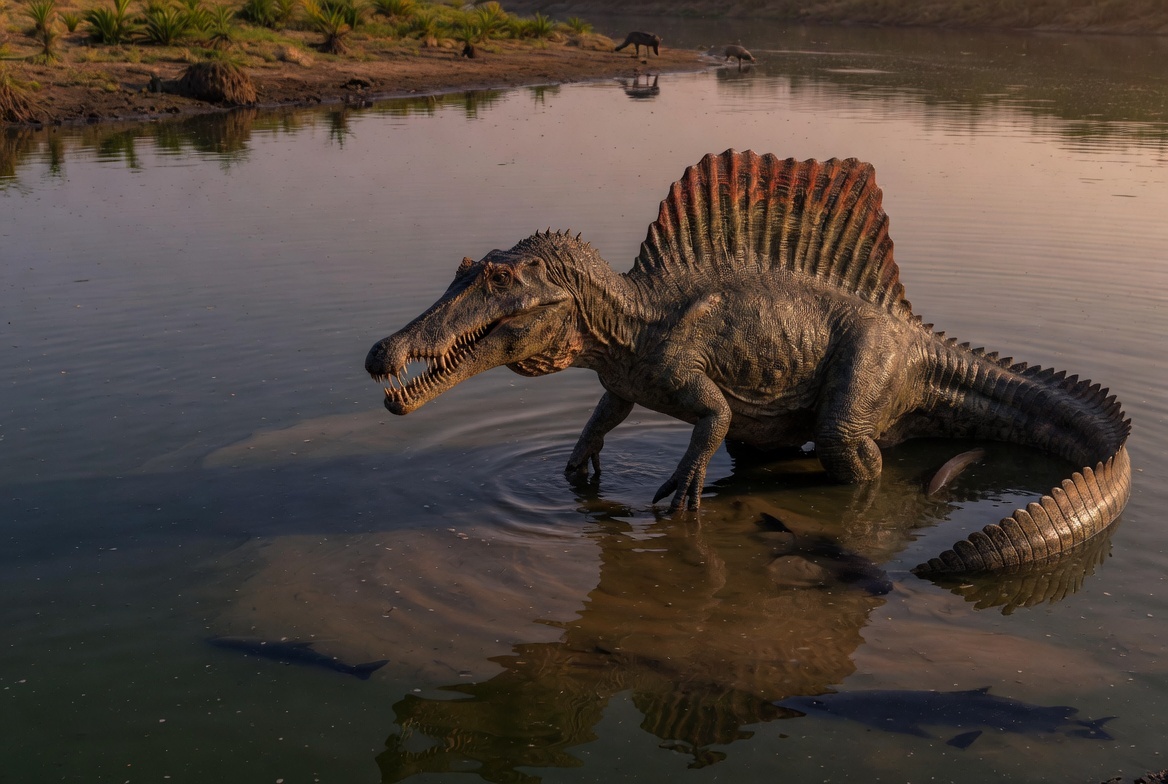
Few dinosaurs have been reconstructed as dramatically as Spinosaurus.
For decades, it was often imagined as a conventional giant theropod with a sail on its back: something like a long-snouted Tyrannosaurus rex adapted to catching fish along riverbanks. Then new fossils changed the picture.
The animal appeared to have:
In 2020, researchers described a fossil tail and tested physical models in water. They argued that its shape generated greater thrust and efficiency than the tails of terrestrial dinosaurs. This discovery produced a striking possibility: Spinosaurus may have been capable of propelling itself through water while hunting aquatic prey.
But the story did not end there.
Other researchers challenged the idea of a specialized underwater pursuit predator. A 2022 eLife study argued that Spinosaurus was too buoyant and unstable to function as an efficient diving hunter. That team favored a semiaquatic animal that spent time near shorelines and waterways, catching fish without behaving like a marine reptile.
This is not a minor disagreement. It changes the entire way people imagine one of the largest predatory dinosaurs ever discovered.
Spinosaurus lived during the Late Cretaceous Period, roughly 99 to 94 million years ago. Fossils have been found in Egypt and Morocco.
The Natural History Museum describes the animal as a large meat-eating theropod around 14 meters long and weighing approximately 7,400 kilograms. Exact estimates vary because the fossils remain incomplete.
The dinosaur inhabited a world shaped by rivers, deltas, coastal systems, and wetlands. North Africa during this period supported large fish, crocodile-like reptiles, turtles, and multiple predatory dinosaurs. Spinosaurus did not evolve in a dry empty desert; the desert preserves rocks from an ancient aquatic environment.
Its anatomy makes sense in that context:
Even researchers who disagree about swimming behavior generally accept that aquatic prey mattered. The real argument is about how far the dinosaur entered the water and how it hunted once it got there.
The Spinosaurus mystery is unusually difficult because some of the most important early evidence vanished.
German paleontologist Ernst Stromer described the first major fossils in the early twentieth century after remains were discovered in Egypt. Those fossils were stored in Munich. However, during the Second World War, the collection was destroyed in an Allied bombing raid.
Paleontology lost the original bones. Stromer’s notes, drawings, and published descriptions survived, but the specimens themselves could no longer be re-examined with modern tools.
That loss shaped the debate for decades. Researchers had to reconstruct Spinosaurus using incomplete historical records, isolated bones, related species, and later discoveries from North Africa. Every major new fossil mattered because the foundation remained unusually fragmented.
In 2020, a Nature paper described a newly recovered Spinosaurus tail. The tail was not narrow and stiff like the tail of a typical large land-based theropod. It was deep, flexible, and vertically expanded.
The researchers tested simplified tail shapes using a robotic flapping apparatus. Their experiments showed that the Spinosaurus tail model produced more thrust and efficiency in water than the models based on terrestrial dinosaurs. The results were more comparable to living aquatic vertebrates that use expanded tails to generate forward propulsion.
This did not prove that Spinosaurus spent every day chasing fish underwater, but it provided serious evidence that the tail was adapted for moving through water. The dinosaur was no longer easy to portray as a standard riverbank predator. Its tail demanded an explanation.
Some researchers pushed the aquatic interpretation further. If the tail generated thrust and the bones were unusually dense, perhaps Spinosaurus submerged itself and pursued prey underwater.
This idea transformed popular reconstructions. The dinosaur became a river monster: a giant sail-backed hunter swimming through murky channels with its tail driving the body forward. The visual is compelling.
But other paleontologists argued that the full body created problems.
In 2022, a detailed eLife study developed CT-based skeletal and flesh models. The researchers concluded that Spinosaurus would have been buoyant, unstable, and relatively slow as a surface swimmer. They argued that it was poorly suited to diving and underwater pursuit.
Their alternative interpretation was still semiaquatic. Spinosaurus may have spent significant time near water, feeding on fish and aquatic animals, while moving along shorelines and entering shallow water when useful.
The disagreement is not whether water mattered. It is how water mattered.
Fossils preserve bones. They rarely preserve behavior.
Researchers must build models, compare living animals, test assumptions, and decide which interpretation best fits the available evidence. Spinosaurus is difficult because it combined features not seen together in any living animal. There is no modern sail-backed giant theropod standing beside a river for direct comparison.
The animal’s back carried long neural spines forming a tall sail or ridge. The exact appearance of the living structure remains uncertain. It may have been a thin sail covered with skin. Some researchers have considered a thicker hump-like structure, although the sail interpretation remains widely discussed.
Its function is also uncertain:
Once again, one feature creates multiple plausible explanations.
Spinosaurus jaws were well suited to capturing fish. Conical teeth and a long snout could help hold slippery aquatic prey. But labeling the dinosaur as a fish-eater does not necessarily mean it ignored other food.
Modern crocodiles eat fish, birds, mammals, and carrion. Bears catch salmon but also consume many other resources. A large opportunistic predator may feed flexibly when opportunities appear.
Fossils cannot provide a complete menu. The cautious conclusion is that fish and aquatic animals were important, while other prey may also have been possible.
The debate also reveals how difficult it is to divide animals into neat categories.
A modern crocodile can walk on land, float at the surface, dive, and attack from the water’s edge. A heron can hunt fish without becoming an aquatic bird. A penguin can become a specialized swimmer while remaining part of a bird lineage shaped by life on land.
Spinosaurus may have occupied its own position along that spectrum. Its adaptations do not need to match one living animal perfectly. Evolution often produces mosaics: combinations of traits shaped by different pressures over time.
This is why confident labels can become misleading. Calling Spinosaurus a “swimming dinosaur” may be useful as a headline. Calling it a “shoreline hunter” may capture another part of the evidence. Neither phrase fully reconstructs every movement the animal made.
The fossil record gives us a body plan. Behavior must be inferred.
Spinosaurus is also unusual because the scientific debate has unfolded in public. Each reconstruction quickly becomes artwork, museum imagery, documentaries, social-media posts, and video-game models. The public can watch the animal change almost in real time.
That visibility creates confusion when older images remain online beside newer ones:
These images are not necessarily evidence that paleontologists have no idea what they are doing. They show how science updates a model when new fossils and new tests appear. Spinosaurus remains one of the best reminders that prehistoric animals were real organisms, not fixed movie characters.
Spinosaurus is fascinating because science has not reduced it to one final cinematic image. The dinosaur was not simply a larger version of Tyrannosaurus rex. It evolved around rivers and aquatic prey. Its snout, teeth, bones, sail, limbs, and paddle-like tail created an animal unlike any living predator.
The biggest mystery is no longer whether Spinosaurus interacted with water. It clearly did. The unresolved question is how deeply it entered that world:
Was it a true underwater hunter? A slow swimmer feeding near the surface? A shoreline ambush predator with an unusually useful tail?
Each new fossil has the potential to shift the picture again.