11
11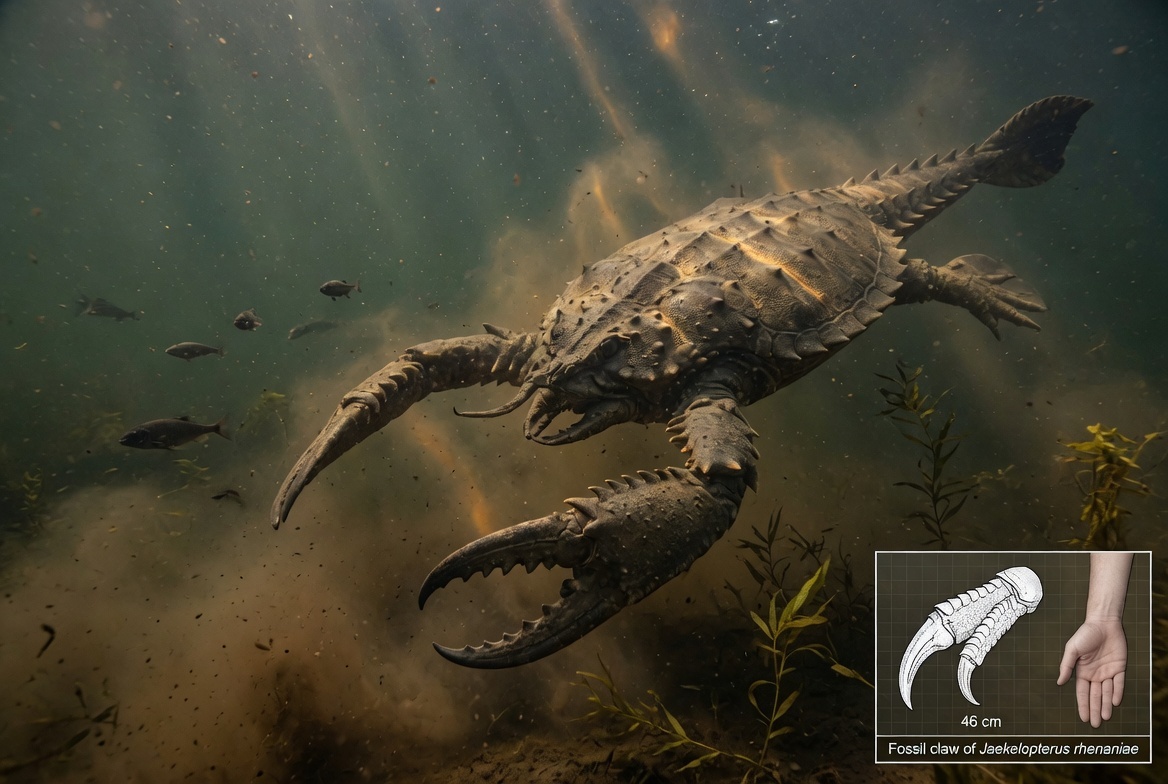
A single fossil can change the scale of an extinct animal. In the case of Jaekelopterus rhenaniae, the key evidence was a claw.
The fossil came from Early Devonian rocks in Germany and measured approximately 46 centimeters when reconstructed. That is not the length of the whole animal—it is the estimated length of just one grasping appendage.
In a 2007 Biology Letters paper, researchers compared the fossil with related giant eurypterids and calculated that the animal may have reached around 2.5 meters in body length.
This would make Jaekelopterus one of the largest arthropods ever known, longer than many adult humans are tall.
The creature is often called a giant sea scorpion. That nickname is useful because eurypterids were ancient aquatic arthropods with a silhouette that reminds people of scorpions. But Jaekelopterus was not simply a modern scorpion dropped into water and enlarged to movie-monster scale; it belonged to an extinct group with its own long evolutionary history.
Jaekelopterus lived around 390 million years ago during the Devonian Period.
Despite the common phrase “sea scorpion,” the Nature report on the discovery described Jaekelopterus as an animal that prowled ancient rivers.
That detail matters. The creature should not automatically be imagined in a deep modern ocean beside whales or sharks. It lived in Paleozoic aquatic systems populated by animals unfamiliar to modern viewers: primitive fishes moved through the water, sediment clouded the bottom, and arthropods occupied ecological roles that would later be taken by very different predators.
Eurypterids were aquatic chelicerates. Chelicerates are the wider arthropod branch that includes living spiders, scorpions, ticks, mites, and horseshoe crabs.
Eurypterids appeared long before Jaekelopterus and diversified into many forms. While some were relatively small, others became large predators.
Their unique anatomy included:
Their exact lifestyles varied. Some may have walked along the bottom, some likely swam, some were active predators, and others may have scavenged or fed on smaller prey. The group disappeared during the Permian extinction, leaving no living eurypterid behind. Jaekelopterus is memorable because it pushed this body plan toward an extreme.
Size estimates deserve careful explanation. Researchers did not discover a perfectly complete 2.5-meter Jaekelopterus laid out in rock. Instead, they found a large fossil chelicera—one of the claw-like appendages near the mouth.
The preserved fragment measured less than the reconstructed total because part of the structure was missing. By comparing proportions with related pterygotid eurypterids, the researchers estimated the overall body length.
This method is reasonable, but it remains an estimate:
The strongest accurate statement is simple: Jaekelopterus reached extraordinary size for an arthropod, and the largest known specimen suggests an animal around 2.5 meters long. The creature was real, but the exact dimensions of the biggest individual remain reconstructed from incomplete evidence.
Giant arthropods immediately raise a question: Why are most living arthropods much smaller?
People often point toward atmospheric oxygen. During some periods of Earth history, oxygen levels were higher than today, potentially supporting larger body sizes in certain land-dwelling arthropods with respiratory systems that become limiting at scale.
But Jaekelopterus complicates the story because it was aquatic. Its size may have been shaped by multiple factors:
The 2007 study discussed a broader pattern of arthropod gigantism and proposed that competition and escalation between predators and prey may have contributed. There is no single universal answer. Giant body size evolved under particular environmental conditions, and when ecosystems changed, the advantage may have disappeared.
Researchers cannot observe the animal hunting directly, but the large claws strongly suggest predatory behavior. They could grasp prey in aquatic environments, making early vertebrates and other arthropods potential targets.
The creature likely occupied a powerful role within its ecosystem. But viral depictions often go too far:
The real image is stranger: a giant armored arthropod moved through ancient waterways long before recognizable land animals dominated the planet.
Jaekelopterus is often described as the largest known arthropod ever to have evolved, and the original paper framed the fossil that way.
However, extinct-animal rankings can become complicated. Arthropleura, a giant millipede-like arthropod from a later period, also reached extraordinary lengths and may rival or exceed some estimates depending on the specimen and reconstruction.
The safest version avoids turning paleontology into a scoreboard. Jaekelopterus was among the largest arthropods known from the fossil record. It was certainly large enough to overturn the common assumption that arthropods have always been small.
A living horseshoe crab offers a distant visual reference for a broad aquatic arthropod body, and a scorpion offers a reference for grasping appendages and segmented armor. Yet, neither animal recreates Jaekelopterus. The eurypterid combined its own features in a body plan that disappeared hundreds of millions of years ago.
Its silhouette would have felt alien:
The word “monster” is easy to overuse, but a 2.5-meter aquatic arthropod genuinely deserves attention.
Fossil discoveries often feel incomplete because they are incomplete. Paleontologists working from fragments must reconstruct the missing puzzle:
The Jaekelopterus fossil is powerful because the fragment forces the mind to reconstruct the missing animal. The claw is unsettling precisely because it is not the whole creature.
The nickname “sea scorpion” makes Jaekelopterus easy to remember, but it can also flatten the animal into something too familiar.
Modern scorpions are land-dwelling arachnids with pincers and a venomous tail stinger. Eurypterids, however, were aquatic relatives within the wider chelicerate branch. Their appendages, swimming styles, habitats, and ecological roles varied across a long evolutionary history.
Important Distinction: Jaekelopterus should not be reconstructed with a modern scorpion’s raised venomous tail. Its tail ended in a tapered structure, and its front appendages carried the grasping power.
This distinction matters for credible visuals. The real animal was not frightening because it copied a living scorpion perfectly; it was frightening because it represented a vanished experiment in arthropod evolution.
The fossil record includes multiple giant arthropods that reached large sizes at different times and in different environments:
It is tempting to force every case into one oxygen-based explanation, but that is too simple. Respiratory systems, water chemistry, predator-prey arms races, competition, temperature, development, and ecology can all influence body size.
Furthermore, the largest individuals may have been rare. A giant fossil gives us evidence of what was possible, but it does not tell us the average size of every member of the species.
The preserved claw also creates a useful sense of scale. Arthropods are often treated as background animals in prehistoric storytelling, but Jaekelopterus reverses that expectation. In its ecosystem, an armored chelicerate could occupy the visual role people usually reserve for a large vertebrate predator.
The fossil fragment is not just large; it changes the hierarchy of the scene.
Jaekelopterus is a reminder that ancient ecosystems did not follow modern expectations. Today, the largest familiar arthropods are impressive but limited in scale. In the Devonian Period, one aquatic arthropod evolved claws so large that a single fossil fragment measured almost half a meter.
Researchers used that fragment to reconstruct an animal around 2.5 meters long. The careful story is already cinematic: a giant armored chelicerate prowled ancient waterways nearly 390 million years ago. It did not need fantasy exaggeration. One fossil claw was enough.