11
11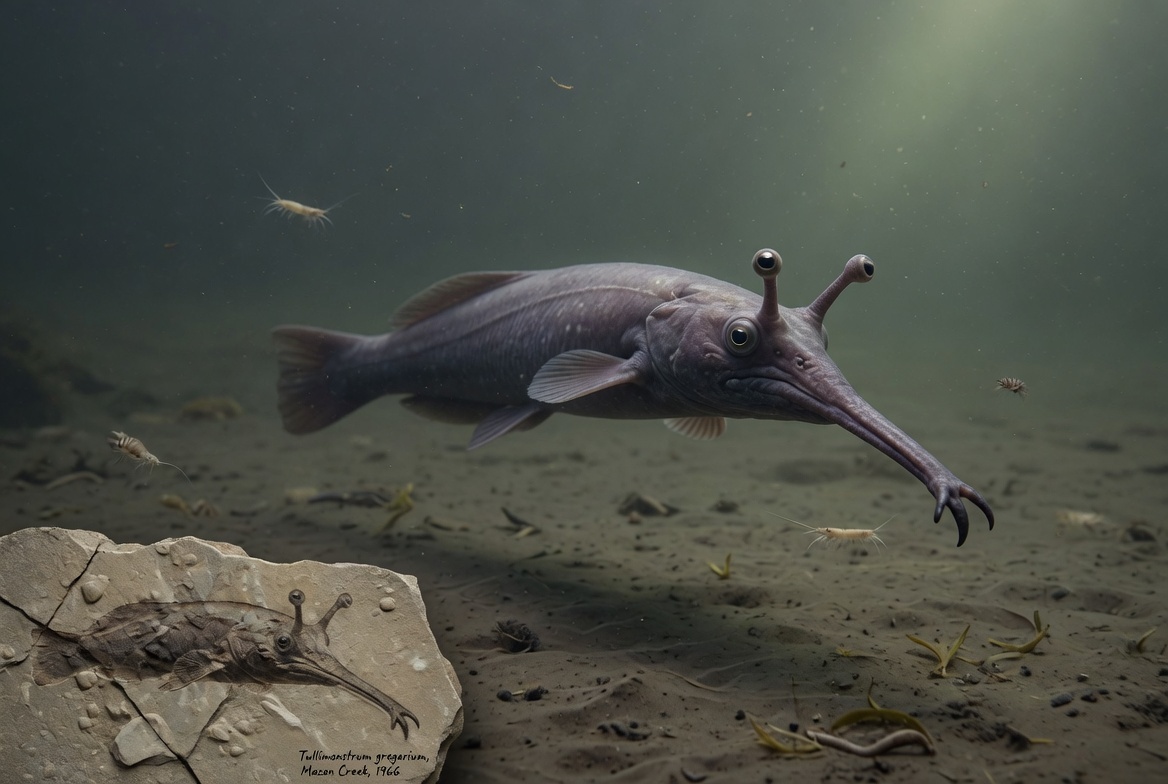
Some prehistoric creatures are mysterious because they were huge. The Tully Monster is mysterious because scientists still argue about what it was.
Officially known as Tullimonstrum gregarium, this strange animal lived around 300 million years ago in what is now Illinois. It is the official state fossil of Illinois, and it remains one of the weirdest soft-bodied fossil animals ever found.
It was not giant. It was not a cinematic predator like Mosasaurus. But visually and scientifically, it is pure mystery.
It had a soft body, stalked eyes, fins, and a long forward structure that ended in a claw-like tip. It looks like something evolution sketched and then deleted.
The Tully Monster is mostly known from fossils found in the Mazon Creek fossil beds of Illinois. These fossils are preserved in ironstone concretions, which can split open to reveal detailed impressions of soft-bodied organisms.
That preservation is one reason the Tully Monster became famous. Soft-bodied animals usually do not fossilize well, so when they do, they can reveal strange forms that are missing from the harder, shell-heavy parts of the fossil record.
But preservation did not solve the main problem. Even with many specimens, scientists have debated for decades where the Tully Monster belongs on the tree of life.
This is the core mystery. Some studies have argued the Tully Monster was a vertebrate, possibly related to jawless fish. Others have pushed back, arguing that the evidence does not clearly support that interpretation and that it may have been an invertebrate.
That debate is exactly why this topic works. The creature is not famous because it is the biggest or the deadliest. It is famous because it is hard to classify.
In science, classification is not just a label. It tells us how an animal evolved, what it was related to, and what its body parts actually mean. When a fossil resists classification, it challenges the map. The Tully Monster does that beautifully.
The Tully Monster had a body plan that does not neatly match most familiar animals.
That combination is what makes it so visually memorable. It is not terrifying in the same way as a giant predator. It is unsettling because it feels wrong.
The viewer recognizes that it is an animal, but struggles to compare it to anything alive today. That tension is perfect for sci-mystery content.
The Tully Monster is sometimes presented online as if it is completely unsolved or even alien-like. That is too much. It was a real Earth animal from a real ancient ecosystem.
Scientists have proposed serious explanations for it, and the debate is based on anatomy, fossil preservation, and comparative biology. The honest mystery is enough:
Those are real scientific questions, not fake conspiracy hooks.
The Tully Monster is useful because it adds variety. Not every creature content piece needs to be about size, teeth, or killing power. Sometimes mystery itself is the hook.
This animal gives the audience a different feeling: curiosity, confusion, and the strange pleasure of seeing something that science still has not fully simplified.
It also has strong visual identity. The proboscis, stalked eyes, and soft body make it instantly recognizable.
The Tully Monster was a real 300-million-year-old soft-bodied animal from Illinois, but its exact place in the animal tree remains debated. Some researchers have argued it was a vertebrate, while others disagree.
Its strange body plan and uncertain classification make it one of the best fossil mysteries for credible sci-mystery storytelling.