11
11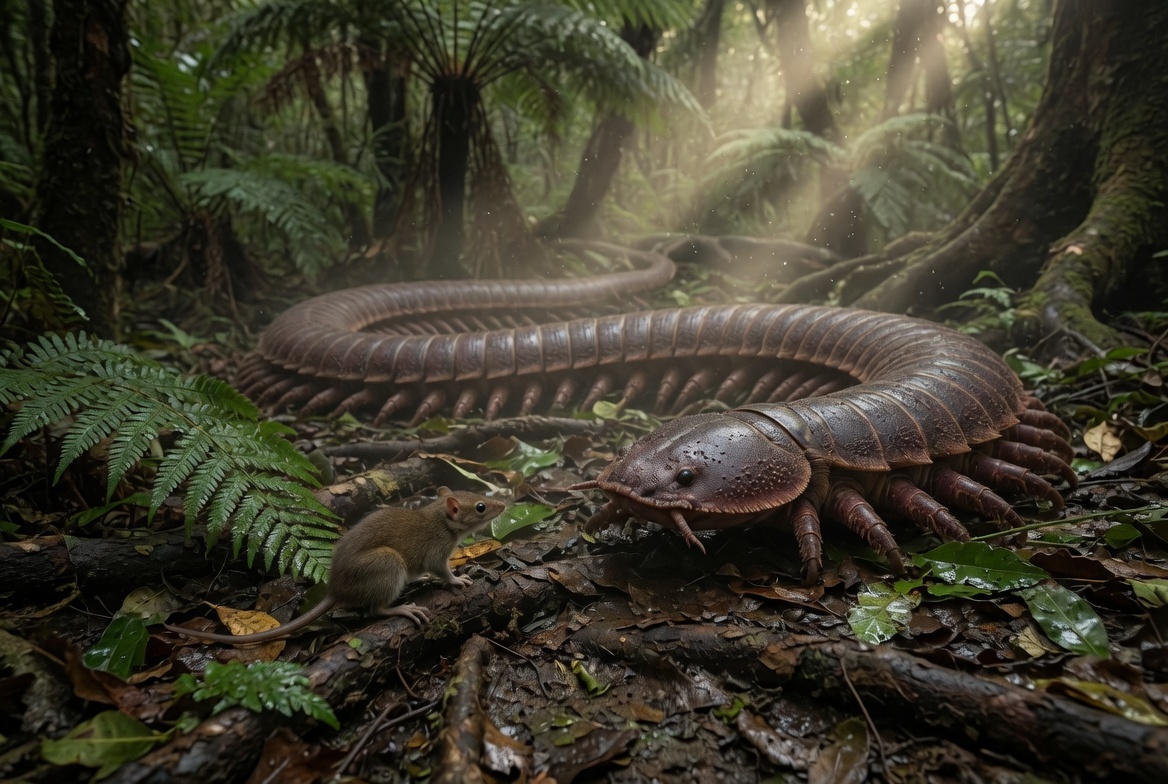
If someone told you that Earth once had a millipede-like animal longer than many people are tall, it would sound like a fake fact designed to go viral. But Arthropleura was real.
This enormous arthropod lived more than 300 million years ago, during the Carboniferous Period, and is widely considered the largest land arthropod known in Earth’s history. That alone makes it instantly compelling.
But what makes Arthropleura especially interesting is that it was not some giant dragonfly or nightmare predator sprinting through the forest. Despite its size and intimidating look, it may have been more of a plant-eating or detritus-feeding creature than a hunter.
So the fear factor comes mostly from appearance and scale. And honestly, that is enough.
Arthropleura is often reconstructed at lengths of more than two meters, with some estimates pushing toward around 2.5 meters or more. That means this creature could be longer than some couches and disturbingly close to the size of a small car.
Its body was broad, segmented, and covered in a hard exoskeleton. To modern eyes, it looks like a giant millipede or centipede, even though its exact relationships and anatomy have taken a long time to understand.
For years, scientists had incomplete fossil remains, which made Arthropleura feel even more mysterious. A giant animal is already fascinating, but a giant animal known from fragments becomes even more intriguing because the imagination fills in the missing details.
Recent fossil discoveries have helped clarify its head anatomy and evolutionary relationships, giving researchers a clearer picture of what Arthropleura actually was. That is important because the more accurately we reconstruct it, the more astonishing the real animal becomes.
One of the most famous ideas connected to Arthropleura is Paleozoic gigantism. During the Carboniferous, oxygen levels in Earth’s atmosphere were higher than they are today. Some scientists believe this helped support the gigantic sizes seen in certain arthropods during that era.
This explanation is widely discussed, but it should be framed carefully. High oxygen may be part of the reason, but ancient ecosystems were complicated. Key factors likely included:
Still, Arthropleura stands as one of the clearest examples of a world where insects and other arthropods could become far larger than what we are used to now. It is one thing to hear that oxygen levels were different in the past. It is another to imagine the proof crawling across the forest floor.
This is where careful storytelling matters. Arthropleura looked dangerous. It looked like something that would dominate nightmares. But there is no strong evidence that it was a top predator hunting large animals.
In fact, many researchers interpret it as a large detritivore or herbivore-like animal, meaning it probably fed on decaying plant matter or similar material.
That does not make it any less captivating. EdgeCase content does not need every creature to be a killer. Sometimes the best hook is simply that something looked terrifying while living a very different life than its appearance suggests.
Arthropleura is the perfect example. It looked like a monster bug. But the truth may be stranger and more interesting: one of the largest bugs ever may have been more of a giant forest recycler than a predator.
Arthropleura also works because it is tied to a very specific lost world. The Carboniferous was not just “a long time ago.” It was a planet of swampy forests, enormous plant growth, unusual atmospheric conditions, and ecosystems unlike modern land environments.
When people see Arthropleura, they are not just reacting to the animal itself. They are reacting to the idea that Earth once ran under very different rules:
That contrast gives the topic real power.
Arthropleura was a real giant millipede-like arthropod from the Carboniferous Period and remains the largest known land arthropod in Earth history. While it looked frightening, current evidence suggests it may not have been a fierce predator at all.
Its enormous size likely reflects the unusual environmental conditions of its time, making it one of the most visually unforgettable examples of how strange ancient Earth could be.