11
11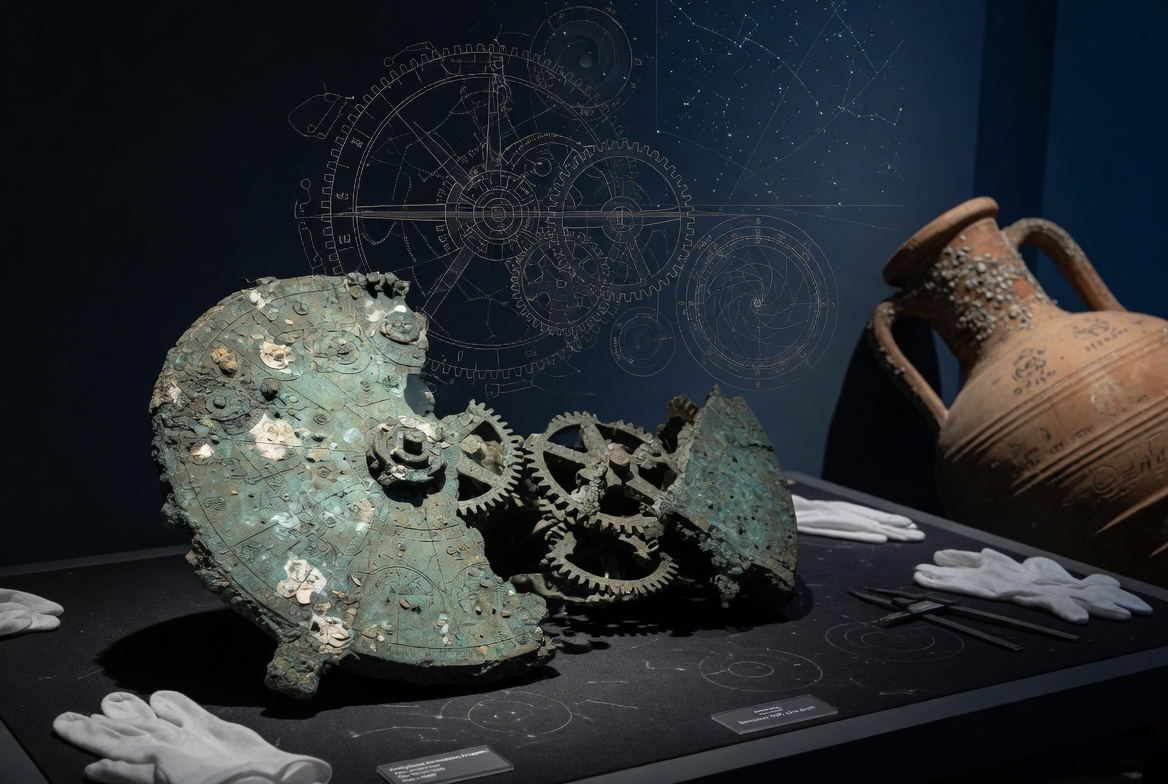
In 1901, divers recovering artefacts from an ancient shipwreck near the Greek island of Antikythera brought up statues, pottery, and corroded fragments of bronze. Among the objects was a damaged lump of material that did not immediately look like one of history’s most remarkable machines.
It had spent centuries underwater. The metal was broken, the surface was heavily corroded, and much of the original object was missing. Then researchers noticed something inside the fragments: gears.
The discovery became known as the Antikythera mechanism. More than a century later, scientists are still reconstructing what the machine did and how ancient craftspeople built it.
The Antikythera mechanism is often described as the world’s earliest known analogue computer. That phrase is useful, but it can also create the wrong image. This was not a digital computer—it did not have electronics, it did not store files, and it did not calculate using modern software.
It was a hand-operated mechanical device built from bronze gears, dials, and inscriptions. Its purpose was astronomical. By turning a crank or operating its gear system, a user could display information related to cycles in the sky.
The surviving evidence indicates that the machine tracked astronomical phenomena and incorporated complex calendar relationships. Researchers have connected its mechanisms with the movements of the Sun and Moon, eclipse cycles, and other celestial information. The device transformed mathematical astronomy into a physical machine. That is what makes it extraordinary.
The mechanism was recovered from a shipwreck that sank near Antikythera during the ancient Mediterranean world. The wreck contained valuable objects, suggesting that the vessel carried an important cargo.
Why was the mechanism onboard? Who owned it? Where was it going? Was it a teaching instrument, a prestigious object for an elite patron, a scientific device used by an astronomer, or a demonstration of technical skill?
The surviving evidence does not provide a complete biography. Even the identity of its maker remains unknown. The machine arrived in modern history without an instruction booklet preserved in perfect condition, without a workshop label, and without a clear explanation from its creator. Instead, researchers received broken fragments from the sea.
The Antikythera mechanism survives in dozens of fragments. Only part of the original machine remains. The corrosion made the device difficult to understand using ordinary visual inspection. Researchers had to use advanced imaging methods, including X-ray techniques, to examine structures hidden inside the damaged metal. These scans revealed gears, inscriptions, and mechanical relationships that could not be understood from the exterior alone.
A major challenge is that the machine is incomplete. When only part of a mechanism survives, scientists must distinguish between confirmed evidence and reconstruction. Some gears are present, some inscriptions can be read partially, and some relationships are clear. Other components must be inferred. The missing parts matter because they may have displayed some of the machine’s most visually impressive information.
The Antikythera mechanism was an ancient Greek astronomical calculator. Its gear system encoded cycles drawn from ancient astronomy. The device contained sophisticated mechanical engineering. The rear dials are better understood than some features of the front.
The mechanism included information connected with calendar cycles and eclipse prediction. It demonstrated that ancient craftspeople could build compact gear systems far more complex than many people once expected. The machine was not a random collection of gears; it was a carefully planned instrument.
The full appearance of the front display remains debated. Researchers have proposed models showing how the device may have represented celestial bodies and astronomical relationships. One influential reconstruction published in Scientific Reports proposed a detailed model of the cosmos displayed by the mechanism.
The authors were careful about the limitation. Because evidence is missing, they could not claim their model was a perfect replica of the original machine. That distinction matters. A reconstruction can fit the surviving evidence elegantly without proving that every missing gear has been recovered conceptually. The mystery is not solved simply because a modern model can be built.
One reason the mechanism feels so strange is the gap surrounding it. Machines with comparable complexity are not common in the surviving archaeological record from the same period. That does not necessarily mean the Antikythera mechanism was the only device of its kind ever made.
A complex machine rarely appears from nowhere. Its maker probably worked within a broader tradition of mathematical, astronomical, and mechanical knowledge. Other devices may have existed. They may have been recycled for bronze, corroded completely, or they may still lie beneath the sea. The Antikythera mechanism could be exceptional because it was unique, or it could be exceptional because it is the rare survivor of a lost tradition.
Bronze is valuable. A damaged bronze object can be melted and reused, which creates a preservation problem. Stone monuments can survive because they are difficult to move and recycle. Pottery fragments survive because broken ceramic material has limited value.
Metal machines are vulnerable. If an instrument became obsolete, damaged, or politically inconvenient, its material could be repurposed. The shipwreck may have saved the Antikythera mechanism by removing it from human hands. The sea damaged the machine, but the sea also protected its fragments from being melted into something else.
The Antikythera mechanism frequently appears in exaggerated internet claims. Some posts describe it as impossibly advanced, while others imply that ancient people could not have built it without lost civilisations or outside intervention.
Those claims underestimate the people who made it. Ancient Greek astronomers developed mathematical models of celestial cycles, and ancient craftspeople worked with metal. Gear systems were difficult but not magical. The device is remarkable because human knowledge, craftsmanship, and experimentation reached an unexpectedly sophisticated level. The scientific mystery is not whether aliens built the machine; the real mystery is how much ancient technical knowledge has vanished because so few devices survived.
Every improvement in imaging creates new possibilities. Researchers revisit inscriptions, test reconstructions, and examine mechanical constraints. They ask whether certain gear systems would rotate properly and compare astronomical models with the physical evidence.
Different teams may disagree about missing components or the exact interpretation of damaged sections. This is not a weakness. The machine is an active research puzzle. The fragments are real, and the reconstruction develops as scientists test what could fit inside the surviving evidence.
It is easy to focus on the machine and forget the unknown person who built it. Someone planned the relationships between the gears. Someone cut bronze components. Someone understood the astronomical cycles encoded inside the design. Someone assembled the mechanism carefully enough that it could operate as a compact physical model.
The maker’s name may be lost, the workshop may be gone, and other machines from the same tradition may have disappeared completely. But the remaining fragments preserve evidence of thought. They show that ancient engineering was not simple—it was capable of turning the sky into machinery.
The Antikythera mechanism is a genuine ancient Greek astronomical calculator recovered from a shipwreck near the island of Antikythera. It used bronze gears and dials to represent complex astronomical cycles, including information related to eclipses.
Only part of the original device survives. Modern reconstructions are grounded in physical evidence, inscriptions, scans, and mechanical reasoning, but some missing features remain uncertain. The most compelling mystery is historical: a damaged machine survived by accident beneath the sea, while the technical world that created it largely disappeared.
References: