11
11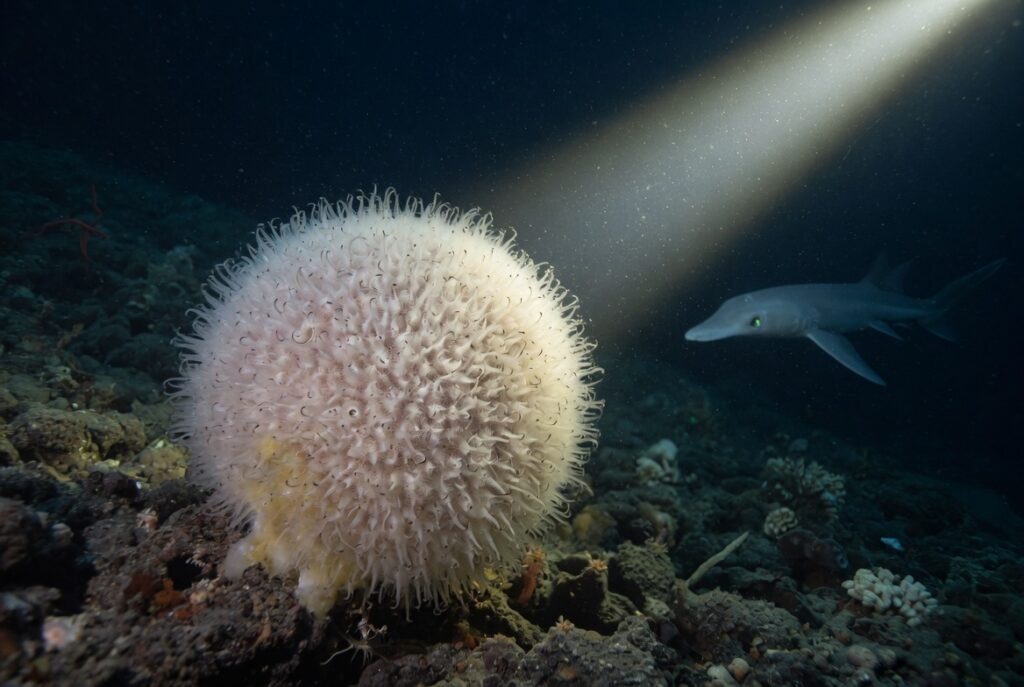
Scientists working with the Ocean Census have announced more than 1,000 newly discovered marine species in a single year.
That number sounds almost unreal. But the ocean is exactly the kind of place where this can happen. Earth’s seas cover most of the planet, yet huge areas remain poorly explored. The deep ocean in particular is cold, dark, pressurized, and extremely hard to study. Every serious expedition has the potential to reveal animals that look unfamiliar even to experts.
Among the discoveries are creatures with names that sound built for the internet: a “ghost shark,” a carnivorous sponge nicknamed the “death ball,” a worm living in a “glass castle,” and bright tiny ribbon worms from Timor-Leste.
The names are dramatic. The science behind them is real.
The “death ball” is not a monster with teeth. It is a sponge. But not the harmless bathroom-image sponge most people imagine.
Some deep-sea sponges are carnivorous. They can trap tiny prey using microscopic structures and slowly digest them. In an environment where food is scarce, that strategy makes sense. The nickname “death ball” comes from its strange spherical appearance and predatory feeding style.
It is creepy because it breaks our normal mental category. We think of sponges as passive. But in the deep sea, even animals that look still can be hunters.
Another highlighted discovery is a ghost shark, also known as a chimaera.
Despite the nickname, it is not a ghost and not a true shark in the everyday sense. Chimaeras are ancient relatives of sharks and rays. Their lineage goes back hundreds of millions of years. That makes them perfect EdgeCase animals. They are not supernatural. They are evolutionary survivors.
Many chimaeras live in deep waters, which makes them difficult to study. Their bodies often look pale, smooth, and strange, with large eyes and unusual head shapes adapted to low-light environments. Finding new species in this group matters because it adds detail to a very old branch of the marine family tree.
The big interpretation is that the ocean may contain far more unknown biodiversity than current records show.
Scientists have long estimated that many marine species remain undescribed. The Ocean Census results support that idea, but exact numbers are uncertain. “Unknown species” estimates vary because it is difficult to count what has not yet been found.
The safer statement is this: the ocean remains massively under-documented. Not fake mysterious. Actually under-documented.
Discovering new ocean species is not just about weird animals. It can affect conservation, climate science, medicine, and ecosystem protection.
If a species is unknown, it is hard to protect. If a habitat is poorly studied, it is easier to damage without realizing what is being lost. Deep-sea mining, warming oceans, acidification, and overfishing all make this work more urgent.
The ocean is not just a collection of creatures. It is a living system. And right now, humans are still trying to identify the parts while the system is changing.
The real mystery is not whether monsters exist. The real mystery is how much life exists that we have never documented.
A carnivorous death ball sponge sounds like sci-fi. A ghost shark sounds like folklore. A worm living inside a glass sponge sounds like fantasy biology. But these are natural animals. That is what makes them cooler.
The Ocean Census discoveries show that the deep ocean is still a frontier. Over 1,000 new species in one year is not just a headline. It is a reminder that Earth’s largest habitat remains one of its least understood.
The monsters are not myths. They are biology waiting for a name.