11
11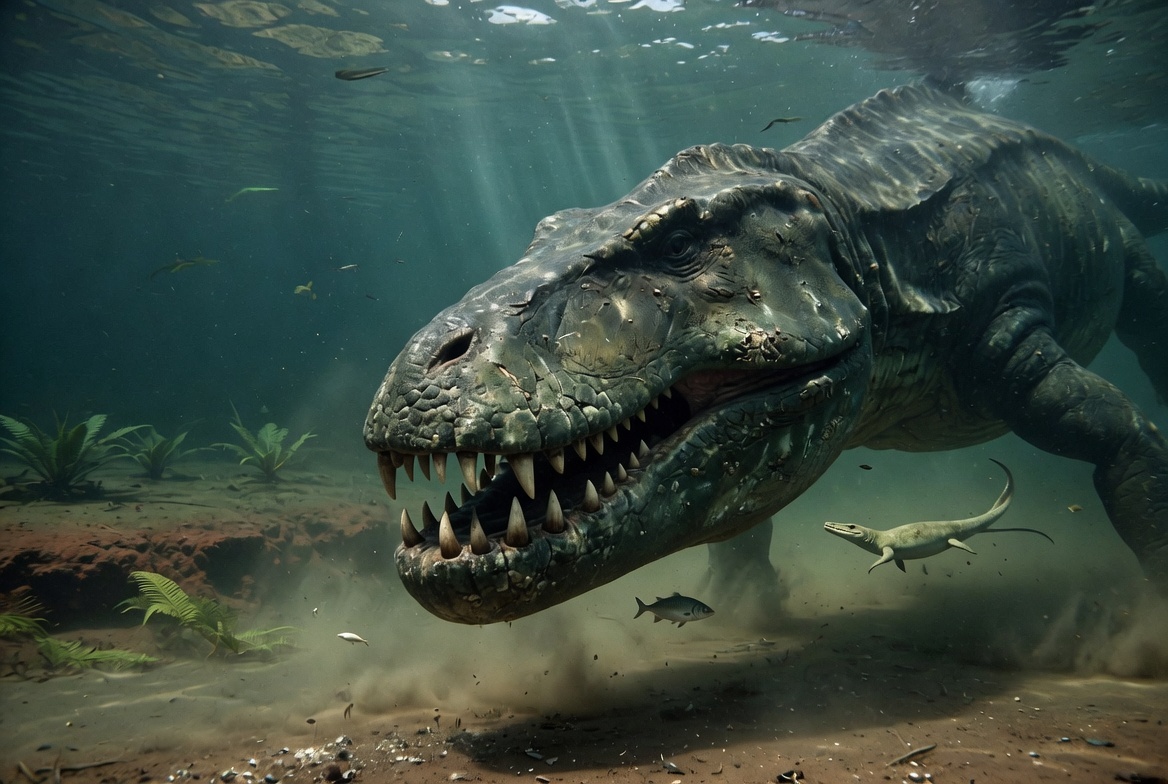
When people imagine the final million years of the dinosaur age, the spotlight usually stays entirely on land. Tyrannosaurs stalk forested floodplains, horned dinosaurs migrate in massive herds, and a catastrophic asteroid waits somewhere beyond the horizon of history.
But the ocean was writing its own spectacular final chapter.
Around 67 million years ago, in the warm, crowded seas covering what is now Morocco, a giant marine reptile occupied the absolute highest level of the aquatic food web. Its name was Thalassotitan atrox.
The animal did not look like a sleek, delicate fish hunter. Its skull was broad, its jaws were exceptionally powerful, and its teeth were thick, conical, and deeply marked by physical wear.
The truth is far more compelling: researchers are reconstructing a lost apex predator from the closing days of the Mesozoic, revealing an ocean that still demanded absolute power before a global reset changed everything.
Mosasaurs were specialized marine reptiles, not dinosaurs, belonging to a wildly successful group that diversified rapidly during the Late Cretaceous. While some related species carried slender jaws and needle-like teeth suited to snatching soft fish, Thalassotitan belonged to an entirely different class of hunter.
Fossils rarely preserve an entire life story. They preserve fragments: dense jaw elements, isolated teeth, or wear patterns compressed into stone. Paleontologists compare these fragments with living lineages, analyze structural stress points, and rebuild a cinematic window into deep time.
Thalassotitan is frequently introduced through an irresistible modern comparison: it was the killer whale of the Cretaceous sea.
While the phrase serves as an excellent shorthand for communicating its ecological position, scientists must place strict boundaries around the analogy to keep the history accurate:
Its senses, reproductive cycle, and predatory instincts belonged to a completely different evolutionary lineage. The analogy is a brilliant tool for mapping a food web, but it fails when treated as a behavioral blueprint.
The Moroccan phosphate deposits preserve one of the most competitive marine communities ever discovered. The waters were packed with an array of sharks, large predatory fish, sea turtles, plesiosaurs, and multiple coexisting species of mosasaurs.
This was not a simple ecosystem with one giant ruler and countless helpless victims. The Cretaceous ocean was crowded with rivals, where large predators constantly encountered other large predators:
To understand this marine titan without slipping into internet exaggeration, the boundary between hard evidence and inference must remain visible.
The Confirmed Facts
The Theory
Scientists cannot reconstruct a definitive weekly menu, prove whether the animal hunted in pairs or alone, or confirm if every broken tooth represents a successful kill versus a scavenged meal. Its exact hunting methods and daily routines remain educated ecological deductions based on skull mechanics.
A fake mystery treats uncertainty as permission to invent fantasy sea monsters. A science mystery treats uncertainty as an invitation to study how ancient ecosystems managed apex predation.
The timing of Thalassotitan’s reign adds a profound layer of tension to its story. Its ecosystem was not primitive, unfinished, or fading gently away. It was a mature, highly specialized, and hyper-competitive marine world where every niche was aggressively occupied.
Then, the asteroid arrived.
The extinction event at the close of the Cretaceous did not just wipe out the non-avian dinosaurs on land; it completely collapsed global marine food webs from the primary plankton upward. Thalassotitan represents a lineage at the absolute peak of its evolutionary success, completely oblivious to the planetary boundary it could not survive.
The animal looks utterly dominant in the fossil record. Geological time simply had other plans.
The most important takeaway is simple: Thalassotitan atrox was a giant mosasaur built for substantial prey. Its broad skull and heavily worn conical teeth support the image of a top marine predator near the end of the dinosaur age.
The fossil evidence confirms a body plan strange and powerful enough to stop people mid-scroll. The scientific interpretation adds the deeper layer: why that body evolved, how the animal managed a competitive ocean, and which parts of its ancient life remain unresolved.
This is real natural history.
Not supernatural horror.
Not fake proof.
Just a real piece of Earth’s past that feels completely impossible.