11
11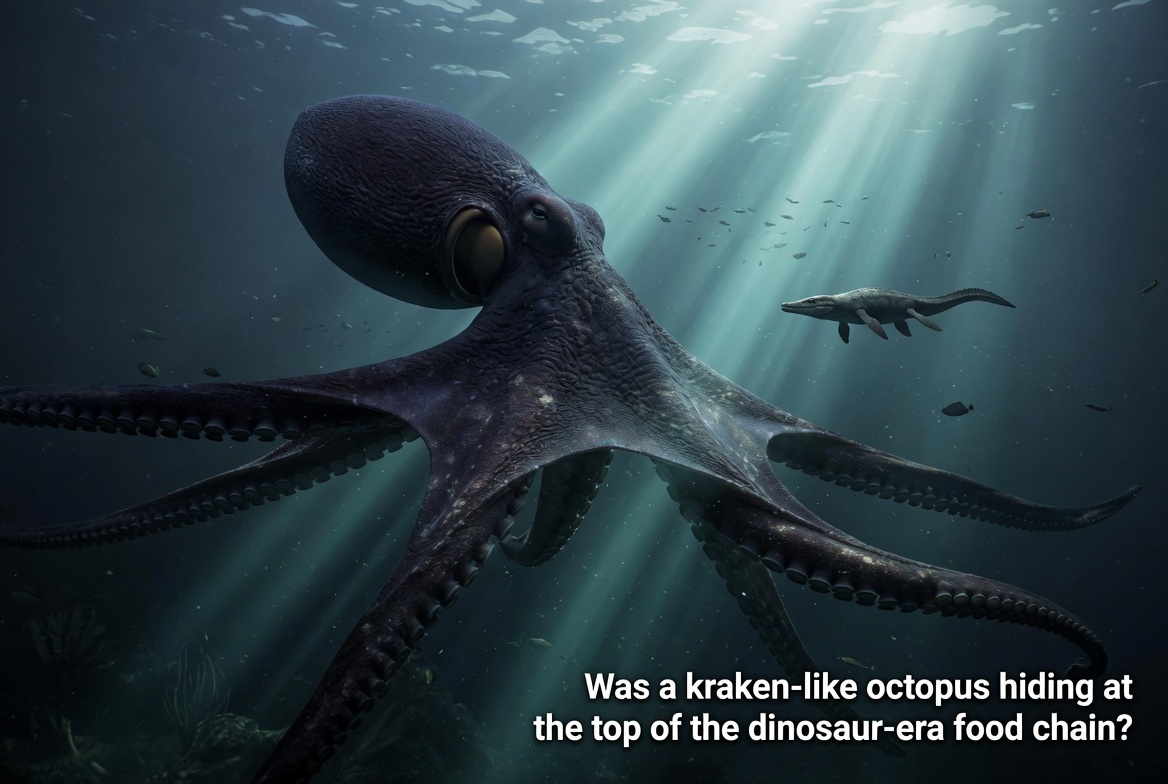
More than 80 million years ago, the oceans were filled with animals that already sound like monsters. Mosasaurs patrolled the water with powerful jaws. Sharks hunted beneath the surface. Armoured fish, marine reptiles, and strange cephalopods competed inside ecosystems that looked nothing like the modern sea.
But researchers have recently highlighted evidence of another possible heavyweight predator. It was not a reptile. It did not have bones. It may have been a gigantic finned octopus.
The animal, known as Nanaimoteuthis haggarti, has been described as a kraken-like creature that may have reached an estimated maximum length of around 19 metres. That would make the largest individuals longer than many modern whales and potentially larger than the giant squid specimens that inspired centuries of sea-monster stories.
The unsettling part is not only its size. The creature belonged to a group of soft-bodied animals that almost never fossilise completely. Most of its body vanished millions of years ago. What remained was enough to suggest that the ancient ocean may have contained predators we have barely started to understand.
Dinosaurs often leave behind bones, teeth, and occasionally remarkable impressions of skin or feathers. Marine reptiles can leave vertebrae, skulls, and flippers. Shellfish leave hard shells. But octopuses are built differently.
A modern octopus has no internal skeleton like a vertebrate. Most of its body is soft tissue. After death, that tissue usually decomposes quickly or is consumed by scavengers. Unless an animal is buried under unusually favourable conditions, very little survives long enough to fossilise.
This creates a major problem for paleontologists. The fossil record does not show every animal that once lived. It is heavily biased toward creatures with durable body parts. Some ecosystems may look incomplete because many of their most important inhabitants simply disappeared before they could leave a clear trace.
For ancient octopuses, the best clues often come from their jaws. These hard structures, sometimes compared with a parrot-like beak, can survive after the softer tissues are gone. Researchers can study their size, shape, and patterns of wear to estimate how the animal lived. That is how the outline of a prehistoric kraken begins to emerge—not from a complete fossil, but from fragments.
Research published in Science examined evidence linked to giant Cretaceous finned octopuses, including Nanaimoteuthis haggarti. The fossils suggest that some of these animals may have been capable of processing hard prey. Wear patterns on their jaws indicate that they were not limited to fragile or soft-bodied meals. They may have eaten fish, crustaceans, shell-bearing animals, and other marine life protected by hard structures.
This matters because it changes the role scientists might assign to these animals. A small, delicate octopus living near the bottom of the food web is one thing. A massive octopus with a strong beak, large body, and the ability to crush hard prey is something else entirely. It could have occupied a much more dominant position in the marine ecosystem.
Some researchers argue that animals like Nanaimoteuthis haggarti may have competed with the large vertebrate predators usually treated as the rulers of Cretaceous seas. That does not mean scientists have proven that the animal defeated mosasaurs in direct combat. There is no confirmed evidence of a prehistoric octopus wrestling marine reptiles in the way illustrated monsters attack ships in old paintings.
But the fossils raise a serious possibility: soft-bodied predators may have played a far larger role in ancient oceans than the surviving evidence once suggested.
The most attention-grabbing estimate is around 19 metres. That number needs context. Scientists did not uncover a perfectly preserved, 19-metre octopus fossil stretched across a rock slab.
The body-size estimate was reconstructed from surviving hard parts and comparisons with related animals. This is a standard paleontological method, but it carries uncertainty. The animal may have been smaller. The largest estimate may represent an extreme individual or an upper limit. The proportions of extinct species may not match modern relatives perfectly.
However, even the uncertainty is fascinating. The fossil evidence points toward octopus relatives that were substantially larger and more ecologically important than many people would expect. The mystery is not whether a fantasy monster existed. The real question is how close the reconstruction comes to the actual animal. A seven-metre predator would already be extraordinary. A 19-metre predator would change the mental image of the Cretaceous ocean completely.
Popular depictions of prehistoric seas tend to focus on marine reptiles. Mosasaur jaws open dramatically in documentaries. Plesiosaurs glide through dark water. Sharks circle beneath the surface. Large vertebrates dominate almost every reconstruction because they left behind fossils that are easier to find and display. Soft-bodied animals rarely receive the same attention.
That may be misleading. Ancient oceans were complex food webs. Their top predators may not always have looked like the creatures most likely to fossilise. Some important species could remain almost completely hidden, represented only by jaws, hooks, impressions, or isolated structures.
The discovery of giant finned octopus remains suggests that paleontologists may be reconstructing certain ecosystems from an incomplete cast of characters. Imagine trying to understand a modern rainforest while almost every big cat, snake, and insect vanishes from the evidence. The surviving animals would still be real. But the ecosystem would look far less dangerous and far less complicated than it actually was. The prehistoric ocean may contain similar blind spots.
The kraken is one of the most famous sea-monster legends in history. In old stories, it was often described as an enormous tentacled animal capable of pulling ships beneath the waves. Over time, the legend became closely associated with giant squid and other deep-sea cephalopods. A prehistoric finned octopus measuring several metres, or possibly much more, naturally invites the same comparison. It is visually irresistible.
But the comparison must remain careful. There is no evidence that Nanaimoteuthis haggarti survived into human history. There is no evidence that sailors encountered this exact species. There is no evidence that it attacked ships.
Calling it “kraken-like” is useful because it communicates scale and appearance. It is not proof that an ancient myth described a surviving Cretaceous animal. The scientific story is already strong enough without that leap. A giant soft-bodied predator lived in oceans tens of millions of years ago, and almost its entire body disappeared from the fossil record. That is strange enough.
Modern octopuses are famous for their unusual behaviour. They can solve problems, explore objects, squeeze through narrow gaps, camouflage themselves, and interact with their surroundings in ways that feel surprisingly deliberate.
Researchers studying the fossilised jaws of prehistoric relatives have also discussed wear patterns that may suggest lateralised behaviour: a preference for using one side more than the other. In simple terms, the animal may have had something resembling handedness.
This does not prove that Nanaimoteuthis haggarti had human-like intelligence. It does not mean the creature planned complex ambushes like a movie villain. Behaviour is extremely difficult to reconstruct from fossils.
However, the possibility makes the animal even more compelling. A gigantic prehistoric cephalopod may not have been merely large. It may have been behaviourally sophisticated by the standards of its ecosystem.
The most unsettling thing about this animal is not the reconstruction itself. It is how little evidence was required to reveal that an entire category of large predators may have been overlooked.
Paleontology often feels solid because museum skeletons appear complete. We see a towering dinosaur, an enormous marine reptile, or a fossil shark jaw mounted on a wall. The display creates the impression that scientists can see the ancient world clearly. In reality, the past is fragmented. Some animals survive as spectacular skeletons. Others leave a few teeth. Others leave only chemical traces. Soft-bodied creatures may disappear so thoroughly that their absence becomes almost invisible.
The fossil record is not a perfect archive. It is a damaged archive. And every now and then, a surviving fragment suggests that something enormous was missing from the story.
Nanaimoteuthis haggarti was not a mythical kraken, and scientists have not recovered its complete body. The largest size estimate remains an interpretation based on fossil evidence, not a direct measurement of a complete specimen.
But the confirmed fossils still matter. They suggest that giant finned octopuses lived in Cretaceous oceans and may have been major predators capable of eating hard-bodied prey. The discovery widens the mystery of prehistoric life. The biggest animals may not always be the easiest ones to find. Some of the ancient ocean’s most impressive predators may have left almost nothing behind.
References: