11
11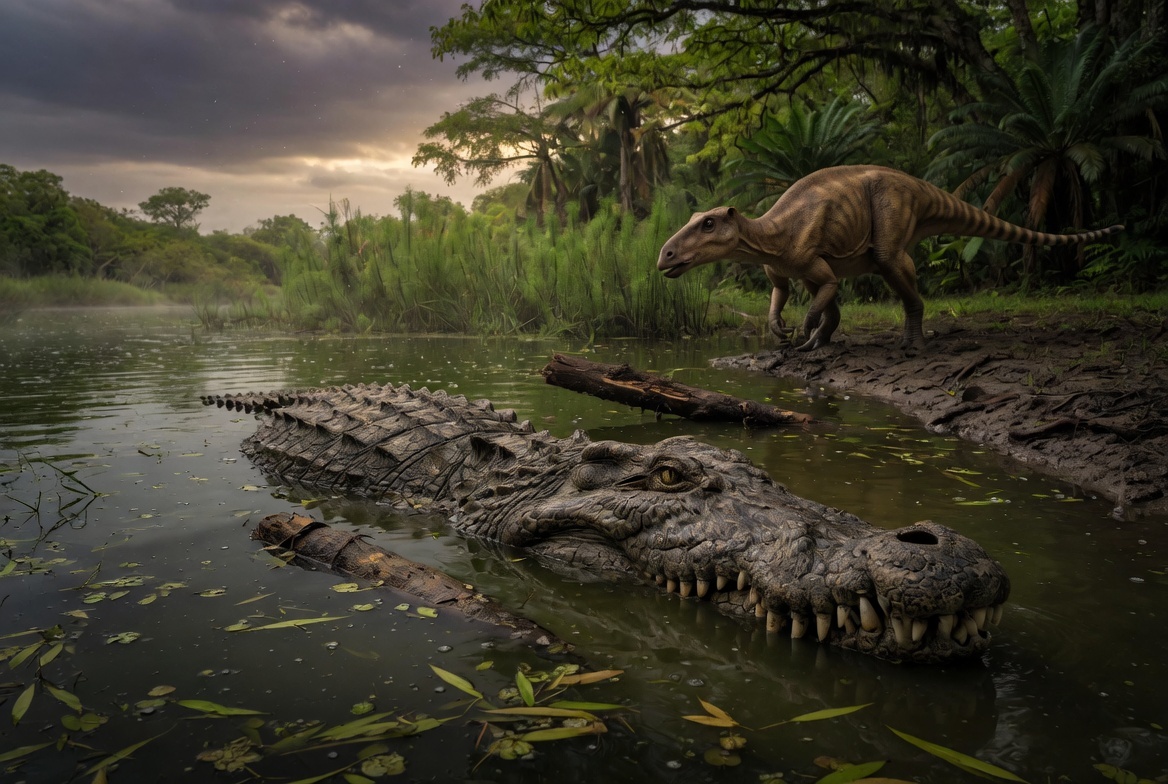
Dinosaurs dominate the way most people imagine the Cretaceous Period. Tyrannosaurs stalk the floodplains, horned dinosaurs move in herds, and giant sauropods cross open landscapes.
But near the water, the hierarchy could change.
Rivers and coastal channels in Late Cretaceous North America were home to Deinosuchus, a giant crocodylian that reached dimensions far beyond any living crocodile or alligator. The name means “terrible crocodile.”
Deinosuchus had a broad skull, thick teeth, heavy armor, and a body capable of turning a riverbank into an ambush zone. It lived alongside dinosaurs and may have attacked some of them when they approached the water.
This does not mean every dinosaur crossing a river became prey—fossils do not preserve a complete wildlife documentary. However, the combination of size, anatomy, and bite-mark evidence makes one conclusion hard to avoid: Dinosaurs were not automatically safe simply because they were large.
Deinosuchus lived during the Late Cretaceous Period, roughly 82 to 73 million years ago. Fossils have been recovered from different parts of North America, including Big Bend National Park in Texas, which preserves remains from an ecosystem where giant reptiles lived beside dinosaurs.
The National Park Service describes Deinosuchus as a crocodile-like predator the length of a school bus.
A major 2020 review in the Journal of Vertebrate Paleontology described Deinosuchus as a lineage of giant crocodylians reaching at least 10 meters in the largest estimates.
Exact body size remains reconstructed from incomplete fossils. Scientists have not recovered one perfectly complete skeleton representing the largest individual. That distinction matters because giant prehistoric-animal estimates can become exaggerated online, but the careful version is still extreme: some Deinosuchus individuals were large enough to rival the length of a modern bus.
Deinosuchus lived with dinosaurs, but it was not a dinosaur.
It belonged to the crocodylian branch of reptiles, part of the wider lineage that eventually includes living crocodiles, alligators, caimans, and gharials. Its general silhouette would have looked familiar:
Yet the scale changed the experience completely. A living alligator can already disappear almost invisibly into dark water. Increase that body toward 10 meters and place it in a Cretaceous channel visited by dinosaurs, and the result becomes one of the most believable prehistoric horror scenes in the fossil record.
Deinosuchus teeth were large and robust. They were not narrow slicing blades like the teeth of many theropod dinosaurs; instead, they were thick, conical, and suited to gripping and crushing.
This mattered because Deinosuchus did not need to cut prey into neat pieces immediately. Like living crocodylians, it could use a powerful bite, body weight, and movement in water to subdue animals.
Some fossils associated with Deinosuchus preserve bite marks:
These traces do not record every detail of an attack. A bite mark cannot always prove whether an animal was hunted alive or scavenged after death, but the marks show that Deinosuchus interacted physically with large vertebrates, including dinosaurs. It was not limited to tiny fish.
The strongest answer is careful: Evidence suggests that Deinosuchus fed on dinosaurs in at least some cases.
Bite marks on dinosaur fossils are consistent with contact from giant crocodylians living in the same environments. The anatomy also supports the possibility. A large Deinosuchus positioned near the edge of a river could attack animals coming to drink or crossing shallow water.
Modern crocodiles provide a useful ecological comparison. They often wait with most of the body hidden. They do not need to chase prey across open land; the river brings opportunities toward them.
However, scientists should not turn every Deinosuchus reconstruction into a guaranteed dinosaur attack. It likely ate a flexible range of prey depending on size and opportunity:
Deinosuchus has a complicated reconstruction history because early fossils were highly incomplete. Large vertebrae, osteoderms, teeth, and skull fragments revealed a massive animal but left room for interpretation.
Later discoveries improved the picture. The 2020 systematic review examined skull anatomy and argued that Deinosuchus included multiple species rather than one simple uniform giant spread across the continent.
This is an important scientific correction. Popular media often treats extinct animals as fixed characters, but real paleontology is more complicated. Fossils separated by geography and time may represent different species within a broader lineage. Deinosuchus is not one monster frozen into one exact shape; it is a genus reconstructed from incomplete evidence across ancient North America.
One of the more unusual details of Deinosuchus anatomy involved the end of the snout. The 2020 review described large openings in the skull near the front of the snout.
Their exact function remains uncertain. They may have related to soft tissue structures not preserved in fossils.
This is a useful reminder that even a familiar-looking animal can contain unresolved features. We understand the general body plan, we know it was enormous, and we know its teeth were powerful—but parts of the living face remain speculative because bone preserves only the framework. Skin, muscle, keratin, and soft tissues disappear.
Deinosuchus carried thick osteoderms, which are bony plates embedded in the skin. Living crocodylians also possess osteoderms, contributing to the armored appearance that makes crocodiles feel ancient even today. In Deinosuchus, this armor was substantial.
Growth evidence suggests that giant individuals may have reached enormous size by continuing to grow over long periods. This differs from the rapid growth strategy associated with many dinosaurs. A Deinosuchus may have spent years becoming progressively more formidable, meaning the biggest adults would have been highly experienced animals occupying powerful positions in their ecosystems.
Cretaceous North America did not look like the modern continent. A vast inland seaway divided major regions, creating coastal plains, rivers, estuaries, and wetlands perfectly suited for large crocodylians.
Deinosuchus lived along these water-rich environments. This setting matters; the animal should not be imagined wandering through dry dinosaur plains like a land predator. Its power came from the interface between water and land.
The shoreline was the trap. Dinosaurs needed water, and Deinosuchus needed patience.
A running predator is visible and announces danger, but an ambush predator creates total uncertainty. The surface of a river may look empty even when a large animal is directly beneath it.
This is why Deinosuchus works so well as a subject. It combines confirmed fossil evidence with a universal fear: something large may be hidden in shallow water. The animal does not need to roar, and it does not need fantasy spikes. It only needs to remain still.
Online discussions often turn prehistoric animals into battle tournaments: Could Deinosuchus defeat Tyrannosaurus rex? Could a large theropod escape from its jaws? Who wins on land versus in water?
These scenarios are entertaining, but they quickly move beyond evidence:
The more credible story is not a staged fight between pop-culture icons, but an ecological truth: near water, a giant crocodylian could threaten animals that looked completely dominant elsewhere.
Bite marks create a powerful story, but they also demand restraint. A marked bone records contact; it does not preserve the entire event. The dinosaur may have been ambushed alive, or the carcass may have simply been scavenged after death.
Paleontologists compare the shape, size, age, and geological setting of marks before connecting them with a predator. This process is less cinematic than a reconstructed attack, but it is far more credible. Deinosuchus remains frightening because the evidence supports a real ecological threat without pretending every single detail is known.
Deinosuchus changes the classic dinosaur scene. The danger was not always walking across open ground; sometimes it was waiting directly beneath the surface.
The animal’s fossils reveal a giant crocodylian with thick teeth, armored skin, and enough size to interact with dinosaurs as prey. It did not need to dominate every ecosystem—it only needed the riverbank. In that narrow zone between land and water, even the largest dinosaurs had a reason to hesitate.